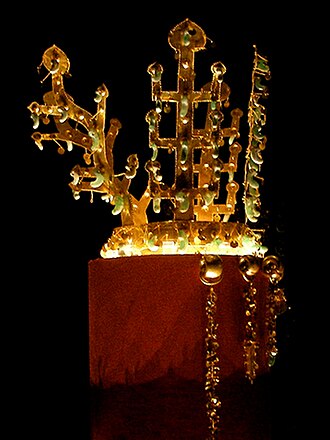
“Among all the treasures buried beneath the ancient tumuli of Gyeongju, nothing speaks more powerfully of Silla’s golden age than the extraordinary crowns unearthed from its royal tombs.”
When archaeologists began excavating the great burial mounds scattered across the ancient city of Gyeongju in the early twentieth century, they could scarcely have anticipated the magnitude of what lay beneath the earth. Inside richly furnished tombs sealed for over a millennium, they discovered objects of breathtaking beauty — among them, a series of golden crowns so intricate, so luminous, and so unlike anything found elsewhere in the ancient world that they would come to define an entire civilization. These are the crowns of Silla, and they remain among the most remarkable artifacts ever recovered from Korean soil.
The Kingdom of Silla, which flourished on the southeastern Korean peninsula from around 57 BCE until 935 CE, produced a material culture of extraordinary sophistication. At its height during the Three Kingdoms period and beyond, Silla’s ruling elite commissioned craftsmen to create objects of gold, jade, and glass that were buried alongside the dead in enormous earthen mounds. It is from these tombs — known in Korean as tumuli — that the famous golden crowns have emerged, offering modern scholars a direct window into the beliefs, aesthetics, and social hierarchies of ancient Korea.
Quick Facts: The Crowns of Silla
| Detail | Information |
|---|---|
| Period of Creation | Approximately 5th–6th century CE |
| Kingdom | Silla (57 BCE – 935 CE) |
| Primary Material | Pure gold sheet, jade (gogok), and gold spangles |
| Discovery Sites | Gyeongju tumuli, including Geumgwanchong, Cheonmachong, and Hwangnamdaechong |
| Current Location | Gyeongju National Museum; National Museum of Korea, Seoul |
| Number of Complete Crowns Found | Six complete gold crowns discovered to date |
| National Designation | Several designated as National Treasures of Korea |
What Makes the Silla Crowns So Extraordinary?
At first glance, the crowns of Silla appear almost impossibly delicate. Crafted from thin sheets of pure gold, each crown features an outer band from which tall, tree-shaped uprights rise dramatically upward. These vertical projections, often interpreted as stylized trees or antlers, are adorned with hundreds of comma-shaped jade pendants known as gogok, as well as tiny gold spangles that would have caught and scattered light with every movement of the wearer’s head. Dangling from the sides and rear of the crown are long, chain-like pendants that would have framed the face and fallen across the shoulders.
The craftsmanship involved is staggering. Artisans cut the gold sheet with precision, punched and embossed decorative patterns into its surface, and then attached thousands of individual components — pendants, dangles, and spangles — using fine gold wire. The result is an object that seems almost to breathe, trembling and glittering with the slightest movement. No two crowns are identical, yet all share the same basic grammar of forms: the circular band, the upright projections, the dangling ornaments.
Six complete gold crowns have been recovered from Silla tombs to date, with additional examples in silver and gilt bronze suggesting that such headgear was produced at varying levels of quality and expense for individuals of different ranks within the aristocracy.
“The Silla crown is not merely a symbol of royal authority — it is a cosmological statement, connecting the wearer to the trees of heaven and the rhythms of the natural world.”
The Tombs That Yielded the Crowns
The crowns were found within a cluster of enormous burial mounds located in and around modern Gyeongju, the ancient capital of Silla. These mounds, some rising to heights of over twenty meters, were constructed by piling earth over a central wooden burial chamber that had been stocked with grave goods. Because the Silla elite did not practice the kind of stone-chambered tomb construction common elsewhere in East Asia during this period, looters found it extraordinarily difficult to penetrate the earthen mounds — a fortunate accident of history that preserved the contents largely intact for over fifteen centuries.
Among the most significant excavations was that of Geumgwanchong (Tomb of the Gold Crown), excavated in 1921, which yielded the first complete gold crown to be scientifically recovered from a Silla tomb. Subsequently, the excavation of Cheonmachong (Heavenly Horse Tomb) in 1973 produced another spectacular gold crown alongside the famous painted birch-bark artifact that gives the tomb its name. Perhaps the most remarkable of all was the excavation of Hwangnamdaechong (Great Tomb at Hwangnam), a double mound of exceptional size whose two burial chambers — one for a woman and one for a man — yielded an astonishing quantity of golden objects, including crowns, belts, earrings, and vessels.
The concentration of so much gold within these tombs speaks to Silla’s unusual relationship with the precious metal. While gold was prized across the ancient world, Silla’s ruling class seems to have accumulated and deployed it on a scale that set the kingdom apart even from its regional contemporaries. Chinese and Japanese sources from the period note Silla’s reputation for gold with a mixture of admiration and envy.
Interpreting the Symbolism: Trees, Antlers, and the Spirit World
Scholars have long debated the precise meaning of the upright projections that rise from the crowns’ outer bands. The most widely accepted interpretation holds that these forms represent stylized trees — possibly the cosmic or world tree that appears in shamanistic traditions across Central and Northeast Asia. In this reading, the crown transforms its wearer into a kind of axis mundi, a living connection between the earthly realm and the world of spirits above.
An alternative interpretation suggests that some of the projections resemble deer antlers, which also carry profound shamanistic significance across the Eurasian steppe. The shaman, in many North Asian traditions, wears antlers as a mark of spiritual authority and the ability to travel between worlds. Given that Silla’s earliest royal traditions appear to have incorporated strong shamanistic elements — the founding myths of the kingdom are rich with images of divine descent and supernatural power — both interpretations may be simultaneously valid.
The comma-shaped gogok pendants, made from green jade or glass, have been interpreted as representing the curved form of a bear claw, a fetal position symbolizing rebirth, or simply as a prestigious ornamental form with deep roots in Korean and Japanese prehistory. Whatever their precise meaning, their presence on the crowns in such abundance emphasizes the ritual and cosmological dimensions of these objects.
3 Reasons the Silla Crowns Changed Our Understanding of Ancient Korea
- They revealed the scale of Silla’s goldworking tradition. Before systematic excavation of the Gyeongju tumuli, the full extent of Silla’s metalworking sophistication was poorly understood. The crowns, along with thousands of other gold objects recovered from the same tombs, demonstrated that Silla had developed one of the most accomplished goldsmithing traditions in the ancient world — one that combined technical mastery with a distinctive and coherent aesthetic vision.
- They provided evidence for shamanistic religious practices at the highest levels of Silla society. The symbolism embedded in the crowns, along with the burial practices that surrounded them, suggests that Silla’s early rulers occupied a role that combined political authority with spiritual function. This has reshaped scholarly understanding of the relationship between religion and kingship in early Korean history, particularly before the adoption of Buddhism as a state religion in 527 CE.
- They placed ancient Korea within a broader Eurasian context. The design vocabulary of the Silla crowns — especially the tree and antler motifs and the comma-shaped pendants — connects Korea to a wide network of shamanistic and artistic traditions stretching from the steppes of Central Asia to the Japanese archipelago. The crowns thus serve as evidence for the deep cultural connectivity of the ancient world, challenging older narratives that treated Korean history in isolation.
The Crowns Today: Where to See Them
Today, the golden crowns of Silla are distributed between several institutions. The Gyeongju National Museum, located in the ancient capital itself, holds several of the most important examples and presents them within the context of the broader Silla material culture that surrounds them. Visiting this museum — set within the same city where the tombs still rise from the earth in Tumuli Park — offers an experience of unusual historical immediacy. The National Museum of Korea in Seoul also holds major examples and displays them as part of its permanent collection of Korean antiquities.
Several of the crowns have been designated as National Treasures of Korea, the highest category of cultural heritage protection available under Korean law. This designation reflects not only their monetary value but their status as irreplaceable emblems of Korean cultural identity — objects that link the modern nation to a glittering and sophisticated past.
The tumuli of Gyeongju themselves are protected as part of the Gyeongju Historic Areas, which was inscribed as a UNESCO World Heritage Site in the year 2000. Walking among the great grassy mounds today, it is possible to feel something of the awe that must have attended their original construction — monuments raised by a kingdom confident in its power and certain of the importance of the individuals it chose to honor.