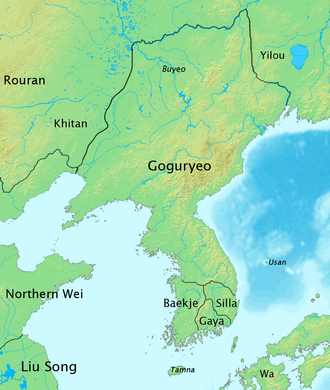
“Three kingdoms rose from the ancient peninsula, each forging an identity that would echo through every century of Korean history that followed.”
For roughly seven centuries, the Korean peninsula was shaped by one of East Asia’s most dramatic political experiments: three powerful kingdoms — Goguryeo, Baekje, and Silla — competing for dominance while simultaneously building civilizations of remarkable sophistication. The Three Kingdoms period is not merely a chapter in Korean history; it is the crucible in which Korean culture, statecraft, Buddhism, and art were first truly forged.
Understanding these three kingdoms means understanding the deep roots of what Korea is today — its relationship with China and Japan, its Buddhist heritage, its literary traditions, and even the resilience that has defined the Korean character across the centuries.
Quick Facts: The Three Kingdoms at a Glance
| Kingdom | Traditional Founding | Core Territory | Fall |
|---|---|---|---|
| Goguryeo | 37 BC | Northern Korea & Manchuria | 668 AD |
| Baekje | 18 BC | Southwestern Korea | 660 AD |
| Silla | 57 BC | Southeastern Korea | 935 AD (as unified state) |
Though the traditional founding dates appear in the ancient chronicles, the kingdoms reached full political and cultural maturity over the following centuries, with each developing distinct identities that still resonate in Korean regional culture today.
How Did Three Separate Kingdoms Emerge on One Peninsula?
The Korean peninsula in the centuries before the common era was not a single unified territory but rather a mosaic of tribal confederacies, small city-states, and proto-kingdoms. The collapse of the Chinese commandery of Lelang in the northern part of the peninsula created a power vacuum, and into that space grew the ambitions of local leaders, warrior aristocracies, and charismatic founders.
Goguryeo emerged in the northern reaches — straddling what is today North Korea and the Manchurian plains of northeastern China. Its founders, according to tradition, were descended from the Buyeo people, and from its earliest days Goguryeo was defined by a warrior culture and an expansionist drive. Its cavalry armies became the most feared military force in the region, and at its height, Goguryeo controlled a vast swath of northern East Asia. Famously, Goguryeo repelled multiple massive invasion attempts by the Sui dynasty of China in the early seventh century — a feat of military resistance that contributed to the Sui dynasty’s own collapse.
Baekje developed in the fertile southwestern regions of the peninsula, where agriculture thrived and access to the Yellow Sea enabled vibrant maritime trade. Baekje became a cultural bridge between the continent and the Japanese archipelago. It was through Baekje that Buddhism, Confucian learning, and sophisticated artistic techniques reached Japan — a historical debt that Japanese culture has long acknowledged. The Baekje kingdom also produced some of the finest metalwork and Buddhist sculpture of ancient Korea.
Silla, the southeastern kingdom, was in many ways the most isolated of the three — hemmed in by mountains and the sea — yet it would ultimately outlast its rivals. Silla’s bone-rank system, a rigid social hierarchy based on bloodline, organized its society with remarkable stability for centuries. The kingdom was also notable for its hwarang, an elite corps of young male warriors and scholars who embodied a code blending Confucian ethics, Buddhist devotion, and martial discipline. Silla’s alliance with the Tang dynasty of China would eventually prove decisive.
3 Defining Characteristics of the Three Kingdoms Era
1. The Adoption and Spread of Buddhism
Buddhism arrived in Goguryeo in 372 AD, brought by the monk Sundo from the Chinese kingdom of Former Qin. Baekje received Buddhism in 384 AD, and Silla — more resistant to outside religious influence — officially adopted it only in 527 AD, after the martyrdom of the court official Ichadon, whose death was said to have produced miraculous signs that convinced the Silla court. Once adopted, Buddhism in all three kingdoms became inseparable from royal authority. Kings built grand temples, commissioned magnificent Buddha images, and used Buddhist ritual as a tool of state legitimacy. The stunning Buddhist art of the Three Kingdoms period — from stone pagodas to gilt-bronze bodhisattvas — remains among Korea’s most treasured cultural heritage.
2. The Constant Wars and Shifting Alliances
The three kingdoms were rarely at peace with one another. Control of the Han River basin — agriculturally rich and strategically critical — changed hands multiple times, passing from Baekje to Goguryeo to Silla over the course of the period. These wars were not mere border skirmishes; they involved vast armies, sophisticated fortifications, and elaborate diplomatic maneuvering with Chinese dynasties on the continent. Silla at one point allied with Baekje against Goguryeo, then shifted to ally with Tang China against both Goguryeo and Baekje — a realignment that changed the fate of the entire peninsula.
3. Cultural Exchange with China and Japan
All three kingdoms maintained active diplomatic and cultural relationships with Chinese dynasties, receiving investiture titles, Confucian texts, legal codes, and administrative models. At the same time, Korea — particularly Baekje — served as a conduit for transmitting continental civilization eastward to Japan. Korean scholars, monks, and craftsmen carried writing, Buddhism, iron technology, and artistic traditions to the Japanese islands, playing a foundational role in the development of early Japanese civilization. This triangular relationship between China, Korea, and Japan during the Three Kingdoms era established patterns of cultural exchange that would persist for centuries.
“Baekje was the great cultural bridge of ancient East Asia — from the continent’s learning to Japan’s earliest civilisation, Korean hands carried the flame.”
The Wars That Ended an Era
By the seventh century, the long stalemate between the three kingdoms was approaching its violent resolution. Goguryeo, despite its legendary military prowess, had been weakened by decades of devastating war against Sui and Tang China. Baekje, under King Uija, alienated key allies through political mismanagement. Silla, meanwhile, had been steadily building its administrative institutions and had secured a crucial military alliance with Tang China under Emperor Taizong.
In 660 AD, a combined Silla-Tang force defeated Baekje, capturing its last king. In 668 AD, after a sustained campaign, Goguryeo fell — its capital taken, its territory divided. The unification of the peninsula under Silla’s leadership had been achieved, though Silla was soon compelled to fight a further war against its Tang allies to prevent the peninsula from becoming a Chinese colony. Silla ultimately succeeded in expelling Tang forces from most of the peninsula, though the former Goguryeo territories in Manchuria were lost.
Comparison: Goguryeo, Baekje, and Silla
| Feature | Goguryeo | Baekje | Silla |
|---|---|---|---|
| Military Strength | Dominant cavalry power; repelled Sui & Tang invasions | Strong but ultimately outmaneuvered diplomatically | Disciplined infantry and elite hwarang corps |
| Cultural Legacy | Mural tomb paintings; fierce warrior ethos | Exquisite Buddhist art; cultural bridge to Japan | Gold crowns; Buddhist sculpture; Gyeongju heritage sites |
| Key Alliance | Occasional ties with nomadic northern peoples | Yamato Japan | Tang China |
| Buddhism Adopted | 372 AD | 384 AD | 527 AD |
| Fate | Fell to Silla-Tang forces, 668 AD | Fell to Silla-Tang forces, 660 AD | Unified the peninsula; survived until 935 AD |
Why the Three Kingdoms Still Matter Today
The Three Kingdoms era is far more than ancient history. It is the foundational mythology of Korean national identity. Koreans today still use the names of the three kingdoms to refer loosely to regional cultures — Gyeonggi and the southeast recalling Silla, the southwest carrying the legacy of Baekje, the north linked to the memory of Goguryeo. Modern Korean dramas, films, and novels return again and again to this period, drawn by its drama, its martial heroes, and its profound cultural creativity.
The tomb murals of Goguryeo, depicting hunting scenes, celestial figures, and daily life in vivid color, were designated a UNESCO World Heritage Site in 2004. The historic areas of Gyeongju — once Silla’s capital — are also a UNESCO World Heritage Site, their ancient tumuli and temple ruins drawing hundreds of thousands of visitors each year. Even the Baekje Historic Areas earned UNESCO recognition in 2015, acknowledging the kingdom’s extraordinary cultural achievements.
In the history of the Korean peninsula, few periods were as consequential, as creative, or as dramatic as the age of the Three Kingdoms. It was an era that produced great warriors and great artists, fierce rivalries and profound spiritual transformations — and it left an inheritance that Koreans carry still.
Continue Exploring
On This Site
- Unified Silla: Korea’s First Golden Age
- How Buddhism Transformed Korean Civilization
- Gyeongju: The City That Remembers Silla