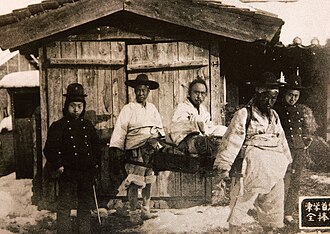
“We rise not to rebel, but to save the people and stabilize the nation.”
In the spring of 1894, a wave of fury swept across the Korean peninsula. Tens of thousands of farmers, laborers, and followers of a new religious movement called Tonghak took up arms against a government they believed had failed them utterly. What began as a local tax protest in the southwestern province of Jeolla transformed into one of the largest popular uprisings in Korean history — and triggered a chain of events that would draw China, Japan, and the dying Joseon dynasty into a catastrophic conflict. The Tonghak Peasant Revolution was not simply a rebellion. It was a cry for justice from the heart of Korean society, and its echoes would reshape the entire region for decades to come.
Quick Facts: The Tonghak Peasant Revolution
| Detail | Information |
|---|---|
| Date | January – December 1894 |
| Location | Korean Peninsula (Joseon dynasty) |
| Key Leader | Jeon Bong-jun (전봉준), known as “Green Bean General” |
| Religious Movement | Tonghak (Eastern Learning), founded by Choe Je-u |
| Outcome | Suppression by Joseon and Japanese forces; Sino-Japanese War triggered |
| Also Known As | Donghak Peasant Revolution; Gabo Peasant War |
| Significance | Catalyst for the First Sino-Japanese War and Gabo Reforms |
The World That Made the Revolution
To understand why hundreds of thousands of ordinary Koreans risked their lives in 1894, we must first understand the world they were living in. The Joseon dynasty, which had ruled the Korean peninsula since 1392, was by the late nineteenth century a deeply strained institution. Five centuries of rigid Neo-Confucian governance had calcified into a system where a small aristocratic class known as the yangban controlled land, government positions, and social mobility. Beneath them, the vast majority of the population — farmers, artisans, and the rural poor — bore an increasingly crushing burden of taxation and corvée labor.
Corrupt local officials, known as amhaeng eosa in folklore but far more sinister in reality, extorted money from peasants at every opportunity. Illegal taxes were layered on top of legal ones. Grain loan systems that were meant to support farmers in lean times had been twisted into instruments of exploitation. Famine and disease stalked the countryside. Meanwhile, foreign goods — especially cheap Japanese textiles and rice — flooded Korean markets following the unequal treaties forced open after 1876, devastating local merchants and small farmers who could not compete.
Into this volatile landscape came Tonghak, or “Eastern Learning” — a new syncretic religion founded in 1860 by Choe Je-u that blended elements of Confucianism, Buddhism, Taoism, and Korean shamanism. Tonghak explicitly rejected the dominance of “Western Learning” (Catholicism) and foreign influence, and its central belief — that every human being carries the divine within them — gave ordinary Koreans a radical sense of inherent dignity. The government had executed Choe Je-u in 1864, seeing his movement as a threat, but Tonghak only grew stronger underground, spreading through the networks of the rural poor.
Why Did the Tonghak Uprising Begin in Gobu County?
The immediate spark for the revolution came from a single county in North Jeolla Province: Gobu. The local magistrate there, Jo Byong-gap, had become notorious for his rapacious greed. He forced peasants to build an irrigation reservoir using unpaid labor, then charged them fees to use the water it held. He levied grain taxes that far exceeded legal limits. He sold government positions for personal profit and punished those who complained with flogging and imprisonment.
In January 1894, a local Tonghak leader named Jeon Bong-jun organized the farmers of Gobu to march on the county office. Jeon was a small man — his nickname, “Green Bean General,” referred to his slight stature — but he was a charismatic and tactically shrewd organizer. The Gobu protest succeeded in driving Jo from his post and distributing confiscated grain back to the farmers. But rather than address the underlying grievances, the central government sent an investigator who punished the protesting farmers and arrested Tonghak leaders.
This response transformed a local grievance into a regional revolt. In the spring of 1894, Jeon Bong-jun issued the formal call to arms. The Tonghak Peasant Army raised its banners at Baeksan, in the heart of Jeolla Province, and issued a proclamation articulating four demands: punishment of corrupt officials and wealthy merchants who exploited the poor; expulsion of foreign forces from Korean soil; abolition of oppressive social distinctions between classes; and redistribution of land to those who actually farmed it. These were not the demands of nihilists or simple bandits — they were a coherent reform agenda rooted in genuine suffering.
“We do not seek to overturn the state, but to cleanse it. Every official who has stolen from the people must answer for his crimes.”
3 Reasons the Revolution Shook All of Northeast Asia
1. The Joseon Government Could Not Suppress It Alone
The Tonghak army proved astonishingly effective in the early phases of the uprising. Equipped mainly with farming tools, bamboo spears, and a small number of captured firearms, the peasant forces defeated government troops at the Battle of Hwangto Pass in April 1894 and captured the city of Jeonju — the regional capital of Jeolla Province — in late May. The Joseon government, unable to suppress the uprising militarily, requested military assistance from China under the terms of the 1885 Treaty of Tianjin, which obligated both China and Japan to notify each other before sending troops to Korea.
2. China’s Intervention Triggered Japan’s Entry
China dispatched approximately 2,500 troops to Korea in June 1894. Under the terms of the same treaty, Japan — which had been looking for a pretext to extend its influence over Korea — immediately sent a far larger force of its own, numbering around 8,000 soldiers, to the peninsula. The Joseon government, alarmed by the sudden presence of two foreign armies on its soil, quickly negotiated the Jeonju Agreement with the Tonghak leaders in June 1894, granting a ceasefire and promising to implement many of the peasants’ demands through local reform councils called jipgang. The peasant army stood down — but the foreign troops did not leave.
3. It Became the Catalyst for the First Sino-Japanese War
With both Chinese and Japanese forces now occupying Korean territory and the immediate pretext of the rebellion defused, Japan sought a new reason to maintain its military presence. In July 1894, Japanese troops seized the Joseon royal palace in Seoul and installed a pro-Japanese government. China, viewing this as an unacceptable violation of its traditional suzerainty over Korea, moved to counter Japan militarily. The result was the First Sino-Japanese War, which lasted from August 1894 to April 1895. Japan won a decisive victory, forcing China to relinquish its claims over Korea through the Treaty of Shimonoseki. Korea was now firmly within Japan’s sphere of influence — a trajectory that would culminate in outright annexation in 1910.
The Second Rising and Final Defeat
When the Tonghak peasant leaders realized that the Japanese military occupation of Korea showed no signs of ending, and that the promised reforms were being implemented in name only, Jeon Bong-jun called for a second uprising in September 1894. This time, the revolt spread far beyond Jeolla Province, igniting across Chungcheong and other parts of the peninsula. Northern Tonghak factions, which had been more cautious during the first uprising, now joined the movement.
But the second rising faced a fundamentally different military situation. The peasant forces were now confronting not only Joseon government troops but a modern, well-armed Japanese military force with extensive combat experience. The decisive engagement came at the Battle of Ugeumchi in November 1894, fought near present-day Gongju in South Chungcheong Province. The Tonghak army, numbering in the tens of thousands, attacked Japanese and Joseon positions repeatedly over several days. The defenders had modern rifles and artillery. The attackers had determination and numbers — but these were not enough. The battle ended in catastrophic defeat for the peasant forces, with thousands killed.
The surviving Tonghak leaders scattered and fled. Jeon Bong-jun was captured in December 1894 and brought to Seoul in chains. He was executed in March 1895, along with other key leaders of the revolution. Contemporary accounts describe him as maintaining his composure and dignity at his execution, embodying the Tonghak belief in the inherent worth of every person to the very end.
Legacy: How Korea Remembers the Tonghak Revolution
The defeat of the Tonghak Peasant Revolution did not end its significance. Paradoxically, the uprising achieved more in failure than many revolutions achieve in victory. The Gabo Reforms of 1894-1895, implemented under Japanese pressure on the new pro-Japanese Joseon government, abolished the centuries-old social hierarchy that divided Koreans into rigid status groups. The cheonmin class — the lowest social stratum, which included slaves, butchers, and entertainers — was legally emancipated. The formal examination system that had gatekept government service for the yangban was reformed. Child marriage was prohibited. These were precisely the kinds of structural changes the Tonghak peasants had demanded.
The revolution’s deeper legacy lived on in Korean political consciousness. The Tonghak movement itself reorganized as the Cheondogyo (Religion of the Heavenly Way) in the early twentieth century and played a significant role in the March 1st Independence Movement of 1919, Korea’s massive nonviolent uprising against Japanese colonial rule. The spirit of popular resistance that the Tonghak revolution embodied — the insistence that ordinary people have the right to demand accountability from those who govern them — became a recurring thread in modern Korean history, visible in the April Revolution of 1960, the Gwangju Uprising of 1980, and the candlelight protests of the twenty-first century.
Today, the battlefields and significant sites of the Tonghak Peasant Revolution are preserved and commemorated across Jeolla and Chungcheong Provinces. The Donghak Revolution Memorial Hall stands near Jeonju, and the site of the Baeksan assembly is marked as a place of national historical significance. Jeon Bong-jun is remembered not as a rebel but as a patriot — a man who gave his life demanding that Korea belong to all Koreans, not merely the privileged few.
Continue Exploring
On Korea Through Time
- From Tonghak to Cheondogyo: The Religion That Shaped Modern Korea
- The Gabo Reforms: How the Peasant Revolution Changed Joseon Society
- The March 1st Movement: Korea’s Great Uprising Against Colonial Rule
- Jeonju: Ancient Capital and Revolutionary Crossroads