“In a single stroke, centuries of Confucian social hierarchy were declared obsolete — on paper, at least.”
In the summer of 1894, the Joseon dynasty stood at a crossroads. Surrounded by competing imperial powers and shaken by internal rebellion, Korea’s government embarked on one of the most ambitious reform programs in its history. Known as the Kabo Reform (갑오개혁, Gabo Gaehyeok), this sweeping series of legislative changes unfolded between July 1894 and February 1896, fundamentally altering the structure of Korean governance, society, and law. Its legacy remains deeply contested — celebrated by some as the dawn of Korean modernity, and criticized by others as reform imposed at the barrel of a foreign gun.
Quick Facts: The Kabo Reform at a Glance
| Category | Details |
|---|---|
| Period | July 1894 – February 1896 |
| Era Name | Named after the gabo (갑오) year in the sexagenary cycle — 1894 |
| Dynasty | Joseon (조선) |
| Key Driving Force | Japanese military presence following the First Sino-Japanese War |
| Primary Body | Deliberative Council (Gungukmicheong) |
| Major Reforms | Abolition of the civil examination system, end of the hereditary caste system, legal equality for social classes |
| Monarch | King Gojong (고종) |
The Crisis That Made Reform Inevitable
By 1894, Joseon Korea faced a perfect storm of pressures. The Donghak Peasant Rebellion — a massive uprising driven by anti-foreign sentiment and anger at government corruption — had spread across the southern provinces. The royal court, unable to suppress it alone, made a fateful request to Qing China for military assistance. Japan, citing the provisions of the Convention of Tientsin (1885), promptly sent its own forces. With both foreign armies on Korean soil and the rebellion subsiding, neither power showed any desire to withdraw.
Japan moved swiftly. In late July 1894, Japanese troops seized the Gyeongbokgung palace and effectively took control of the Korean government. They installed a pro-Japanese cabinet and pushed the establishment of the Deliberative Council (Gungukmicheong), a new governing body charged with drafting and passing reforms. This council would approve over 200 reform measures during its brief existence. Japan’s motivations were not purely altruistic: a modernized, Japan-friendly Korea served as a buffer state and commercial partner as Tokyo prepared for war with Qing China.
It is important to recognize, however, that Korean reformers had been calling for modernization for years. Officials influenced by the Enlightenment Faction (Gaehwapa), including veterans of the failed Gapsin Coup of 1884, saw this moment as an opportunity — however compromised — to push through changes they genuinely believed Korea needed.
What Did the Kabo Reform Actually Change?
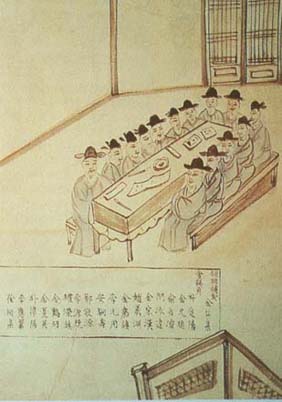
The scope of the Kabo Reform was extraordinary. Across multiple rounds of legislation — historians typically divide it into three phases — the Deliberative Council dismantled institutions that had defined Korean society for five centuries.
1. The End of the Bone-Deep Caste System
Perhaps the most socially radical change was the formal abolition of Korea’s hereditary status system, the bone rank-influenced social hierarchy that had long divided Koreans into the aristocratic yangban class, commoners, and the lowest-status cheonmin. The reforms declared legal equality among all social classes, meaning that a person’s birth no longer determined their legal standing before the state. Crucially, the institution of slavery was abolished, freeing the hereditary slave class (nobi) that had existed within both government and private households.
2. Abolition of the Gwageo Examination System
For roughly five centuries, the gwageo — Korea’s rigorous civil service examination modeled on Chinese precedent — had been the primary gateway to government office. Mastery of classical Chinese texts, Confucian philosophy, and literary composition was the price of entry into the elite. The Kabo Reform abolished this system entirely, replacing it with new criteria for official appointment based on education and demonstrated competence rather than classical learning alone. This was a seismic shift: it severed the link between Confucian scholarship and political power that had defined the Joseon state since its founding in 1392.
3. Administrative and Legal Modernization
The reforms reorganized the central government into a modern cabinet structure with eight ministries, separating executive and judicial functions. A new, rationalized legal code was introduced, and the use of torture in criminal proceedings was restricted. The lunar calendar, used for millennia, was officially replaced by the Gregorian calendar in January 1896. The traditional practice of collective punishment — by which entire families could be penalized for an individual’s crime — was abolished.
4. Social Customs and Personal Rights
The reforms addressed personal life in ways that struck at deeply rooted social customs. Early marriage was prohibited, with minimum ages established for marriage. Widows, long forbidden by Confucian custom from remarrying, were legally permitted to do so. The strict class-based regulations governing what clothing people could wear were abolished. These measures, though significant on paper, often faced quiet resistance in practice, particularly in conservative rural communities.
“The Kabo reforms were Korea’s most comprehensive attempt at self-reinvention before the twentieth century — yet they arrived under the shadow of Japanese bayonets, leaving their legitimacy permanently in question.”
Who Were the Korean Reformers Behind Kabo?
While Japanese pressure was the immediate catalyst, it would be a mistake to regard the Kabo Reform as purely an external imposition. Key Korean officials played central roles in drafting and implementing the changes. Kim Hongjip (김홍집) served as prime minister through much of the reform period and was the most prominent Korean face of the movement. He had long advocated for modernization and had famously returned from Japan in 1880 with a pamphlet urging Korea to ally with Japan and the United States as a counterweight to Russian expansion.
Other reform-minded officials, including Pak Yeongyo and Yu Gilchun — the latter a pioneer of Korean vernacular writing and progressive thought — participated in drafting the new legislation. These men genuinely believed that Joseon’s survival in a world of competing empires depended on rapid, deep-rooted transformation. Their tragedy was that the vehicle for their ideals was a Japanese occupation that Korean public opinion was increasingly hostile toward.
Why Did the Kabo Reform Ultimately Fail to Take Root?
The reforms produced dramatic change on paper but faced significant obstacles in practice. Three factors undermined their lasting effectiveness:
- Loss of Japanese backing after the Triple Intervention (1895): Japan’s victory over Qing China in the First Sino-Japanese War (1894–1895) was followed immediately by the Triple Intervention, in which Russia, France, and Germany pressured Japan to return the Liaodong Peninsula to China. Japan’s regional prestige suffered, and its grip on Korean politics weakened temporarily. This created space for the pro-Russian faction at the Korean court, centered on Queen Min, to push back against Japanese influence.
- The assassination of Queen Min (October 1895): Japanese agents, in collaboration with Korean collaborators, murdered Queen Min — a fierce opponent of Japanese dominance — at Gyeongbokgung Palace. The atrocity backfired catastrophically, triggering outrage across Korea and internationally, and discrediting the reform government by association.
- King Gojong’s flight to the Russian legation (February 1896): Following the murder of the queen, King Gojong escaped to the Russian legation in Seoul, where he remained for nearly a year. From there, he ordered the arrest of reform ministers. Kim Hongjip was seized by an angry mob and killed in the street. The reform government collapsed, and with it, the institutional momentum of the Kabo program.
The Kabo Reform’s Comparison: Before and After
| Area of Life | Before Kabo (Traditional Joseon) | After Kabo Reform |
|---|---|---|
| Social Status | Hereditary class system; yangban, commoners, cheonmin legally distinct | Legal equality declared across all classes |
| Government Entry | Gwageo classical examination system | Merit and modern education criteria |
| Slavery | Hereditary nobi slavery legal | Slavery abolished |
| Calendar | Lunar calendar | Gregorian calendar adopted (Jan 1896) |
| Widow Remarriage | Forbidden by Confucian custom | Legally permitted |
| Collective Punishment | Practiced in law | Abolished |
| Judicial Torture | Permitted in criminal proceedings | Restricted and curtailed |
What Is the Kabo Reform’s Legacy for Korea Today?
Historians continue to debate the Kabo Reform’s place in Korean history. Nationalist Korean historiography has often been ambivalent: the reforms were genuinely progressive, yet they were introduced under Japanese coercion and associated with a period of Korean humiliation. Some scholars view Kabo as a lost opportunity — a modernization program that, had it emerged from purely internal Korean initiative, might have set Korea on a more autonomous developmental path.
Others point out that many of the reform’s social provisions — particularly the abolition of slavery and the caste system — were far ahead of their time and represented real advances in human dignity, whatever their political context. The reforms also laid administrative groundwork that later governments, including those of the colonial period and the postwar Republic, built upon.
What is beyond dispute is that the Kabo Reform marks a decisive rupture in Korean history. It is the moment when the institutions of medieval Joseon were officially declared obsolete, and the tortured, contested path toward modern Korea truly began.