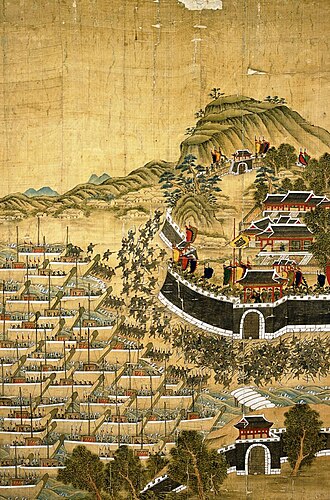
“The mountains and rivers of our kingdom remain, but where are the flowers and grasses of former times?” — A lament echoing across Korea during the years of the Imjin War
Few events in Korean history carry the weight, the grief, and the hard-won resilience of the Imjin War. Known in Korean as Imjin Waeran (임진왜란), this brutal conflict — fought between 1592 and 1598 — saw Japanese forces under the warlord Toyotomi Hideyoshi invade the Joseon Peninsula twice in the space of seven years. The war drew in Chinese Ming dynasty forces, tested Korean military ingenuity to its limits, and left a scar on the Korean landscape and collective memory that has never fully healed. To understand Korea — its spirit, its relationship with Japan, and its pride in heroes like Admiral Yi Sun-sin — you must first understand the Imjin War.
Quick Facts: The Imjin War at a Glance
| Detail | Information |
|---|---|
| Korean Name | 임진왜란 (Imjin Waeran) |
| Dates | 1592–1598 |
| Aggressors | Japan (under Toyotomi Hideyoshi) |
| Defenders | Joseon Korea, Ming Dynasty China |
| Key Korean Hero | Admiral Yi Sun-sin |
| Notable Weapon | The Turtle Ship (Geobukseon) |
| Outcome | Japanese forces withdrew; Joseon and Ming prevailed |
| Legacy | Massive destruction of Korean culture, agriculture, and population |
Why Did Japan Invade Korea in 1592?
The origins of the Imjin War lie in the ambitions of Toyotomi Hideyoshi, the powerful warlord who had unified Japan after decades of civil war. Hideyoshi harbored extraordinary ambitions — he sought nothing less than the conquest of Ming China, envisioning a vast East Asian empire under Japanese dominance. Korea, which occupied the peninsula between Japan and China, was to serve as the highway for that conquest. When Joseon Korea refused to grant Japanese forces safe passage and declined to join an anti-Ming alliance, Hideyoshi ordered the invasion.
Joseon, which had enjoyed more than a century of relative peace under the stable rule of the Yi dynasty, was poorly prepared for the assault. The country’s military institutions had weakened considerably. Disagreements among court factions — the Easterners and Westerners — had sapped political energy and delayed meaningful military reform. When Japanese forces landed at Busan in the fourth month of 1592, the shock was immediate and devastating.
The Japanese army — hardened by decades of internal warfare, equipped with firearms including the Portuguese-introduced arquebus — swept northward with alarming speed. Joseon’s fortified positions fell one after another. Within weeks, the capital Hanyang (modern Seoul) had been abandoned by King Seonjo, who fled northward toward the Chinese border. It was a moment of profound national humiliation, and one that galvanized resistance across the peninsula.
The Korean Resistance: Armies, Monks, and a Naval Genius
What followed the initial Japanese advance was not surrender but a remarkable, multi-layered resistance. Three forces combined to slow and eventually reverse the Japanese offensive: the Ming Chinese intervention, the Joseon regular army’s gradual reorganization, and perhaps most crucially, the irregular uibyeong — righteous armies made up of ordinary Korean civilians, scholars, and Buddhist monks who took up arms to defend their homeland.
The monk-soldier Hyujeong, also known as Sosan Daesa, called on Buddhist clergy across Korea to join the resistance, and thousands answered. Local yangban scholars raised and led guerrilla forces that harassed Japanese supply lines. These acts of popular resistance are remembered with enormous pride in Korean historical memory.
Yet it was at sea that Korea’s most decisive advantages were realized. Admiral Yi Sun-sin, commander of the Joseon Left Naval Command, proved himself one of the most gifted naval commanders in world history. Operating from the southwestern coast, Yi orchestrated a series of brilliant naval victories that cut Japanese supply lines and prevented the coordination of their land and sea campaigns. His fleet, which included the famous geobukseon or turtle ship — an iron-plated vessel designed to ram enemy ships and resist boarding — struck fear into Japanese naval commanders.
“I have twelve warships remaining. I will fight to the death and never retreat.” — Admiral Yi Sun-sin, facing near-certain annihilation at the Battle of Myeongnyang, 1597
The Battle of Myeongnyang stands as one of history’s most astonishing naval engagements. With a bare dozen ships against a Japanese fleet estimated at more than 130 vessels, Yi exploited the treacherous currents of the Myeongnyang Strait and inflicted a crushing defeat. The Japanese navy never recovered its strategic initiative.
The Role of Ming China: Alliance and Ambiguity
Joseon’s position within the Confucian world order meant that Korea looked to Ming China as the paramount power and cultural exemplar. When King Seonjo appealed to the Ming emperor for military aid, China responded — partly out of genuine concern for a loyal tributary state, and partly out of recognition that a Japanese-controlled peninsula would pose a direct threat to Chinese territory.
Ming forces crossed the Yalu River in 1592 and initially suffered a sharp defeat at Pyongyang before regrouping and driving the Japanese back. The intervention was decisive in stabilizing the front and eventually pushing Japanese forces southward. However, Ming involvement was complicated — Chinese commanders sometimes prioritized negotiations over military action, and a period of drawn-out peace talks (1593–1596) gave Japan time to regroup before launching the second invasion in 1597, known as the Jeongyu War (정유재란).
The second invasion was, if anything, more brutal than the first. Japanese commanders, frustrated by the failure of negotiations, pursued a scorched-earth strategy across the southern provinces. Entire communities were massacred. The so-called “nose mounds” (mimizuka) in Japan — containing the preserved noses of Korean and Chinese victims — stand as grim testament to this violence.
A Comparison of the Two Invasions
| Feature | First Invasion (1592–1593) | Second Invasion (1597–1598) |
|---|---|---|
| Korean Name | Imjin Waeran (임진왜란) | Jeongyu Jaeran (정유재란) |
| Japanese Objective | Rapid conquest, advance to China | Consolidate southern Korea |
| Initial Japanese Success | Rapid advance to Hanyang (Seoul) | Slower progress, contested from the start |
| Ming China’s Role | Intervention halted Japanese advance | Sustained military engagement |
| Korean Naval Role | Major victories under Yi Sun-sin | Battle of Myeongnyang; Yi’s death at Noryang |
| Outcome | Stalemate; negotiations began | Japanese withdrawal after Hideyoshi’s death |
The End of the War and the Death of a Hero
The war ended not through a decisive military defeat of Japan on land, but through the death of Toyotomi Hideyoshi in September 1598. With their patron gone and the campaign unraveling, Japanese forces began a general withdrawal from Korea. The final naval engagement of the war, the Battle of Noryang in the eleventh month of 1598, saw Yi Sun-sin’s combined Korean-Ming fleet intercept the retreating Japanese armada. The battle was a Korean victory — but Yi Sun-sin did not live to see its conclusion. Struck by a stray bullet during the fighting, he died on the deck of his flagship. His last reported words were: “The battle is at its height — do not announce my death.”
Yi’s death cast a long shadow over the victory. He remains, to this day, Korea’s most revered military figure. His statue stands at the center of Gwanghwamun Square in Seoul, watching over the capital he helped save.
What Did the Imjin War Leave Behind?
The human and cultural cost of the Imjin War was staggering. Scholars estimate that Korea lost a significant portion of its population to violence, famine, and disease. Vast tracts of agricultural land were left uncultivated. Countless Buddhist temples, palaces, and cultural treasures were burned or looted — the Gyeongbokgung Palace in Seoul lay in ruins for nearly three centuries before its eventual reconstruction.
Japanese forces systematically abducted Korean artisans, potters, scholars, and craftspeople, forcibly transplanting Korean knowledge and skill to Japan. Korean celadon and pottery traditions, in particular, were absorbed into Japanese ceramic culture — a cultural theft whose legacy can still be traced in the history of Japanese Karatsu and Hagi ware.
Yet the Imjin War also catalyzed important changes. The experience of popular resistance gave rise to a stronger sense of Korean collective identity. Military reforms were undertaken. New weapons and tactics were developed. And the memory of figures like Yi Sun-sin and the righteous armies became foundational to Korean national consciousness — a reminder that ordinary people, and extraordinary individuals, can resist even overwhelming force.
The geopolitical consequences extended far beyond Korea. The war severely weakened the Ming dynasty, draining its treasury and military resources at a time when new threats were emerging from the north. Historians have argued that the Imjin War’s drain on Ming power was a contributing factor in the eventual rise of the Manchu Qing dynasty that replaced it in 1644. Meanwhile, Japan’s Tokugawa shogunate — which replaced Hideyoshi’s regime — would pursue a dramatically different foreign policy of isolation and trade restriction.
Continue Exploring
On Korea Through Time
- Admiral Yi Sun-sin: The Undefeated Commander of Joseon
- Gyeongbokgung Palace: Rise, Destruction, and Rebirth
- The Joseon Dynasty: Five Centuries of Korean History