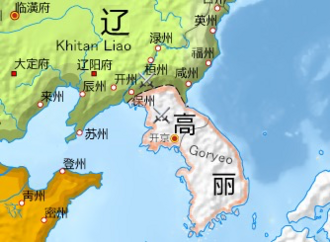
“We have already submitted to the Song. Now you must also pay tribute to our Liao dynasty — or face war.”
— Demand delivered by the Khitan envoy Xiao Sunning to Goryeo, 993 CE
In the late tenth and early eleventh centuries, the Korean peninsula became the battleground for one of medieval East Asia’s most consequential conflicts. The Goryeo–Khitan War was not a single clash but a prolonged series of three major invasions launched by the Khitan Liao dynasty against the Goryeo Kingdom. What emerged from this crucible of warfare was a Korean state that had tested and proven its diplomatic cunning, military resilience, and cultural identity against one of the most formidable empires of the age.
The conflict stretched from 993 to 1019 CE, spanning more than two decades of tension, battle, negotiation, and reconstruction. Its outcome shaped the political geography of Northeast Asia and left a deep imprint on Korean statecraft and national consciousness that endures in historical memory to this day.
Quick Facts: The Goryeo–Khitan War at a Glance
| Detail | Information |
|---|---|
| Period | 993–1019 CE |
| Belligerents | Goryeo Kingdom vs. Khitan Liao Dynasty |
| Number of Major Invasions | Three (993, 1010, 1018–1019) |
| Goryeo Capital | Gaegyeong (modern Kaesong) |
| Key Goryeo Figure (First Invasion) | General Seo Hui |
| Key Goryeo Figure (Third Invasion) | General Gang Gam-chan |
| Decisive Battle | Battle of Gwiju, 1019 CE |
| Outcome | Goryeo retained sovereignty; both sides normalized relations |
Background: Why Did the Khitan Invade Goryeo?
To understand the Goryeo–Khitan War, one must first understand the shifting tectonic plates of East Asian geopolitics in the tenth century. The Khitan people had founded the Liao dynasty in 907 CE, building a powerful empire that controlled vast territories across Manchuria and parts of northern China. By the late 900s, Liao had become one of the dominant powers in the region, locked in an ongoing rivalry with the Song dynasty of China.
Goryeo, founded in 918 CE by Wang Geon (Taejo), had unified the Korean peninsula by 936 CE, absorbing the remnants of the Later Three Kingdoms. From its capital at Gaegyeong, Goryeo maintained close cultural and diplomatic ties with the Song dynasty, a relationship the Khitan viewed with deep suspicion. The Liao court feared that a Goryeo aligned with Song could threaten its southeastern flank.
There was also a territorial dimension. Goryeo had been expanding its northern frontier, pushing into areas that the Khitan considered within their sphere of influence. Jurchens — semi-nomadic peoples who inhabited the lands between Goryeo and Liao — complicated the picture further, as both powers competed for influence over these intermediate tribes. These overlapping grievances — strategic encirclement, territorial rivalry, and diplomatic alignment — combined to make war, eventually, almost inevitable.
The First Invasion (993): Seo Hui’s Brilliant Diplomacy
In 993 CE, the Khitan general Xiao Sunning led an army of reportedly 800,000 soldiers — a number almost certainly exaggerated in the sources, but indicative of the scale of the force — across the Yalu River and into northern Goryeo territory. The sheer size of the invading force created panic at the Goryeo court in Gaegyeong, and some officials urged the king to cede northern territories and submit to Liao suzerainty.
It was at this critical juncture that General Seo Hui stepped forward, volunteering to negotiate directly with the Khitan commander. What followed was one of the most remarkable acts of diplomatic statecraft in Korean history. Rather than capitulating, Seo Hui engaged Xiao Sunning in a formal debate about the legitimacy of Khitan claims. He argued that Goryeo was the legitimate successor to the ancient kingdom of Goguryeo — indeed, the very name “Goryeo” was derived from “Goguryeo” — and that the lands between Goryeo and Liao had historically belonged within Goryeo’s sphere.
Seo Hui further pointed out that the reason Goryeo maintained relations with Song rather than Liao was not ideological hostility but simple geography: Jurchens controlled the overland routes between Goryeo and Liao, making communication and formal diplomatic contact difficult. If Liao wanted Goryeo’s allegiance, the Khitan should help clear those Jurchen intermediaries from the border regions.
Astonishingly, Xiao Sunning accepted this argument. The Khitan withdrew their forces without a major battle, and in the aftermath Goryeo actually gained territory — the so-called “Six Garrison Fortresses” region along the northwestern frontier — in exchange for formally acknowledging Liao’s suzerainty and cutting formal ties with Song. It was a diplomatic masterpiece: Goryeo had faced down an invasion and come away with more land than it had before.
“Seo Hui’s negotiation with the Khitan in 993 stands as one of the supreme examples of diplomacy over military force in the medieval world — a general who won a war by talking.”
The Second Invasion (1010): The Burning of Gaegyeong
The peace that followed the first invasion proved fragile. Relations between Goryeo and Liao deteriorated through the first decade of the eleventh century, fueled by mutual suspicion and Goryeo’s continued reluctance to fully abandon its cultural orientation toward China’s Song dynasty. The spark for renewed conflict came from internal Goryeo politics: in 1009, the powerful general Gang Jo led a coup, assassinating King Mokjong and placing a new king on the throne.
The Khitan emperor used this political upheaval as a pretext for invasion. In 1010, Liao Emperor Shengzong personally led a massive army across the Yalu River, demanding that Goryeo hand over Gang Jo and submit more completely to Khitan overlordship. The Goryeo forces were overwhelmed in the north, and King Hyeonjong was forced to flee the capital, which the Khitan forces entered and burned.
Yet despite this catastrophic early phase, the invasion ultimately failed to achieve Liao’s strategic goals. The Goryeo king fled south rather than surrendering, Khitan supply lines grew dangerously extended, and Goryeo forces — including guerrilla resistance in the countryside — harassed the invaders continuously. The Khitan eventually withdrew, extracting promises of tribute and formal submission, but without capturing the Goryeo king or dismantling the state.
The Third Invasion (1018–1019): Triumph at Gwiju
The third and final Khitan invasion proved to be their undoing. By 1018, Liao had grown frustrated with Goryeo’s continued resistance to full submission — the promises made after the second invasion had been honored only partially, and Goryeo had been quietly rebuilding and fortifying its northern defenses. The Khitan dispatched a force of approximately 100,000 soldiers under the command of Xiao Baiya to settle the matter once and for all.
Goryeo’s response was led by General Gang Gam-chan, a brilliant military commander who had also served as a civil official. Gang Gam-chan implemented a strategy combining active defense with deliberate counterattack. When the Khitan crossed the Yalu, Gang Gam-chan is said to have ordered a river dammed upstream and then released the water as a flood against the advancing forces — an account that may be partly legendary but reflects the bold, unconventional tactics associated with his command.
The decisive engagement came at Gwiju (modern Kusong in North Korea) in February 1019, as the Khitan forces were withdrawing northward after failing to penetrate deep into Goryeo territory. Gang Gam-chan’s forces caught the retreating Khitan army in a devastating ambush. The sources report that of the roughly 100,000 Khitan soldiers who had crossed into Goryeo, only a few thousand returned home alive. The battle was a catastrophic defeat for Liao, and the Khitan never invaded Goryeo again.
3 Reasons Why Goryeo Ultimately Prevailed
- Diplomatic Agility: From Seo Hui’s brilliant negotiation in 993 to the managed retreats and promise-making that followed the second invasion, Goryeo consistently demonstrated an ability to use words and concessions strategically, buying time and territory while never fully surrendering its sovereignty.
- Military Adaptation: Rather than meeting the massive Khitan armies in open-field pitched battles — where nomadic cavalry excelled — Goryeo commanders increasingly relied on fortress defense, scorched-earth tactics, guerrilla harassment, and the exploitation of Korea’s difficult terrain to negate Liao’s numerical and cavalry advantages.
- State Cohesion: Despite the burning of the capital during the second invasion and the flight of the king, the Goryeo state never collapsed. The bureaucratic and military structures held together, the king maintained legitimacy, and the population did not acquiesce in occupation. This institutional resilience ultimately exhausted the Khitan will and capacity to maintain extended campaigns on the peninsula.
What Was the Legacy of the Goryeo–Khitan War?
The aftermath of the war reshaped the diplomatic landscape of Northeast Asia. Following the Battle of Gwiju, both Goryeo and Liao stepped back from the brink and normalized relations on terms that left Goryeo’s sovereignty effectively intact. Goryeo formally acknowledged Liao suzerainty — using the Liao calendar and sending periodic tribute — but retained its own king, court, culture, and internal governance. It was a classic East Asian tributary relationship in form, but Goryeo’s independence in substance was never seriously in doubt again during the Liao period.
Within Korea, the war generated heroes whose memory persisted for centuries. Seo Hui and Gang Gam-chan became archetypes of the scholar-official who could also serve the state in military crisis — figures whose stories were told and retold as examples of Confucian virtue in action. Gang Gam-chan in particular became a legendary figure, and the victory at Gwiju was celebrated as one of the great military triumphs in Korean history.
The war also had a significant material legacy. The experience of multiple devastating invasions accelerated Goryeo’s program of fortress construction along its northern frontier and deepened the military-civil bureaucratic structures that would sustain the kingdom through future crises. Some historians also note that the Goryeo court’s prayers for divine protection during the invasions — including the commissioning of Buddhist texts — contributed to the tradition of wood-block printing that would eventually produce the Tripitaka Koreana, one of the most complete collections of Buddhist scriptures ever compiled and now a UNESCO World Heritage treasure.
| Invasion | Year | Khitan Leader | Goryeo Response | Outcome for Goryeo |
|---|---|---|---|---|
| First | 993 | Xiao Sunning | Diplomatic negotiation by Seo Hui | Territorial gain; limited concessions |
| Second | 1010 | Emperor Shengzong | King flees; guerrilla resistance | Capital burned; kingdom survived |
| Third | 1018–1019 | Xiao Baiya | Military command by Gang Gam-chan | Decisive victory at Battle of Gwiju |
Continue Exploring
Deepen your understanding of Goryeo’s remarkable history and the world it inhabited with these resources: