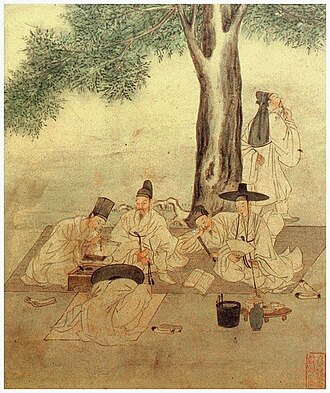
“A seonbi does not abandon his principles even in poverty, nor does he forget righteousness even in prosperity.”
— Traditional Korean proverb reflecting the seonbi ideal
Few figures in Korean history have captured the national imagination quite like the seonbi (선비). These scholar-gentlemen of the Joseon dynasty (1392–1897) were more than simply educated men — they represented an entire moral philosophy, a way of living that placed virtue, scholarship, and integrity above personal gain or political convenience. To understand the seonbi is to understand much of what shaped Korean civilization over five centuries.
Even today, the word seonbi carries enormous cultural weight in Korea. To call someone a seonbi is to pay them one of the highest compliments in the Korean language — a person of learning, moral seriousness, and upright character. This ideal did not emerge overnight. It was centuries in the making, shaped by the adoption of Neo-Confucianism as the official state philosophy and the particular social circumstances of the Joseon dynasty.
Quick Facts: The Seonbi of Joseon Korea
| Category | Details |
|---|---|
| Korean Term | 선비 (Seonbi) |
| Dynasty | Joseon (1392–1897) |
| Social Class | Yangban (aristocratic-scholar class) |
| Core Philosophy | Neo-Confucianism |
| Primary Pursuit | Moral self-cultivation and classical scholarship |
| Key Examination | Gwageo (civil service examination) |
| Defining Virtue | Integrity (절개, jeolgae) even under hardship |
Who Were the Seonbi? Defining the Scholar-Gentleman
The term seonbi does not translate perfectly into English. “Scholar-gentleman” comes closest, but even that falls short. A seonbi was not simply someone who had read many books or passed government examinations. The concept carried a profound moral dimension: a seonbi was someone who had internalized Confucian ethical principles so deeply that they governed every aspect of their conduct — in public office, in family life, and in private behavior when no one was watching.
The seonbi ideal was closely associated with the yangban class, the hereditary aristocracy that dominated Joseon society. However, the two categories were not identical. Being born into a yangban family gave a man the opportunity to become a seonbi, but it did not make him one automatically. The title had to be earned through genuine dedication to learning and virtue. A yangban who pursued only wealth or power, neglecting his moral cultivation, was considered to have failed the seonbi ideal — and Korean history records many bitter critiques of such men by their more principled contemporaries.
Conversely, the ideal of the seonbi sometimes transcended strict class boundaries. A man of modest background who demonstrated extraordinary learning and moral integrity might be spoken of with the honorific respect due to a seonbi, even if social convention kept him from the highest offices. This tension between the inherited aristocratic system and the meritocratic ideal embedded in Confucian thought was one of the defining contradictions of Joseon society.
What Philosophical Foundations Shaped the Seonbi Ideal?
The seonbi ideal cannot be understood without understanding Neo-Confucianism, which the founders of the Joseon dynasty adopted as the official state philosophy in 1392, deliberately moving away from the Buddhist orientation of the preceding Goryeo dynasty. Neo-Confucianism, as developed by Chinese thinkers like Zhu Xi and later interpreted and debated by Korean scholars, placed extraordinary emphasis on moral self-cultivation, the investigation of ethical principles, and the alignment of personal virtue with social harmony.
For the seonbi, this meant a lifelong commitment to studying the Confucian classics — works like the Analects of Confucius, the writings of Mencius, and the foundational texts of the Neo-Confucian tradition. But study alone was not enough. The seonbi was expected to embody what he learned: to practice filial piety toward his parents, loyalty toward his king, faithfulness toward his friends, and righteousness in all his dealings. The ideal human being, in this framework, was not a warrior or a merchant or an artist, but a morally perfected scholar-official who served both his family and the state with impeccable integrity.
Korea developed a particularly intense and distinctive version of this Confucian scholarly culture. Korean Neo-Confucian scholars engaged in some of the most rigorous philosophical debates in all of East Asian intellectual history, most famously the Four-Seven Debate of the sixteenth century, in which leading seonbi thinkers like Yi Hwang (Toegye) and Yi I (Yulgok) argued over the precise metaphysical relationship between moral feelings and human nature. These were not abstract academic disputes — they were understood as having profound implications for how human beings should live and how the state should be governed.
“The seonbi sought not merely to pass examinations, but to become, through decades of study and self-discipline, a living embodiment of moral truth — a man whose character itself was a form of governance.”
3 Defining Characteristics of the Seonbi
1. Unwavering Moral Integrity (절개, Jeolgae)
Perhaps the most admired quality of the seonbi was jeolgae — moral integrity or constancy, the refusal to compromise one’s principles even under extreme pressure. The highest expression of this virtue was the willingness to risk or sacrifice one’s career, freedom, or life rather than serve an unjust ruler or sign one’s name to a dishonest document. Korean history celebrates many seonbi who were exiled, imprisoned, or executed rather than bend to political pressure. Far from being seen as tragic failures, these men became revered figures — their resistance to power regarded as the ultimate proof of authentic seonbi character.
2. Dedication to Classical Learning
A seonbi spent the better part of his life in study. Beginning in childhood at village schools called seodang, progressing through local academies known as hyanggyo, and potentially continuing at the prestigious Sungkyunkwan — the royal Confucian academy in the capital — the path of the seonbi was a path of continuous learning. The goal was mastery of the classical texts, but also the cultivation of skills in poetry, calligraphy, and historical writing. The gwageo civil service examination system provided the formal structure through which scholarly achievement could translate into government office, but many seonbi pursued learning for its intrinsic moral value, even when political circumstances made official careers impossible or undesirable.
3. Frugality and Disdain for Luxury
The authentic seonbi was expected to live simply. Ostentatious display of wealth was considered incompatible with genuine scholarly virtue. The ideal seonbi lived frugally, concerned himself with books and moral cultivation rather than material accumulation, and was willing to endure poverty with equanimity rather than compromise his principles for financial gain. This ideal of learned simplicity gave rise to a distinctive aesthetic in Korean culture — one that prized understated elegance over extravagance, and moral substance over superficial decoration.
Seonbi vs. Other East Asian Scholar Ideals
| Feature | Korean Seonbi | Chinese Junzi (君子) | Japanese Samurai-Scholar |
|---|---|---|---|
| Primary Emphasis | Moral integrity and classical scholarship | Virtuous governance and ritual propriety | Martial skill combined with literary cultivation |
| Relationship to Power | Willing to remonstrate or withdraw from unjust rulers | Service to virtuous rule; remonstrance as duty | Loyalty to lord paramount; bushido framework |
| Social Base | Yangban hereditary aristocracy | Broader meritocratic ideal; examination system | Military aristocracy (bushi class) |
| Lifestyle Ideal | Frugal, scholarly, morally austere | Cultivated, ritually correct, administratively capable | Disciplined, loyal, combining pen and sword |
The Seonbi in Joseon Political Life
The relationship between the seonbi ideal and actual political practice in Joseon was complex and often turbulent. In theory, the gwageo examination system was designed to channel the talents of learned and virtuous men into government service, creating an administration staffed by morally cultivated scholar-officials. In practice, Joseon politics were frequently convulsed by bitter factional struggles among competing groups of yangban officials — the famous Sarim factions of the sixteenth century and the later divisions between Southerners, Northerners, Old Learning, and New Learning adherents in subsequent centuries.
During the great political purges of the early sixteenth century — the sahwa (literati purges) — hundreds of seonbi scholars were executed or exiled by royal order. Rather than destroying the seonbi ideal, these catastrophes in some ways reinforced it: the scholars who died or suffered rather than betray their convictions became moral exemplars, their stories repeated and celebrated as proof that authentic virtue transcended political fortune.
Many seonbi, particularly after the political turmoils of the sixteenth century, chose to retreat from official life altogether, establishing private academies called seowon in the countryside. These institutions — dedicated to honoring revered Confucian teachers and providing a space for serious scholarship outside the pressures of court politics — became enormously important centers of regional culture and intellectual life. The seowon landscape of Joseon Korea reflected the seonbi conviction that moral cultivation was ultimately more important than political success.
The Legacy of the Seonbi in Modern Korea
The Joseon dynasty ended in 1897, and the social structures that had sustained the seonbi class were swept away in the upheavals of the late nineteenth and early twentieth centuries. Yet the seonbi ideal has proven remarkably durable in Korean culture. The image of the principled scholar who refuses to compromise, who places moral truth above personal advantage, who studies not for profit but for the cultivation of genuine human virtue — this figure continues to exercise a powerful hold on the Korean moral imagination.
Contemporary Koreans invoke the seonbi ideal in discussions of political integrity, educational values, and national character. The word remains a term of the highest compliment. Public figures who demonstrate exceptional moral courage or intellectual integrity under pressure are praised as embodying the seonbi spirit. Conversely, politicians or officials who demonstrate hypocrisy or corruption are often criticized for having betrayed the seonbi ideal that their scholarly credentials might otherwise suggest they represent.
Several of the seowon associated with the greatest seonbi scholars of Joseon — including those honoring Yi Hwang (Toegye) at Dosan Seowon and Yi I (Yulgok) at Ogsan Seowon — were inscribed on the UNESCO World Heritage List in 2019 as part of the collective designation of the Seowon of Korea. This international recognition reflects the enduring significance of the scholarly culture that the seonbi embodied: a culture of moral seriousness, intellectual depth, and the conviction that learning exists not merely to produce useful skills, but to make human beings genuinely better.
In the landscape of Korean history, the seonbi stands as one of the most distinctive and consequential ideals ever produced — a vision of what educated humanity could and should be, whose influence is still felt in Korean culture, education, and public life today.
Continue Exploring
On Coreaverse
- Seowon: The Private Academies That Shaped Joseon Intellectual Life
- The Gwageo Examination: Korea’s Path to Power Through Learning
- Yi Hwang (Toegye): Joseon’s Greatest Neo-Confucian Philosopher