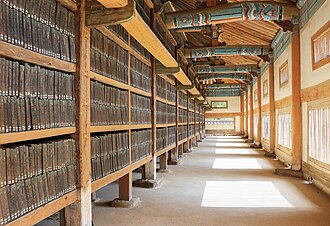
“The woodblocks of the Tripitaka Koreana represent not merely a religious text, but the concentrated will of an entire civilization to preserve knowledge in the face of destruction.”
In the mountaintop halls of Haeinsa Temple in South Korea’s South Gyeongsang Province, more than 80,000 intricately carved wooden printing blocks stand in silent rows. These blocks form the Tripitaka Koreana — the most complete and accurate collection of Buddhist scriptures ever assembled in classical Chinese, and one of the most extraordinary feats of human craftsmanship in world history. Carved over several decades during Korea’s Goryeo dynasty, the Tripitaka Koreana has survived wars, invasions, and the passage of nearly eight centuries with astonishing completeness.
Today it is recognized as a UNESCO Memory of the World treasure and a National Treasure of South Korea. But the story behind its creation — shaped by faith, political crisis, and a fierce determination to protect Korean civilization — is as compelling as the object itself.
Quick Facts: The Tripitaka Koreana at a Glance
| Fact | Detail |
|---|---|
| Full Korean Name | Goryeo Daejanggyeong (고려대장경) |
| Dynasty | Goryeo (918–1392) |
| Number of Woodblocks | Approximately 81,258 |
| Number of Characters | Approximately 52 million |
| Language | Classical Chinese (Literary Sinitic) |
| Current Location | Haeinsa Temple, South Gyeongsang Province, South Korea |
| UNESCO Status | Memory of the World Register |
| South Korean Status | National Treasure No. 32 |
| Storage Structure | Janggyeong Panjeon (UNESCO World Heritage Site) |
What Is the Tripitaka Koreana, and Why Was It Created?
The word Tripitaka comes from Sanskrit and refers to the “Three Baskets” — the foundational scriptural collection of Theravada Buddhism, encompassing the rules of monastic discipline (Vinaya), the discourses of the Buddha (Sutta), and the higher philosophical teachings (Abhidhamma). In the East Asian Buddhist tradition, collections of this scope were compiled in classical Chinese and served as comprehensive canonical references for monks, scholars, and the faithful alike.
Korea’s Goryeo dynasty had deep ties to Buddhism, which functioned not only as a spiritual tradition but also as a pillar of state ideology. The court patronized temples, sponsored rituals, and supported the copying and production of scriptures on a grand scale. It was in this environment that the idea of producing a definitive, complete canon of Buddhist texts took root.
The first Goryeo Tripitaka was carved beginning in 1011, during a period of devastating Khitan invasions from the north. The project was explicitly framed as an act of collective prayer — a plea to the Buddha for divine protection of the kingdom. That first set of blocks, housed near modern-day Daegu, was destroyed when the Mongol armies invaded Korea in 1232, a loss that devastated the scholarly and religious community.
The destruction of the first canon made the need for a second all the more urgent. Under the direction of the Goryeo court — which had retreated to Ganghwa Island off the western coast to escape Mongol pressure — a second, even more ambitious carving project was launched. This second effort, completed around 1251, produced the Tripitaka Koreana as it exists today.
The Making of 81,258 Woodblocks
The physical production of the Tripitaka Koreana was a project of staggering scale. Each of the approximately 81,258 wooden printing blocks measures roughly 24 centimeters in height and between 60 and 70 centimeters in length. The wood — believed to be primarily birch and other dense-grained timbers — was carefully seasoned in seawater and then dried to prevent warping and cracking. The surfaces were planed smooth and coated with lacquer to protect the carved text from moisture and insects.
Each block is carved on both sides, bearing an average of around 23 lines of text with 14 characters per line. The carving itself was done by teams of skilled craftsmen working under the supervision of Buddhist monks and scholars. The precision is remarkable: modern scholars who have carefully examined the blocks have found extraordinarily few errors across the entire 52-million-character corpus. When mistakes were made, craftsmen would fill the error with a wooden plug, carve the correct character into it, and continue — a testament to the painstaking care taken throughout the process.
The compilation was not merely a transcription exercise. Scholars consulted Chinese, Khitan, and Song dynasty editions of Buddhist texts, cross-referencing them to produce an authoritative and corrected canon. The resulting text is considered by scholars of East Asian Buddhism to be the most accurate surviving version of the Chinese Buddhist canon.
“Across 81,258 blocks and 52 million carved characters, not a single block has been lost in nearly 800 years — a record that defies easy explanation and commands nothing less than awe.”
Why Did the Woodblocks Survive? The Genius of Haeinsa
The survival of the Tripitaka Koreana over nearly eight centuries is itself a remarkable story. The blocks were moved to Haeinsa Temple in the late 14th century, after the founding of the Joseon dynasty, and housed in a pair of purpose-built storage halls known collectively as Janggyeong Panjeon. These halls, constructed in the 15th century, are now a UNESCO World Heritage Site in their own right — recognized for the ingenious passive environmental design that has kept the blocks in extraordinary condition without any modern climate control.
The builders of Janggyeong Panjeon understood intuitively what modern preservationists confirm through measurement: the enemy of wooden objects is fluctuating humidity. The halls were oriented and ventilated through a sophisticated system of differently sized windows and louvered openings that create natural airflow, drawing moisture out of the building in summer and preventing condensation in winter. The floors are packed with a mixture of charcoal, salt, clay, sand, and limestone — materials that absorb excess moisture and release it during dry periods, acting as a natural humidity buffer.
The result is a microclimate that has remained remarkably stable for centuries. The blocks show almost no warping, cracking, or significant decay. This combination of architectural wisdom and careful site selection — Haeinsa sits in a forested mountain valley with natural ventilation — preserved what wars and time could not destroy.
In a remarkable episode from the Korean War (1950–1953), a South Korean air force officer reportedly refused orders to bomb Haeinsa Temple — which North Korean forces were using as a shelter — because he could not bring himself to destroy the woodblocks inside. The story, whether fully documented or partly legendary, speaks to the profound cultural reverence Koreans hold for the Tripitaka Koreana.
3 Reasons the Tripitaka Koreana Matters Today
1. It Is the Most Accurate Version of the Chinese Buddhist Canon
Scholars of East Asian Buddhism regard the Tripitaka Koreana as the most textually reliable version of the Chinese Buddhist canon ever produced. Because Goryeo scholars compared multiple editions from different traditions before carving each block, the text reflects a careful editorial process unprecedented for its era. Buddhist institutions and scholars worldwide have used it as the reference standard for centuries.
2. It Represents an Unbroken Chain of Preservation
Unlike many great works of premodern scholarship, the Tripitaka Koreana has never been lost, scattered, or substantially damaged. All 81,258 blocks remain intact and in place. This completeness makes it extraordinarily rare among cultural artifacts of comparable age and scale anywhere in the world.
3. It Embodies the Relationship Between Korean Identity and Buddhism
The Tripitaka Koreana was created twice — once during a Khitan invasion and once during Mongol occupation — each time as an act of national spiritual resistance. The canon is therefore not only a religious document but a symbol of Korean cultural resilience: the belief that preserving knowledge and faith is a form of collective survival. That meaning resonates deeply in Korean historical consciousness to this day.
Comparison: First and Second Goryeo Tripitaka
| Feature | First Tripitaka (Chojo Daejanggyeong) | Second Tripitaka (Tripitaka Koreana) |
|---|---|---|
| Begun | 1011 | 1237 (approximately) |
| Completed | Around 1087 | Around 1251 |
| Reason for Creation | Khitan invasions; plea for divine protection | Mongol invasions; replacement of destroyed first canon |
| Original Location | Daegu region (Buinsa Temple) | Ganghwa Island, later moved to Haeinsa |
| Current Status | Destroyed by Mongols in 1232 | Intact; preserved at Haeinsa Temple |
| Textual Basis | Chinese and Song dynasty editions | Multiple editions including Khitan and Song canons |
The Tripitaka Koreana in the Modern World
The blocks have been digitized in recent decades, making the text accessible to scholars worldwide without risk to the originals. The Research Institute of Tripitaka Koreana in South Korea has led efforts to create a high-resolution digital archive of all 81,258 blocks, ensuring that even if the physical objects were ever threatened, the text would survive in digital form.
Haeinsa Temple itself remains an active Buddhist community, one of the “Three Jewel Temples” of Korean Buddhism — designated as the temple of the Dharma (teaching). Visitors to Haeinsa can view the Janggyeong Panjeon storage halls and, from the exterior walkways, glimpse the rows of woodblocks within. The blocks themselves are not touched or moved except under exceptional scholarly circumstances, handled with the same reverence that has surrounded them for centuries.
For travelers, historians, and anyone drawn to the intersection of faith, scholarship, and human endurance, the Tripitaka Koreana stands as one of Korea’s most profound gifts to the world — a monument not in stone but in wood and ink, and in the unbroken will to preserve what matters most.
Continue Exploring
On This Site
- The Goryeo Dynasty: Buddhism, Culture, and Crisis
- Haeinsa Temple: Where History Lives in Wood
- The Mongol Invasions and Korean Resistance