“Through the brush and the book, a man of humble birth might rise to stand beside kings.”
For nearly a millennium, a single institution stood at the heart of Korean statecraft, social mobility, and Confucian culture: the gwageo (과거), Korea’s state civil service examination system. Modelled on the Chinese imperial examination, the gwageo served as the principal gateway to government office in both the Goryeo (918–1392) and Joseon (1392–1897) dynasties. It tested candidates on their mastery of classical Chinese texts, literary composition, and Confucian philosophy — and in doing so, it shaped almost every dimension of Korean intellectual and political life.
To understand Korean history is, in no small part, to understand the gwageo. The examination system influenced who held power, how families planned their futures across generations, and what it meant to be educated and respectable in premodern Korea. It was at once a meritocratic ideal and, in practice, a mechanism that often reinforced existing social hierarchies.
Quick Facts: The Gwageo at a Glance
| Feature | Details |
|---|---|
| Korean name | 과거 (Gwageo) |
| Introduced | 958 CE, during the reign of Goryeo King Gwangjong |
| Abolished | 1894, during the Gabo Reform era |
| Dynasties | Goryeo (918–1392) and Joseon (1392–1897) |
| Modelled on | Chinese imperial examination (keju) |
| Main categories | Munwa (civil), Mukwa (military), Japwa (technical) |
| Primary subjects tested | Classical Chinese texts, Confucian philosophy, literary composition |
| Top degree | Jinsa (literary licentiate) and Munkwa (higher civil examination) |
Origins: How Did the Gwageo Begin?
The gwageo was introduced in 958 CE during the reign of King Gwangjong of the Goryeo dynasty. Gwangjong was a reforming monarch who sought to centralise royal authority and reduce the power of the hereditary aristocracy. By creating a formal examination system, he hoped to recruit capable officials on the basis of demonstrated learning rather than birth alone — a revolutionary concept in the context of early Korean statecraft.
The system was directly inspired by China’s imperial examination, known as the keju, which had existed in various forms since the Sui dynasty (581–618 CE). A Chinese scholar named Ssanggidae (Shuang Ji) is credited with helping to design the Goryeo system. From its inception, the gwageo focused heavily on classical Chinese literature and Confucian canonical texts — knowledge that marked a man as educated, cultured, and fit for public service.
While Gwangjong’s intentions were partly to break the grip of entrenched aristocratic clans, the examination system in practice became closely associated with the yangban class — the hereditary scholar-official elite — who had both the resources and the leisure to dedicate years to intensive study.
Structure of the Examination
The gwageo was not a single test but a layered system of examinations, each with its own stages, subjects, and degree of difficulty. Over the centuries, particularly during the Joseon period, the structure became highly formalised.
At the broadest level, the gwageo was divided into three main tracks:
- Munwa (문과) — The Civil Examination: This was the most prestigious track, testing candidates on Confucian classics, history, and literary composition in classical Chinese. Passing the munwa opened the door to the highest posts in the bureaucracy. The examination proceeded through a local preliminary stage (sogwa), a secondary licentiate examination (saengwon-jingsa), and finally the higher civil examination (munkwa) held in the capital.
- Mukwa (무과) — The Military Examination: This track tested martial skills including archery, horsemanship, and physical strength, alongside some theoretical knowledge of military texts. Though less socially prestigious than the civil examination, the mukwa provided an important pathway into the military officer corps.
- Japwa (잡과) — The Technical Examinations: These covered specialised fields including medicine, translation and interpretation of foreign languages (particularly Chinese and Japanese), astronomy, law, and accounting. Candidates who passed the japwa typically served in technical bureaus rather than in the highest policy-making positions.
The civil examination in particular was divided into what scholars often call the lower and higher levels. The lower examinations — the saengwon (classics licentiate) and jinsa (literary licentiate) — were deeply competitive in their own right, conferring social status and access to the prestigious Sungkyunkwan, the national Confucian academy in the capital. But the ultimate prize was the munkwa degree, success in which led directly to appointment in the central government.
“The examination hall was both a crucible and a stage — where years of solitary study were measured in a single gruelling session, and where a family’s fortunes could be transformed overnight.”
Why Did the Gwageo Matter So Much to Korean Society?
Few institutions in Korean history touched as many lives, across as many centuries, as the gwageo. Its significance operated on multiple levels simultaneously.
First, it was the primary route to political power. In Joseon Korea, positions in the central bureaucracy — the Six Ministries, the State Council, the royal censorate — were filled almost exclusively by men who had passed the higher civil examination. Without a munkwa degree, advancement to the upper ranks of government was essentially closed. This meant that ambitious families invested enormous resources — sometimes across multiple generations — in preparing their sons for the examinations.
Second, it shaped the entire educational culture of Joseon. The curriculum of private village schools (seodang), regional academies (hyanggyo), and the elite Sungkyunkwan was overwhelmingly oriented toward preparing students for the gwageo. The texts students memorised, the literary forms they practised, the philosophical positions they were expected to articulate — all were determined by what the examination demanded. This created a remarkably unified intellectual culture across the Korean peninsula.
Third, it was deeply entangled with questions of social status. The yangban class jealously guarded access to the civil examination. Although in theory any free male commoner could sit the exam, in practice the years of preparation required — and the social networks needed to navigate the system — meant that the yangban dominated the pass lists. Slaves, members of certain stigmatised occupational groups, and those with disqualifying blemishes in their family background were formally excluded. The gwageo thus simultaneously embodied a meritocratic ideal and reinforced existing hierarchies.
The Experience of Sitting the Gwageo
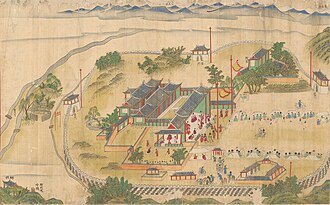
Sitting the gwageo was a gruelling, high-stakes ordeal. Candidates arrived at examination grounds carrying their own writing materials and supplies, often spending multiple days confined in small open-air cubicles where they composed lengthy essays and poems in classical Chinese under timed conditions. The physical conditions could be harsh, with examinations sometimes held in extreme heat or cold.
The most celebrated examination venue was the Sungkyunkwan in Hanyang (present-day Seoul), the Joseon capital’s national academy, though major examinations were also held at royal palace grounds and at regional centres. Successful candidates at the final stage of the munkwa examination would be announced publicly — their names read aloud before the royal court — in a ceremony of considerable drama and social consequence.
Many men sat the gwageo repeatedly across their lifetimes without ever passing the highest levels. The competition was fierce: in a typical munkwa examination during the Joseon period, only a handful of candidates — sometimes as few as three, sometimes up to thirty-three — would be selected from hundreds or even thousands of applicants. This intense competition meant that failure was the norm, not the exception, and the psychological and social weight of repeated failure was a recurring theme in Korean literature and personal records of the period.
Comparing the Gwageo in Goryeo and Joseon
| Feature | Goryeo Period | Joseon Period |
|---|---|---|
| Introduced | 958 CE under King Gwangjong | Continued and expanded from Goryeo |
| Social access | Broader in theory; some commoner success recorded | Increasingly dominated by yangban elite |
| Role of Buddhism | Buddhist clerical examinations also existed alongside gwageo | Buddhist examinations abolished; purely Confucian focus |
| Examination subjects | Chinese classics, literary composition | Four Books, Five Classics, policy essays, literary forms |
| Institutional support | Gukjagam (national academy) | Sungkyunkwan (national Confucian academy) |
| Frequency | Irregular | Regular triennial cycle (式年試, sigyeonsi) plus special examinations |
The Joseon dynasty placed even greater emphasis on the gwageo than its Goryeo predecessor had, embedding the examination system at the very centre of the state’s Confucian ideology. The founding philosophy of Joseon held that virtuous, learned officials — produced by rigorous examination — were the surest foundation of good government. Special examinations were also held to mark royal celebrations, military victories, and other significant occasions, supplementing the regular triennial cycle.
Decline and Abolition
By the nineteenth century, the gwageo system was under severe strain. Corruption had become endemic: wealthy families bribed examiners, ghostwriters were employed to sit examinations in candidates’ names, and the circulation of answers was widespread. The ideal of pure meritocracy had been significantly eroded.
The final blow came with the Gabo Reform of 1894, a sweeping modernisation programme carried out under the influence of Japan following the First Sino-Japanese War. The gwageo was formally abolished as part of this reform effort, replaced by a new system of government appointments that drew on Western-style education and training. The abolition marked the end of nearly a thousand years of examination culture in Korea — a rupture that reshaped Korean society, education, and elite identity with extraordinary speed.
The legacy of the gwageo, however, did not simply disappear. Scholars have long noted that Korean culture’s intense emphasis on educational achievement, competitive examination, and academic credentials — visible today in the fierce competition surrounding the suneung (대학수학능력시험), South Korea’s modern university entrance examination — echoes patterns established during the long centuries of gwageo culture.