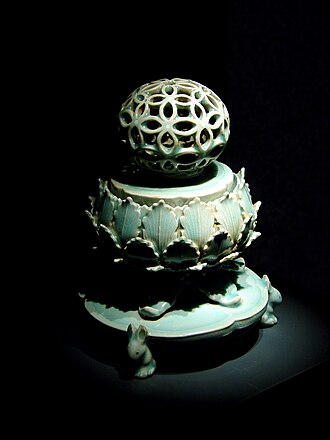
“The first treasure under heaven is the blue-green color of Goryeo ceramics.”
Few artistic achievements in Korean history have commanded as much international admiration as the celadon ceramics of the Goryeo dynasty (918–1392). Fired in kilns along the southwestern coast of the Korean peninsula, these vessels — with their mysterious jade-green glaze and delicately inlaid designs — represented the pinnacle of East Asian ceramic craftsmanship. Collected by royalty, praised by foreign dignitaries, and now displayed in the world’s greatest museums, Goryeo celadon remains one of the most enduring symbols of Korean cultural genius.
Quick Facts: Goryeo Celadon at a Glance
| Fact | Detail |
|---|---|
| Korean Name | Goryeo Cheongja (고려청자) |
| Dynasty | Goryeo (918–1392) |
| Peak Period | 12th–13th centuries |
| Primary Production Sites | Gangjin and Buan, South Jeolla Province |
| Defining Technique | Sanggam (inlay) decoration |
| Characteristic Glaze Color | Jade or kingfisher blue-green (bisaek) |
| Influenced By | Chinese Yue and Ru ware traditions |
| Key Patrons | Goryeo royal court and Buddhist monasteries |
Origins: How Did Goryeo Celadon Begin?
The story of Goryeo celadon begins with Korean potters looking southward and westward — toward the sophisticated ceramic traditions of Tang and Song dynasty China. During the late Unified Silla period and the early decades of the Goryeo dynasty, Korean craftsmen studied Chinese celadon techniques, particularly those associated with the Yue kilns of Zhejiang province. These Chinese wares featured a distinctive grey-green glaze achieved through careful control of kiln atmosphere and iron-oxide content in the glaze.
Korean potters did not simply imitate what they saw. By the 10th and 11th centuries, they had begun developing their own distinctive aesthetic sensibility. The clay bodies used in Korean kilns, the local mineral compositions available for glazing, and the firing conditions particular to kiln sites along the Korean southwest coast all contributed to an outcome that diverged meaningfully from Chinese precedents. The result was a glaze color the Koreans called bisaek — a word often translated as “kingfisher blue” or “jade green” — which foreign observers found bewitching.
The kiln complex at Gangjin, in present-day South Jeolla Province, became the most important center of celadon production. Archaeological excavations have revealed dozens of kiln sites in this region, and the sheer volume of sherds recovered attests to centuries of intensive production. The site is now recognized as a place of outstanding cultural importance and draws researchers and visitors from across the world.
The Sanggam Revolution: A Technique Born in Korea
If the jade-green glaze defined Goryeo celadon to the outside world, it was the development of the sanggam inlay technique that elevated it to an art form with no precise parallel anywhere in East Asia. Sanggam — meaning “inlaid” — involved carving fine designs into the surface of leather-hard clay, then filling those incised channels with slip (liquid clay) of contrasting colors, typically white and black. After the piece dried, excess slip was carefully scraped away, leaving a surface in which the design appeared embedded within the clay body itself. When the piece was fired and the glaze applied, the inlaid patterns shone through the translucent celadon glaze with extraordinary clarity and refinement.
This technique appears to have been invented in Korea — there is no clear Chinese precedent for sanggam inlay in ceramics — and it transformed the decorative possibilities available to Goryeo potters. Motifs included cranes soaring through clouds, willow trees bending over water, chrysanthemums, peonies, fish and waves, and abstract interlocking scroll patterns. These designs were not merely decorative. They carried symbolic weight: cranes represented longevity and transcendence, while cloud motifs evoked the spirit world and celestial realms so important to the Buddhism that permeated Goryeo court culture.
“In the exquisite inlaid celadon of Goryeo, the craftsman’s hand and the philosopher’s mind worked as one — each vessel a small universe of meaning rendered in clay and fire.”
The finest examples of sanggam ware date to the 12th and early 13th centuries, a period often described as the golden age of Goryeo ceramics. Pieces from this era display a technical mastery that later scholars and connoisseurs have found difficult to surpass. The control over glaze thickness, the precision of the inlaid lines, and the overall harmony of form and decoration all point to workshops operating at the very top of their craft.
3 Reasons Why Goryeo Celadon Stood Apart from All Other East Asian Pottery
1. The Incomparable Bisaek Glaze
The color of authentic Goryeo celadon glaze was widely recognized in its own time as something extraordinary. The Chinese envoy Xu Jing, who visited the Goryeo capital of Gaegyeong (modern Kaesong) in 1124, recorded his admiration in a text called the Goryeo dogyeong (Illustrated Account of Goryeo). He identified the glaze color as one of the most remarkable things he had encountered in Korea. The precise blue-green tone — neither too blue nor too grey, with a depth that seemed to shift in changing light — was the product of extremely precise kiln management and glaze chemistry that potters had refined over generations.
2. The Innovation of Inlay Decoration
As described above, the sanggam technique was a genuine Korean innovation with no direct equivalent in the Chinese ceramic tradition that originally inspired Goryeo potters. This was not adaptation — it was invention. The ability to embed black and white designs within the glaze layer, creating pictures that appeared almost painted from within the clay itself, gave Goryeo ceramics a visual character entirely their own. This innovation demonstrated that Korean craftsmen were not passive recipients of Chinese influence but active and creative participants in the broader East Asian artistic conversation.
3. Integration of Buddhist and Courtly Symbolism
Goryeo was a kingdom in which Buddhism occupied a central place — politically, spiritually, and aesthetically. The royal court lavished patronage on monasteries, and Buddhist ritual objects including incense burners, ewer vessels, and ceremonial cups were among the most prestigious items produced in celadon. The decorative motifs chosen for these pieces were often laden with Buddhist meaning. Even vessels intended for secular court use reflected an aesthetic sensibility shaped by Buddhist ideas of harmony, impermanence, and the beauty of natural forms. This integration of religious symbolism and refined court taste gave Goryeo celadon a depth of meaning that went far beyond purely decorative concerns.
Decline and the Legacy That Survived
The golden age of Goryeo celadon production did not last forever. The devastating Mongol invasions of the 13th century, which began in 1231 and continued across several decades, disrupted virtually every aspect of Goryeo society. Kiln sites were abandoned or destroyed, skilled potters were displaced, and the social infrastructure that had supported high-quality ceramic production was severely weakened. When production eventually resumed, the quality of celadon pieces produced never fully recovered the heights of the 12th-century peak. Glaze colors became less refined, forms less elegant, and inlay decoration more mechanical.
By the late Goryeo period and into the succeeding Joseon dynasty (1392–1910), the ceramic tradition shifted toward new forms. Joseon potters developed buncheong ware — a grey-bodied stoneware with white slip decoration — and eventually the pure white porcelain that came to define the aesthetic of the Confucian Joseon court. But they never forgot the achievement of Goryeo celadon. For subsequent generations of Korean artists and scholars, the finest pieces from the great kilns of Gangjin and Buan represented a standard of beauty against which all later ceramic work would be measured.
Comparing Goryeo Celadon with Related Ceramic Traditions
| Feature | Goryeo Celadon | Chinese Yue Ware | Joseon Buncheong |
|---|---|---|---|
| Primary Period | 10th–14th centuries | 9th–11th centuries | 15th–16th centuries |
| Glaze Color | Jade blue-green (bisaek) | Olive green | Grey with white slip |
| Signature Technique | Sanggam inlay | Carved surface decoration | Painted or stamped slip |
| Primary Patrons | Royal court, Buddhist monasteries | Tang and Song imperial courts | Joseon government, general elite |
| Korean Innovation? | Yes — inlay technique is uniquely Korean | No — Chinese origin | Yes — developed from Goryeo tradition |
Goryeo Celadon Today: Where Can You Encounter These Masterpieces?
Surviving examples of Goryeo celadon are among the most prized objects in Korean national collections and in major museums worldwide. The National Museum of Korea in Seoul holds an exceptional collection that spans the full range of celadon production, from the earliest experimental pieces of the 10th century to late Goryeo ware showing the decline of the tradition. Visitors to Seoul can view masterpieces including famous melon-shaped ewers, delicate vases with inlaid crane designs, and incense burners whose lids are sculpted in the form of crouching lions.
In South Jeolla Province, the Gangjin Celadon Museum stands near the historic kiln sites themselves and provides visitors with a detailed account of how these vessels were made. The kilns of Gangjin have been proposed for inclusion on the UNESCO World Heritage List, a recognition that would place this extraordinary production site alongside other landmarks of global cultural heritage. Meanwhile, Korean craftspeople in Gangjin continue to practice celadon-making today, keeping the technical traditions alive even as they develop new creative directions.
Internationally, pieces of Goryeo celadon can be found in collections including the Metropolitan Museum of Art in New York, the British Museum in London, and the Guimet Museum in Paris. Their presence in these collections reflects the esteem in which Goryeo ceramics have been held by Western collectors and curators since the late 19th century, when Korean art first began to attract serious international scholarly attention.