“The Tripitaka Koreana stands as one of the most remarkable achievements in the history of printing and Buddhist scholarship — a monument to faith, precision, and the enduring power of the written word.”
Hidden within the ancient wooden halls of Haeinsa Temple in South Korea’s South Gyeongsang Province lies one of humanity’s most extraordinary cultural treasures. The Tripitaka Koreana — known in Korean as Goryeo Daejanggyeong (고려대장경) — is the world’s most complete and accurate collection of Buddhist scriptures, carved onto more than 81,000 wooden printing blocks during the Goryeo dynasty. Produced over decades of painstaking labor, it represents not only a monumental feat of medieval craftsmanship but also a profound expression of Korean Buddhist faith and scholarly dedication.
For over 750 years, these wooden blocks have endured war, humidity, and the passage of time, surviving in near-perfect condition. Today, the Tripitaka Koreana is recognized as a UNESCO Memory of the World and a National Treasure of South Korea — a testament to the vision and devotion of an entire civilization.
Quick Facts: The Tripitaka Koreana at a Glance
| Detail | Information |
|---|---|
| Korean Name | Goryeo Daejanggyeong (고려대장경) |
| Dynasty | Goryeo (918–1392) |
| Number of Wooden Blocks | Approximately 81,258 |
| Number of Characters | Approximately 52 million |
| Current Location | Haeinsa Temple, South Gyeongsang Province, South Korea |
| UNESCO Recognition | Memory of the World Register |
| South Korean National Treasure | Designated National Treasure |
| Type of Wood Used | Birch and other hardwoods, specially treated |
What Is the Tripitaka Koreana and Why Does It Matter?
The word Tripitaka comes from Sanskrit and means “three baskets” — referring to the three main categories of Buddhist scriptures: the Vinaya (monastic rules), the Sutras (the Buddha’s teachings), and the Abhidharma (philosophical analysis). The Tripitaka Koreana contains all three, compiled and carved with an extraordinary level of accuracy that has made it the definitive reference for Buddhist scholars worldwide.
What sets the Korean version apart from other Buddhist canons produced across Asia is its remarkable completeness and precision. Each block was carved by hand, character by character, with scholars comparing multiple Chinese, Korean, and Indian source texts to ensure accuracy. The result was a scripture that corrected errors found in older Chinese editions and became the gold standard for the Buddhist Tripitaka tradition in East Asia.
Beyond its religious significance, the Tripitaka Koreana offers modern historians a unique window into medieval Korean society — its religious institutions, state administration, craftsmanship, and intellectual life during the Goryeo period.
A Canon Born from Crisis: The First and Second Carvings
The story of the Tripitaka Koreana is inseparable from the story of invasion and survival. The Goryeo dynasty faced repeated threats from foreign powers, and it was precisely in these moments of crisis that the Korean court and Buddhist clergy turned to the monumental project of carving the scriptures.
The First Tripitaka was carved during the eleventh century, when Goryeo was under threat from the Khitan Liao dynasty. Korean leaders and monks believed that the spiritual merit generated by creating the canon would invoke divine protection and drive out the invaders. The project was completed over several decades and represented the first full carving of the Buddhist canon in Korea. However, this first set of blocks was tragically destroyed when the Mongols invaded Goryeo in the thirteenth century and burned the repository that housed them.
It was this catastrophic loss that gave rise to the Second Tripitaka — the set that survives to this day. With the Mongol invasions devastating the Korean peninsula beginning in 1231, the Goryeo court took refuge on Ganghwa Island and embarked once again on the colossal task of re-carving the entire canon. The second carving was completed in 1251 and surpassed its predecessor in both scale and scholarly rigor.
Once again, the motivations were spiritual as much as practical: Korean Buddhists believed that the act of producing the sacred texts would accumulate enough merit to secure heavenly intervention against the Mongol armies. Whether or not divine forces played a role, the finished canon has endured for nearly eight centuries — a remarkable survival story in its own right.
“Each of the 81,258 wooden blocks was carved on both sides, meaning that over 160,000 surfaces were engraved — all by hand, all with extraordinary precision, and with fewer errors than many modern printed texts.”
The Craft Behind the Canon: How Were the Blocks Made?
The production of the Tripitaka Koreana was not simply a spiritual undertaking — it was also a triumph of medieval engineering and craftsmanship. Creating blocks that could survive centuries required meticulous preparation of the wood itself.
Trees were cut and the timber was soaked in seawater for several years to prevent warping and cracking. The wood was then boiled in salt water, dried in the shade, and finally coated with lacquer to protect against insects and moisture. Only after this lengthy preparation process could the carving begin. Each block measures roughly 70 centimeters in length and contains about 23 lines of text on each face, with each line holding approximately 14 characters. The carving had to be done in mirror image so that the printed text would read correctly.
Scholars estimate that it would have taken a skilled craftsman approximately a year and a half to carve a single block — meaning that the entire project required the sustained labor of thousands of workers, monks, and artisans over many years. The organizational and logistical achievement alone is staggering, especially given the wartime conditions under which it was produced.
3 Reasons the Tripitaka Koreana Remains Unmatched
1. Unparalleled Textual Accuracy
When scholars produced the second carving in the thirteenth century, they consulted dozens of existing versions of the Buddhist canon — including texts from China, Korea, and other sources — to produce the most accurate and complete edition possible. Modern Buddhist scholars still rely on the Tripitaka Koreana as a reference standard when studying canonical texts, as it contains corrections to errors found in other versions of the canon.
2. Extraordinary Physical Preservation
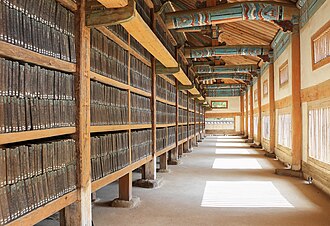
The wooden blocks housed at Haeinsa Temple have survived for more than 750 years with minimal deterioration. Much of this preservation is due to the ingenious design of the Janggyeong Panjeon — the storage halls built to house the blocks. These structures, themselves designated a UNESCO World Heritage Site, were designed to maintain optimal conditions of temperature, humidity, and airflow using only traditional architectural techniques. Ventilation openings of different sizes on the upper and lower portions of the walls allow air to circulate naturally, preventing moisture buildup that would otherwise warp or rot the wooden blocks.
3. A Living Cultural Heritage
Unlike many ancient artifacts displayed behind glass in museums, the Tripitaka Koreana remains in active use as a reference for Buddhist scholarship. Reprints and digital editions based on the original blocks continue to be produced, ensuring that the knowledge preserved within them reaches scholars and practitioners around the world.
Haeinsa Temple: The Home of the Tripitaka
The Tripitaka Koreana has been housed at Haeinsa Temple in the Gayasan mountains since the late fourteenth century, when it was moved from Ganghwa Island following the end of the Goryeo dynasty and the establishment of the Joseon dynasty. Haeinsa — one of Korea’s three “Jewel Temples” — was chosen as the new home for the canon, and the Janggyeong Panjeon storage halls were constructed specifically to house and preserve the blocks.
The Janggyeong Panjeon (장경판전) is itself recognized as a UNESCO World Heritage Site, separate from the Memory of the World designation given to the wooden blocks themselves. This dual recognition underscores the extraordinary nature of both the physical objects and the architecture designed to protect them. Visitors to Haeinsa today can view the blocks through the latticed windows of the storage halls — a humbling experience that connects the modern world with nearly a millennium of Korean Buddhist history.
Comparison: Major Buddhist Canons of East Asia
| Canon | Region/Dynasty | Medium | Survival Status |
|---|---|---|---|
| Tripitaka Koreana (2nd carving) | Korea / Goryeo | Wooden printing blocks | Intact — 81,258 blocks surviving |
| Tripitaka Koreana (1st carving) | Korea / Goryeo | Wooden printing blocks | Destroyed by Mongol invasion |
| Chinese Buddhist Canon (Song dynasty) | China / Song | Printed text | Partially surviving |
| Dunhuang manuscripts | China / Tang and earlier | Paper scrolls | Surviving (scattered globally) |
Legacy and Global Recognition
The Tripitaka Koreana’s significance extends far beyond the Korean peninsula. It has been described by scholars as the most important collection of Buddhist texts in the world, representing a pinnacle of East Asian printing technology and textual scholarship. Its inscription on UNESCO’s Memory of the World Register acknowledges its status as part of the shared heritage of all humanity.
In Korea itself, the Tripitaka Koreana occupies a place of deep national pride. Its survival through centuries of war, occupation, and political upheaval is seen as a symbol of Korean cultural resilience. During the Korean War, commanders were reportedly ordered not to bomb Haeinsa Temple precisely because of its irreplaceable contents — a decision that allowed this ancient treasure to survive yet another conflict.
Today, ongoing digitization projects are making the contents of the Tripitaka Koreana accessible to scholars worldwide, ensuring that the knowledge painstakingly carved onto those 81,000 wooden blocks continues to illuminate Buddhist thought and Korean history for generations to come.
Continue Exploring
On Korea Through Time
- The Goryeo Dynasty: Korea’s Buddhist Golden Age
- Haeinsa Temple: One of Korea’s Three Jewel Temples
- Janggyeong Panjeon: The Architecture of Preservation