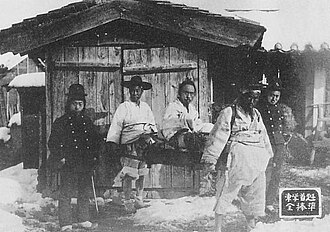
“We rise not against the king, but against the corrupt officials who have stolen from the people and brought our nation to ruin.”
In the spring of 1894, tens of thousands of Korean farmers, laborers, and followers of the Tonghak religious movement took up arms against a government they believed had abandoned them. What began as a local protest in the southwestern province of Jeolla quickly escalated into one of the most significant popular uprisings in Korean history — an event that would not only shake the Joseon dynasty to its foundations but also draw in foreign powers and ultimately ignite the First Sino-Japanese War. The Tonghak Peasant Revolution stands as a defining moment in Korea’s long story: a desperate cry from below that changed everything above.
Quick Facts: The Tonghak Peasant Revolution
| Date | 1894 |
|---|---|
| Location | Korean Peninsula (Joseon Dynasty) |
| Key Leader | Jeon Bongjun (전봉준), known as “Green Bean” for his short stature |
| Movement Basis | Tonghak (Eastern Learning) religious and social philosophy |
| Primary Grievances | Corrupt local officials, heavy taxation, foreign economic exploitation |
| Foreign Involvement | Qing China and Meiji Japan both sent troops to Korea |
| Outcome | Rebellion suppressed; sparked the First Sino-Japanese War (1894–1895) |
| Legacy | Recognized as a foundational event in Korean democratic and nationalist history |
What Was the Tonghak Movement, and Why Did It Inspire Revolution?
To understand the revolution, one must first understand the Tonghak movement itself. Founded in 1860 by Choe Je-u, Tonghak — meaning “Eastern Learning” — arose as a direct philosophical and spiritual counterpoint to what its followers called Seohak, or “Western Learning,” which referred to Catholicism spreading through Joseon at the time. Tonghak blended elements of Confucianism, Buddhism, and Shamanism into a homegrown Korean spiritual system that emphasized the inherent dignity and equality of all people. Its central tenet, innaecheon — “humanity is Heaven” — declared that every person carried divine worth regardless of their social status.
This was a radical idea in a society still rigidly organized by the Confucian class system. While aristocratic yangban elites monopolized political power and social prestige, the vast majority of Koreans — peasant farmers, craftspeople, and the heavily discriminated baekjeong underclass — had little recourse against exploitation. Tonghak gave these people not only a spiritual community but an intellectual framework to understand their suffering as unjust, and their resistance as righteous.
By the early 1890s, Tonghak had spread widely across the southern and central regions of the Korean peninsula. Its leaders organized rallies demanding that the government posthumously exonerate Choe Je-u, who had been executed in 1864 on charges of spreading heterodox beliefs. These early peaceful demonstrations created a network of organized, politically conscious communities that would soon transform into something far more forceful.
The Conditions That Made Revolution Inevitable
Ideology alone does not make a revolution. The specific conditions of 1890s Joseon created a powder keg waiting for a spark. The Joseon government was deeply weakened by decades of factional conflict within the court, and the opening of Korea to foreign trade following the 1876 Ganghwa Treaty had introduced new economic pressures that fell hardest on the peasantry. Japanese merchants flooded Korean markets with cheap manufactured goods, while Korean grain — particularly rice — was exported in large quantities to Japan, leading to food shortages and rising prices at home.
Local county magistrates, known as suryeong, were notorious for extracting illegal taxes and bribes from farmers who had no institutional means of redress. The government in Seoul was either unwilling or unable to rein in this systemic corruption. For ordinary Koreans working the land, daily life in the early 1890s meant crushing debt, arbitrary official violence, and the constant threat of losing one’s livelihood to predatory taxation or grain export policies.
“The people are the roots of the nation. When the roots wither, the nation cannot survive.”
The immediate trigger came in 1894 in Gobu County, in the southwestern province of Jeolla. The local magistrate, Jo Byeonggap, had forced peasants to build a new reservoir and then charged them water fees to use it — a breathtaking act of official extortion. When petitions for relief were ignored or met with punishment, Jeon Bongjun, a local Tonghak leader and former minor official, organized the farmers of Gobu into an armed force. They seized the county office, distributed grain from government stores to the poor, and dismantled the hated reservoir. The revolution had begun.
Three Phases That Defined the Uprising
1. The First Rising: Victory at Hwangtohyeon and Jangseong
What started as a local grievance rapidly escalated into a regional military campaign. The Joseon government sent troops to suppress the rebellion, but at the Battle of Hwangtohyeon in May 1894, the Tonghak peasant army — disciplined, motivated, and fighting on familiar terrain — defeated the government forces decisively. This victory shocked Seoul and electrified supporters across the south. Further victories followed, including the capture of Jangseong, and the rebel forces continued north, eventually taking control of Jeonju, the provincial capital of Jeolla and a city of major symbolic and strategic significance.
At this high-water mark of their military success, the rebel leaders opened negotiations with the government. The result was the Jeonju Accord — a remarkable agreement in which the Joseon court promised substantial reforms in exchange for the peasant army standing down. The rebels established Jipgang offices, local governing councils through which they attempted to implement reform directly at the county level, creating what amounted to a parallel administrative system across much of Jeolla province.
2. Foreign Intervention and Its Catastrophic Consequences
The Joseon court, alarmed by the initial rebel advances, had made what would prove to be a fateful decision: it requested military assistance from Qing China. Under the terms of the 1885 Convention of Tientsin, both China and Japan were obligated to notify each other before sending troops to Korea. When China notified Japan of its troop dispatch, Japan responded by sending its own — far larger — military force, claiming the right to protect its nationals and interests on the peninsula.
Suddenly, Korea was occupied by two foreign armies, neither of which had any intention of leaving quietly. Japan, pursuing an aggressive policy of regional dominance, used the presence of Chinese forces as a pretext to launch attacks on both the Qing military in Korea and at sea. The First Sino-Japanese War erupted in the summer of 1894, and Korea became both its stage and its prize.
3. The Second Rising and Final Defeat
Horrified by the Japanese military takeover of the royal palace in Seoul in July 1894 and the installation of a pro-Japanese reform cabinet, Jeon Bongjun and the Tonghak leaders mobilized their forces again in the autumn of 1894. This second rising was different in character — explicitly anti-Japanese and anti-foreign rather than primarily directed at domestic officials. Tonghak armies from across the country converged, joining forces with northern Tonghak units led by Choe Sihyeong.
The critical confrontation came at the Battle of Ugeumchi in November 1894. Facing a combined force of modern Japanese troops armed with superior rifles and artillery alongside Joseon government soldiers, the Tonghak peasant army — armed largely with traditional weapons and muskets — suffered a catastrophic defeat. Tens of thousands of rebels were killed. Jeon Bongjun fled but was captured in December 1894 and executed in Seoul in March 1895. The revolution was crushed.
Comparing the Revolution’s Demands with Its Outcomes
| Rebel Demand | Short-Term Outcome (1894–1895) | Long-Term Legacy |
|---|---|---|
| End corruption of local officials | Partial reform under Gabo Reform program | Reform agenda influenced later governance debates |
| Abolish the rigid class system | Gabo Reforms formally abolished hereditary class distinctions | Contributed to modernizing Korean social structure |
| Expel Japanese influence | Failed — Japan’s influence dramatically increased | Fueled ongoing Korean nationalist resistance movements |
| Land reform and equitable taxation | Not meaningfully implemented | Became a central theme in 20th-century Korean political debates |
| Rehabilitation of Tonghak founder Choe Je-u | Not granted by Joseon government | Choe Je-u is now celebrated as a founding figure of Cheondogyo religion |
Why the Tonghak Revolution Still Matters in Korea Today
The Tonghak Peasant Revolution ended in military defeat and mass death, but its historical significance has only grown with time. In South Korea, the revolution is taught as a foundational moment in the nation’s democratic and nationalist tradition — proof that ordinary Koreans were not passive subjects of history but active agents who fought for justice, dignity, and sovereignty long before the twentieth century.
The Gabo Reform program that the pro-Japanese government implemented in 1894–1895, while introduced under foreign pressure, addressed several of the rebels’ core demands: the formal abolition of the hereditary class system, reforms to taxation, and the elimination of certain forms of official corruption. Historians debate how much credit the Tonghak revolution deserves for forcing these changes, but the timing is undeniable — reform came only after the peasant armies had demonstrated the explosive cost of maintaining the status quo.
The revolution also gave birth to lasting cultural and religious institutions. The Tonghak movement evolved into Cheondogyo, a distinctly Korean new religion that played an important role in the March 1st Independence Movement of 1919 against Japanese colonial rule. The spirit of Tonghak — the insistence on human dignity, the rejection of foreign domination, and the demand for a government accountable to its people — threaded directly into Korea’s long independence struggle.
Today, Jeon Bongjun is commemorated across Jeolla province. The Donghak Revolution Memorial Hall stands in Jeongeup (formerly Gobu), and the battlefields of Hwangtohyeon and Ugeumchi are marked as historic sites. Every year, ceremonies honor the tens of thousands of farmers who gave their lives in one of history’s most remarkable grassroots uprisings.