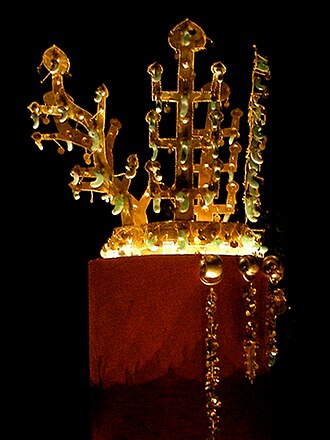
“No object from ancient Korea speaks more powerfully of royal majesty than the shimmering golden crowns unearthed from the tumuli of Gyeongju — monuments not only to wealth, but to a civilization at the height of its creative power.”
Among the most breathtaking artifacts ever recovered from Korean soil, the golden crowns of the Silla Kingdom stand in a category entirely their own. Excavated from burial mounds scattered across the ancient capital of Gyeongju, these extraordinary objects have captivated historians, archaeologists, and art lovers for over a century. Crafted from thin sheets of hammered gold and adorned with jade ornaments and dangling gold spangles, they represent the pinnacle of Silla craftsmanship and offer a rare, glittering window into the royal culture of one of Korea’s Three Kingdoms.
The Silla Kingdom, which dominated the southeastern Korean peninsula from 57 BCE and eventually unified the peninsula in 668 CE, is remembered today as much for its artistic legacy as for its political achievements. And nowhere is that legacy more vivid than in the golden crowns its rulers carried with them — literally — into the afterlife.
Quick Facts: The Crowns of Silla
| Detail | Information |
|---|---|
| Kingdom | Silla (57 BCE – 935 CE) |
| Period of Production | Approximately 5th–6th century CE |
| Primary Material | Hammered gold sheet, jade (gogok), gold spangles |
| Discovery Sites | Tumuli (burial mounds) in Gyeongju, North Gyeongsang Province |
| Key Examples | Gold Crown from Geumgwanchong, Gold Crown from Cheonmachong, Gold Crown from Hwangnamdaechong |
| Current Location | National Museum of Korea (Seoul); Gyeongju National Museum |
| National Treasure Status | Designated National Treasures of South Korea |
What Makes the Silla Crowns So Remarkable?
At first glance, a Silla crown appears almost impossibly delicate — a confection of gold so thin and intricate that it seems unlikely to have survived more than fifteen centuries underground. Yet survive they did, emerging from royal burial mounds in extraordinary condition. The crowns typically consist of a circular gold headband from which rise several tall, tree-shaped or antler-shaped uprights. Hanging from these uprights and from the headband itself are comma-shaped jade pendants known as gogok, alongside dozens of small, leaf-shaped gold spangles that would have caught the light and shimmered with every movement of the wearer.
The upright ornaments are one of the crowns’ most distinctive features. Scholars have long debated their symbolic meaning. The branching, tree-like forms have been interpreted by some researchers as representations of the cosmic tree or world tree — a concept found across Eurasian shamanic traditions — suggesting that Silla rulers may have held both political and spiritual authority. Others have pointed to similarities with antler motifs found among nomadic cultures of the Central Asian steppes, hinting at deep cultural exchanges along ancient trade routes long before the Silk Road became widely known.
The gogok, or comma-shaped jade pieces, add another layer of symbolic richness. This distinctive curved jewel form appears across ancient Korean and Japanese cultures and is associated with spiritual protection and vitality. On the Silla crowns, they appear in vivid green, suspended from gold wires so that they sway and catch the light alongside the gold spangles.
“The Silla crowns are not merely jewelry — they are cosmological statements, announcing the wearer’s place at the center of the universe, between heaven and earth.”
The Great Tumuli of Gyeongju: Where the Crowns Were Found
The crowns were not discovered in a single dramatic moment but emerged gradually over the course of the twentieth century as archaeologists systematically excavated the great burial mounds — known as tumuli — that still dot the landscape of Gyeongju, the ancient Silla capital. These mounds, some rising to considerable heights, were constructed to inter Silla royalty and aristocracy along with the objects they would need in the afterlife. The sheer quantity and quality of goods buried within them speaks to the enormous wealth commanded by the Silla elite.
Among the most significant excavations were those of Geumgwanchong (the Tomb of the Gold Crown), Cheonmachong (the Heavenly Horse Tomb), and Hwangnamdaechong (the Great Tomb at Hwangnam). Each of these mounds yielded not only crowns but a staggering array of gold belts, earrings, bracelets, glass vessels, bronze mirrors, iron weapons, and horse trappings — together painting a portrait of a society that invested tremendous energy and resources in honoring its dead.
Geumgwanchong, excavated in 1921, was the first tomb to yield a complete gold crown and gave its name to the entire category of burial site. The crown recovered there remains one of the finest examples known, with five upright ornaments rising from its headband and an exceptional number of jade and gold pendants. Cheonmachong, excavated in 1973, is famous not only for its gold crown but for the extraordinary birch bark painting of a galloping horse — the cheonma or heavenly horse — that gave the tomb its name and has become one of the most iconic images of ancient Korean art.
3 Reasons the Silla Crowns Matter to Korean History
1. They Reveal the Power Structure of Silla Society
The fact that such extravagant objects were produced at all — and buried rather than recycled — tells us something fundamental about Silla society. Only a ruling class of immense wealth and authority could command the resources necessary to commission, create, and then permanently inter such masterworks. The crowns are tangible evidence of a hierarchical society in which royal status was expressed through the conspicuous display of gold.
2. They Connect Korea to a Wider Eurasian World
The stylistic elements of the Silla crowns — particularly the tree and antler forms of the uprights and the comma-shaped jade pendants — have parallels across a vast geographic range, from the Korean peninsula westward through Central Asia. This suggests that Silla, despite its position at the eastern edge of the continent, was not culturally isolated. Goods, ideas, and artistic conventions flowed along networks connecting Korea to the broader Eurasian world during the first millennium CE.
3. They Demonstrate Extraordinary Metalworking Skill
The technical achievement represented by the Silla crowns is considerable. Working without modern tools, Silla goldsmiths hammered gold into thin, even sheets, cut intricate shapes, and assembled complex structures capable of holding their form across more than a thousand years. The precision of the work, and the aesthetic sensibility it reflects, confirms that Silla had artisan workshops of the highest order — craftspeople whose skill rivaled anything being produced elsewhere in the ancient world.
Comparison: Silla Gold Crowns and Other Ancient Royal Crowns
| Feature | Silla Crowns (Korea) | Tutankhamun’s Crown (Egypt) | Scythian Gold Crowns (Central Asia) |
|---|---|---|---|
| Primary Material | Hammered gold sheet | Gold, glass, semi-precious stones | Gold with animal motifs |
| Symbolic Form | Tree / antler uprights, comma jade | Uraeus serpent, sun disk | Animal style, naturalistic forms |
| Found In | Royal burial mounds (tumuli) | Royal tomb (Valley of the Kings) | Burial kurgans on the steppe |
| Approximate Period | 5th–6th century CE | 14th century BCE | 7th–3rd century BCE |
| Cultural Significance | Royal authority, shamanic cosmology | Divine kingship, solar worship | Warrior prestige, nomadic identity |
Where Can You See the Silla Crowns Today?
Several of the most important Silla gold crowns are on permanent display and accessible to visitors. The National Museum of Korea in Seoul holds outstanding examples, including pieces from Geumgwanchong, and presents them as centerpieces of its ancient Korean art collection. In Gyeongju itself, the Gyeongju National Museum maintains a dedicated collection of artifacts from the local tumuli, allowing visitors to see the crowns in the context of the landscape from which they were recovered. The surrounding Gyeongju Historic Areas, a UNESCO World Heritage Site, preserves the burial mounds themselves, some of which remain unexcavated — meaning the full story of Silla’s golden royalty may not yet be complete.
For those unable to travel to Korea, high-quality photographic resources and scholarly discussions of the crowns are available through institutions including the Academy of Korean Studies and Britannica’s coverage of ancient Korean art. However, there is genuinely no substitute for standing before one of these objects in person — watching the gold spangles catch the light and imagining the figure of a Silla ruler, fifteen centuries ago, wearing this crown as a declaration of their place between the human and the divine.
Continue Exploring
On Coreaverse
- The Gyeongju Historic Areas: Walking Through Silla’s Ancient Capital
- The Three Kingdoms of Korea: Silla, Baekje, and Goguryeo Explained
- Korean Gold and Jade: The Art of Ancient Korean Adornment