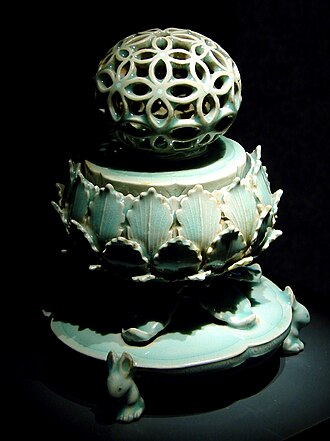
“The first is the bluish-green color of Goryeo celadon.”
— Song dynasty Chinese connoisseur Taiping Laoren, 12th century, naming Korean celadon among the world’s finest wonders
Few objects from Korean history carry the quiet authority of a piece of Goryeo celadon. Set before you, a celadon wine ewer or incense burner gleams with a color that centuries of admirers have struggled to put into words — jade-like, yet not jade; green, yet threaded with grey-blue; luminous, yet somehow soft. This was not an accident of the kiln. It was the hard-won result of generations of Korean potters pushing the boundaries of ceramic technology, aesthetic refinement, and artistic invention during the Goryeo dynasty (918–1392).
Korean pottery and porcelain represent one of the peninsula’s most enduring contributions to world art. Spanning thousands of years — from Neolithic earthenware to Joseon-era white porcelain — Korean ceramic traditions have continually evolved, absorbing outside influences and transforming them into something distinctly Korean. But it is celadon, above all, that has captured the imagination of collectors, historians, and museum-goers around the world.
Quick Facts: Korean Celadon at a Glance
| Feature | Detail |
|---|---|
| Primary Dynasty | Goryeo (918–1392) |
| Korean Name | Cheongja (청자) |
| Defining Color | Jade-green (bisque-fired with iron-oxide glaze) |
| Peak Period | 12th–13th centuries |
| Key Innovation | Sanggam inlay technique (상감) |
| Successor Tradition | Joseon white porcelain (Baekja, 백자) |
| Major Production Center | Gangjin, South Jeolla Province |
Origins: Where Did Korean Celadon Begin?
The story of Korean celadon begins in the late Unified Silla period and accelerates dramatically in the early Goryeo era. Korean potters first encountered celadon techniques through contact with Chinese kilns, particularly those of the Yue ware tradition from southern China. Early Goryeo celadon from the 10th and early 11th centuries closely resembles its Chinese predecessors in form and glaze — the exchange of technology and aesthetic ideas between the two cultures was vigorous and well-documented.
Yet Korean potters did not simply copy what they saw. Working with local clays and developing their own kiln structures, they began modifying the firing process to produce effects unique to the peninsula. By the mid-11th century, Goryeo celadon was already developing its own character, and by the 12th century, it had achieved a glaze color and surface quality that even Chinese critics acknowledged as extraordinary.
The heart of celadon production settled in the southwestern coastal region, particularly around Gangjin in what is today South Jeolla Province. Archaeological excavations at kiln sites in Gangjin have yielded thousands of sherds and intact pieces that trace the full arc of Goryeo celadon’s rise and transformation. The area’s fine clays, abundant wood for firing, and access to coastal trade routes made it an ideal center for this demanding craft.
The Jade-Green Glaze: A Technology of Beauty
The color that made Goryeo celadon famous — that elusive, luminous jade-green — was no simple achievement. It depended on precise control of the kiln atmosphere, the iron content of the glaze, the firing temperature, and the quality of the clay body beneath. Too much oxygen in the kiln and the iron in the glaze would oxidize, turning brown or yellow. Too little, and the reduction atmosphere would pull the color toward the coveted grey-green that Goryeo potters and their admirers prized above all.
Korean potters became masters of reduction firing — a process in which oxygen is limited inside the kiln at critical moments, causing chemical changes in the glaze that produce the characteristic color. The finest pieces achieve a depth and translucency in their glaze that seems almost alive, shifting in tone as light moves across the surface. This quality — called biy색 in Korean, meaning the color of kingfisher feathers — was the most celebrated attribute of the best Goryeo pieces.
“The subtle, jade-like quality of the finest Goryeo celadon glaze was achieved through an exceptional command of reduction firing — a mastery that even contemporary Chinese potters recognized as surpassing their own tradition.”
Beyond color, Goryeo potters developed a remarkable range of decorative techniques. Early pieces relied on incised or carved designs — lotus flowers, cranes, clouds, and willow trees pressed or cut into the clay before glazing. These motifs carried deep symbolic weight in the Buddhist and aristocratic culture of the Goryeo court, which was the primary patron of the finest wares.
3 Reasons Goryeo Celadon Stands Apart in World Ceramic History
1. The Invention of Sanggam Inlay
The most celebrated innovation of Goryeo potters was the development of the sanggam (상감) inlay technique, which appears to have been refined in Korea during the 12th century. In this process, a potter would carve a design into the leather-hard clay, then fill the carved channels with white or black slip (liquid clay) before smoothing the surface and applying the celadon glaze. When fired, the contrasting slip colors showed through the translucent glaze, creating intricate two-tone designs of extraordinary delicacy.
The sanggam technique allowed Goryeo potters to achieve a level of pictorial detail on ceramic surfaces that was simply unprecedented in East Asian pottery at the time. Scenes of cranes flying among clouds, willows bending over water, and lotus blossoms unfolding across the surface of wine ewers and cosmetic boxes became the hallmarks of the finest 12th and 13th century production. This was not borrowed from China — it was a Korean invention, and it represents one of the most original contributions to world ceramic history.
2. The Breadth of Forms Produced
Goryeo celadon was not limited to a single category of vessel. Potters produced an astonishing range of forms tailored to the needs of the Goryeo aristocracy and Buddhist institutions: wine ewers and cups, incense burners shaped like lions or lotus blossoms, oil bottles, cosmetic boxes, pillow rests, brush washers, and even roof tiles for Buddhist temples. Some of the most celebrated surviving pieces are shaped entirely as sculptural objects — a celadon ewer in the form of a bamboo shoot, or an incense burner modeled as a turtle supporting a lotus-bud lid.
This variety reflects both the technical mastery of Goryeo potters and the sophisticated patronage network that supported them. The Goryeo court and its aristocracy demanded objects of refinement and novelty, and the kilns of Gangjin and elsewhere delivered.
3. International Recognition in Its Own Time
It is remarkable that Goryeo celadon was celebrated not only within Korea but across East Asia during its peak period. Chinese writers of the Song dynasty commented admiringly on the quality of Korean ceramics, and celadon pieces circulated as diplomatic gifts and luxury trade goods. The 12th-century Chinese writer Taiping Laoren placed the color of Goryeo celadon at the very top of his list of the world’s finest things — a remarkable tribute from a culture that considered itself the supreme authority on ceramic arts.
Decline, Transition, and the Rise of White Porcelain
The Mongol invasions of the 13th century dealt a devastating blow to the sophisticated patronage networks and specialized kiln operations that had sustained the finest Goryeo celadon. Production continued, but the quality of the best pieces never fully recovered. Wares became simpler, the glaze color less refined, the decoration less meticulous. This gradual decline tracks closely with the broader political and social disruptions of the late Goryeo period.
When the Joseon dynasty was established in 1392, it brought with it a new cultural and aesthetic sensibility. Joseon’s ruling Confucian elite favored restraint and moral seriousness over the elaborate decoration associated with the Buddhist-inflected culture of Goryeo. White porcelain — called baekja (백자) — became the prestige ware of the new dynasty. Its clean, unadorned surface was seen as an embodiment of Confucian virtue: honest, unaffected, pure.
Yet celadon did not disappear overnight. A transitional ware known as buncheong (분청사기) emerged in the early Joseon period, combining the grey-green clay body of celadon with bolder, more freely painted decoration in white slip. Buncheong wares have their own distinctive charm — rougher, more spontaneous, and intensely regional in character — before white porcelain eventually dominated the ceramic landscape of Joseon Korea.
Comparison: Goryeo Celadon vs. Joseon White Porcelain
| Feature | Goryeo Celadon (청자) | Joseon White Porcelain (백자) |
|---|---|---|
| Dynasty | Goryeo (918–1392) | Joseon (1392–1897) |
| Dominant Color | Jade-green | Pure white |
| Cultural Context | Buddhist aristocratic court | Confucian scholar-official elite |
| Key Decoration | Sanggam inlay, carved motifs | Underglaze cobalt blue, iron |
| Aesthetic Ideal | Refinement, elegance, naturalism | Restraint, purity, moral clarity |
| Peak Period | 12th–13th centuries | 15th–18th centuries |
| Major Kiln Centers | Gangjin, Buan | Gwangju (Gyeonggi), Bunwon |
Why Does Korean Celadon Still Matter Today?
Goryeo celadon survives in museum collections around the world — in Seoul’s National Museum of Korea, in the Metropolitan Museum of Art in New York, in the Victoria and Albert Museum in London, and in dozens of other institutions. Each piece that has survived eight centuries is a small miracle, given the fragility of ceramic objects and the turbulent history of the Korean peninsula.
In Korea today, the tradition is alive in a different sense. Gangjin hosts an annual celadon festival, and contemporary Korean potters continue to study and experiment with the techniques of the Goryeo masters. The Korean government has designated numerous celadon pieces as National Treasures, and the kiln sites of Gangjin are recognized for their outstanding historical significance. Scholarly and archaeological work at these sites continues to deepen our understanding of how the original potters achieved their remarkable results.
For historians and art lovers alike, Goryeo celadon represents something beyond mere aesthetic achievement. It is evidence of a civilization at a peak of creative confidence — one that absorbed the best of what the wider East Asian world had to offer, and then surpassed it. The jade-green glaze that Song dynasty critics admired in the 12th century still stops viewers in their tracks today, across the distance of nine hundred years.