“I still have twelve ships.”
— Admiral Yi Sun-sin, before the Battle of Myeongnyang, 1597
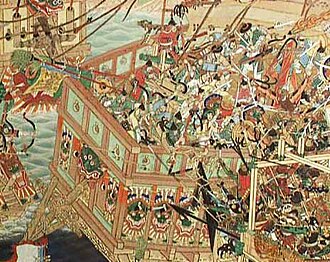
On October 26, 1597, in a narrow strait off the southwestern coast of the Korean peninsula, one of history’s most astonishing military upsets unfolded. Admiral Yi Sun-sin, commanding a fleet of just 13 warships, confronted a Japanese naval force of more than 130 warships. Against all logic and expectation, the Korean fleet did not simply survive — it won decisively. The Battle of Myeongnyang (명량대첩) stands today as a defining moment in Korean history: a testament to tactical brilliance, extraordinary courage, and the unyielding will of a single commander who refused to yield even when all seemed lost.
Quick Facts: The Battle of Myeongnyang
| Date | October 26, 1597 |
|---|---|
| Location | Myeongnyang Strait (Uldolmok), near Jindo Island, Jeollanam-do |
| Korean Commander | Admiral Yi Sun-sin |
| Korean Fleet Size | 13 warships (some sources note 1 additional vessel in reserve) |
| Japanese Fleet Size | Over 130 warships |
| Outcome | Decisive Korean victory |
| Conflict | Imjin War (Japanese invasions of Korea, 1592–1598) |
| Significance | Halted Japanese naval advance; protected Korea’s western supply lines |
The Road to Myeongnyang: How Korea’s Navy Was Left with 13 Ships
To understand the magnitude of what happened at Myeongnyang, one must first understand the desperate circumstances that preceded it. The Imjin War had begun in 1592 when Japanese forces under Toyotomi Hideyoshi invaded Korea with an enormous army. While Japanese land forces swept rapidly northward, Admiral Yi Sun-sin’s Joseon navy had consistently dominated at sea, winning a series of brilliant engagements that frustrated Japan’s ability to resupply its troops by water.
Yi’s record of naval victories — at Okpo, Sacheon, Hansando, and many other engagements — made him a revered figure and a serious obstacle to Japanese ambitions. His genius lay not only in bold tactics but in his mastery of the Korean turtle ship (geobukseon), an armored warship that proved devastatingly effective in battle. Yet politics would nearly undo what Japanese arms could not.
In 1597, Yi Sun-sin was arrested, tortured, and stripped of his command on charges that were largely the result of political intrigue and a Japanese deception operation designed to neutralize Korea’s most effective naval commander. He was demoted to the rank of common soldier. His replacement, Admiral Won Gyun, led the Joseon fleet to catastrophic defeat at the Battle of Chilchonryang in August 1597 — the only major naval defeat Korea suffered during the entire war. The fleet of over 100 ships was almost entirely destroyed. Korea’s naval dominance evaporated almost overnight.
With the situation desperate and the Japanese navy now free to operate along Korea’s western coast, the Joseon court had no choice but to reinstate Yi Sun-sin. He returned to command to find a shattered navy: just 12 to 13 warships remained. Royal advisors suggested abandoning the navy altogether and incorporating the sailors into the land army. Yi Sun-sin’s famous reply — that he still had twelve ships — became one of the most celebrated statements in Korean military history. He would fight with what he had.
Why Did Yi Sun-sin Choose the Myeongnyang Strait?
Facing odds of more than ten to one, Yi Sun-sin could not hope to win through conventional naval engagement. His genius lay in understanding that the battlefield itself could become his greatest weapon. He chose to make his stand at the Myeongnyang Strait, known today as Uldolmok, a narrow channel between the mainland and Jindo Island in what is now Jeollanam-do province.
The strait was one of the most hydrologically extreme waterways on the Korean peninsula. Strong tidal currents — among the fastest in Korea — surged through the narrow channel, reversing direction with the tides and reaching considerable speeds. The geography of the strait meant that a large fleet could not deploy its numerical advantage effectively: ships would be funneled into a narrow front, unable to maneuver, unable to flank, and at the mercy of the very currents Yi planned to exploit.
Yi studied the tidal patterns carefully. He knew that the current would first flow in a direction favorable to the Japanese advance, and then, as the tide turned, would reverse and work against them. His plan was to hold the Japanese fleet at the strait’s entrance during the favorable current — forcing them to fight in confined conditions — and then, as the tide reversed, use the new current to further disrupt the enemy fleet and press the advantage.
“The admiral did not simply fight the Japanese fleet. He made the sea itself fight for him.”
3 Reasons the Battle of Myeongnyang Was a Turning Point in the Imjin War
1. It Denied Japan Control of Korea’s Western Sea Routes
Japan’s strategic plan in the second phase of the invasion depended on moving troops and supplies along Korea’s western coastline toward the capital and beyond. A Japanese naval victory at Myeongnyang would have opened these sea lanes and dramatically accelerated the army’s advance. Yi’s victory slammed that door shut. Japanese land forces were left without reliable western maritime supply lines for the remainder of the war, severely limiting their operational capacity.
2. It Restored Korean Morale After the Disaster at Chilchonryang
The near-total destruction of the Joseon fleet at Chilchonryang had been a profound shock to Korean morale — both military and civilian. The return of Yi Sun-sin and his stunning victory at Myeongnyang demonstrated that the war was not yet lost and that Korean resistance could still produce decisive results against a far more powerful enemy. The battle reinvigorated the Korean war effort at a critical moment.
3. It Proved That Tactical Intelligence Could Overcome Numerical Inferiority
The Battle of Myeongnyang entered military history as a canonical example of using terrain, tidal conditions, and strategic positioning to neutralize an enemy’s numerical advantage. Yi Sun-sin’s exploitation of the Myeongnyang Strait’s powerful tidal currents remains one of the most studied examples of environmental battlefield awareness in East Asian military history. The battle demonstrated that a smaller, better-led force, fighting on ground of its own choosing, could defeat a vastly larger enemy.
The Battle Itself: October 26, 1597
As the Japanese fleet advanced into the strait, Yi Sun-sin’s flagship moved forward — alone at first, as the other Korean commanders hesitated. Yi reportedly led from the front, forcing his other ships to follow. The narrow waters of the Myeongnyang Strait prevented the Japanese fleet from spreading out and surrounding the Korean vessels. Instead, they were compelled to engage in a narrow-front battle, negating much of their numerical superiority.
Korean cannon fire raked the leading Japanese ships at close range. The powerful tidal current, flowing against the Japanese advance, disrupted their formation and made maneuvering difficult. Japanese ships crowded together in the narrow channel became entangled with one another, and the confusion in their ranks grew. As the tide turned and began flowing in the opposite direction, the situation deteriorated further for the Japanese.
Among the Japanese casualties was a senior commander, whose death further demoralized the attacking fleet. The Japanese eventually broke off the engagement and withdrew. Korean records indicate that dozens of Japanese warships were sunk or destroyed. Yi Sun-sin’s 13 ships emerged from the battle without the loss of a single vessel.
Yi Sun-sin’s Legacy and the Battle in Korean Memory
The Battle of Myeongnyang secured Yi Sun-sin’s place as Korea’s most celebrated military hero — a status he holds to this day. He went on to fight further engagements as the Imjin War moved toward its conclusion, dying in battle at the decisive Battle of Noryang in November 1598, reportedly his last words being a request that news of his death not be announced until after the battle was won.
In modern Korea, Yi Sun-sin is commemorated everywhere. A large statue of the admiral stands at the heart of Gwanghwamun Square in central Seoul. The Myeongnyang strait itself, and the nearby area around Jindo Island, attracts visitors who come to walk the ground where the battle was fought. The 2014 Korean film The Admiral: Roaring Currents, based on the Battle of Myeongnyang, became the highest-grossing film in Korean cinema history at the time of its release, demonstrating the enduring grip the battle holds on Korean cultural imagination.
The battle is taught in Korean schools as a foundational event in national history — proof that resourcefulness, intelligence, and refusal to surrender can overcome seemingly impossible odds. For a peninsula that has faced repeated threats to its existence across the centuries, the Battle of Myeongnyang carries a meaning that extends well beyond military history.
Visiting the Myeongnyang Strait Today
The site of the battle is accessible today near Jindo in Jeollanam-do province. The Myeongnyang Battle Historic Site commemorates the engagement, and visitors can observe the famous Uldolmok tidal current — still one of the strongest in Korea — that played so decisive a role in Yi Sun-sin’s victory. The Korea National Maritime Museum is located nearby in Mokpo, offering further context on Korea’s extraordinary naval history during the Joseon period.
Standing at the strait today, watching the powerful currents surge through the narrow channel, it becomes easier to understand how a great commander could look at thirteen ships and a roaring stretch of sea — and see, not defeat, but victory.