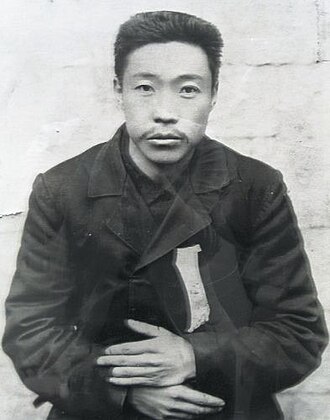
“I devoted my life to recovering my country’s independence and to promoting peace in East Asia.”
Few figures in Korean history provoke as much reverence and emotion as An Jung-geun (안중근). Born in 1879 and executed at just thirty years of age, he spent his brief life in passionate resistance to Japan’s creeping annexation of Korea. His assassination of Itō Hirobumi — the first Resident-General of Korea and one of the architects of Japanese imperial policy — at Harbin Station on 26 October 1909 transformed him instantly into a symbol of Korean dignity and self-determination. More than a century later, his name remains synonymous with patriotism, sacrifice, and the refusal to submit to colonial rule.
Quick Facts: An Jung-geun at a Glance
| Detail | Information |
|---|---|
| Born | 2 September 1879, Haeju, Hwanghae Province, Joseon Korea |
| Died | 26 March 1910, Lüshun (Port Arthur) Prison, Manchuria |
| Religion | Roman Catholic (baptised Thomas) |
| Known For | Assassination of Itō Hirobumi at Harbin Station, 26 October 1909 |
| Clan | Sunheung An clan |
| Legacy | National martyr of Korea; awarded Order of Merit for National Foundation (posthumous) |
Early Life: A Family Shaped by Faith and Principle
An Jung-geun was born on 2 September 1879 in Haeju, in the Hwanghae Province of what was then the Joseon Kingdom. He came from a prominent family of the Sunheung An clan. His father, An Tae-hun, was a man of significant local standing and a devout convert to Roman Catholicism — a faith that would profoundly shape the young An Jung-geun’s moral outlook and sense of justice.
An received a classical Confucian education in his childhood, studying Chinese literature and the foundational texts that defined elite Korean culture of the era. However, alongside his scholarly formation, he also developed a love of martial arts and marksmanship from a young age — skills that would later serve a far graver purpose than he could have imagined as a boy. He was baptised into the Catholic Church and took the Christian name Thomas, a name he would carry throughout his adult life and sign proudly on the remarkable calligraphy works he produced in prison.
Why Did An Jung-geun Take Up Armed Resistance?
To understand An Jung-geun’s path from Catholic gentleman to armed independence fighter, one must understand the catastrophic geopolitical shifts Korea experienced in the first decade of the twentieth century. Following Japan’s victory in the Russo-Japanese War of 1904–05, Korea was forced to sign the Eulsa Treaty of 1905, stripping the country of its diplomatic sovereignty and placing it under the control of a Japanese Resident-General. Itō Hirobumi, a towering figure in Meiji Japan’s political landscape, served as that first Resident-General and was widely regarded as the primary force driving Korea toward full annexation.
For An Jung-geun, this was not merely a political crisis — it was a moral catastrophe. He had already been deeply involved in educational and enlightenment movements in Korea, helping to establish schools in an effort to build a stronger, more capable Korean society. When those peaceful efforts proved insufficient against the relentless pressure of Japanese imperialism, he moved to the Russian Far East, joining Korean independence fighters operating across the border. He participated in armed guerrilla operations against Japanese forces in the region, fighting as part of the Righteous Army (의병, Uibyeong) movement.
“Even if my body dies, the spirit of independence will never perish.”
It was from within this broader context of organised armed resistance — not as a lone fanatic but as a soldier in a cause — that An Jung-geun’s most famous act emerged. He and a small group of fellow activists identified Itō Hirobumi’s scheduled arrival at Harbin Station as a historic opportunity. An Jung-geun volunteered for the mission.
Harbin Station: The Moment That Changed History
On the morning of 26 October 1909, Itō Hirobumi arrived at Harbin Station in Manchuria (then part of Russian-controlled territory) for a meeting with the Russian Finance Minister Vladimir Kokovtsov. An Jung-geun had positioned himself among the crowd on the platform, dressed in Western clothing that allowed him to blend in with the international throng of onlookers and journalists.
As Itō walked along the platform reviewing Russian honour guards, An Jung-geun stepped forward and fired three shots from a Browning pistol, striking Itō. He then fired additional shots, wounding three members of Itō’s entourage. Itō Hirobumi died of his wounds approximately thirty minutes later. An Jung-geun was immediately apprehended by Russian military police on the scene.
His first act upon being seized, according to multiple accounts, was to shout “Daehan Dongnip!” — Long live Korean independence — in Russian, so that the international witnesses present could understand his motivation. It was a declaration, not an escape attempt. He had never intended to flee.
Trial, Calligraphy, and a Final Statement
An Jung-geun was transferred to Japanese custody and tried at the Lüshun (Port Arthur) District Court. The trial, conducted under Japanese jurisdiction, lasted only a matter of days. An Jung-geun did not deny his actions; instead, he used the proceedings as a platform to articulate his political philosophy and to argue that his act was that of a soldier fighting for his nation, and that he should therefore be treated as a prisoner of war rather than a common criminal.
During his months of imprisonment awaiting execution, An Jung-geun produced an extraordinary body of calligraphy work. Writing in classical Chinese, he created hundreds of pieces — proverbs, poems, and original aphorisms — that were sought after and treasured by Japanese prison staff and officials who witnessed his execution. Each piece was signed with his left handprint, missing the tip of his ring finger, which he had ritually cut off in 1909 as a pledge of dedication to Korean independence alongside eleven other activists. These calligraphy works survive today as treasured national relics in Korea.
He also used his time in prison to write an ambitious treatise on East Asian peace, titled Dongyang Pyeonghwaron (A Discourse on Peace in East Asia). He was unable to complete it before his execution on 26 March 1910, but the portions that survive reveal a sophisticated thinker who believed that Japan, Korea, and China should cooperate as equals to resist Western imperialism — and that Japan’s violent subjugation of Korea was a betrayal of that shared destiny.
Comparing Two Legacies: An Jung-geun in Korea and Japan
| Aspect | Korea’s View | Japan’s View |
|---|---|---|
| Status | National hero and martyr | Historically referred to as an assassin or criminal |
| Commemorations | Statues, museums, national memorial day | Limited; remains a sensitive diplomatic topic |
| His Writings | Studied in schools; calligraphy displayed in museums | Some Japanese scholars have written sympathetically of his philosophy |
| Diplomatic Impact | Central to Korean national identity and Japan-Korea relations | His memorial at Harbin Station remains a recurring point of bilateral tension |
Death and Enduring Legacy
An Jung-geun was executed by hanging at Lüshun Prison on 26 March 1910 — just five months before Japan formally annexed Korea in August 1910. He was thirty years old. His final request was that his remains be buried in Harbin and later returned to Korea once independence was achieved. That wish has not yet been fulfilled: his burial site remains unknown, a fact that continues to pain Koreans and drive ongoing efforts by both the South Korean government and researchers to locate his remains.
The Republic of Korea posthumously awarded An Jung-geun its highest honour, the Order of Merit for National Foundation. Memorials, statues, and dedicated museums stand in his name across South Korea. Perhaps most poignantly, a memorial hall was established at Harbin Station in 2014 — at the very location where he carried out his act — following a request by the Chinese government in recognition of his historical significance in the region.
His calligraphy, his unfinished treatise on East Asian peace, and the story of his ring finger — severed as a pledge — have all passed into Korean cultural memory as powerful symbols. School children learn his name alongside that of Admiral Yi Sun-sin and Queen Seondeok. He appears in films, novels, and graphic novels. His image is displayed in homes. For many Koreans, he represents not violence, but the irreducible human need for dignity in the face of oppression.
Continue Exploring
- On This Site: The Joseon Dynasty: Korea’s Last Royal Era
- On This Site: The Righteous Army (Uibyeong): Korea’s Armed Resistance Movement
- An Jung-geun — Wikipedia
- Encyclopedia of Korean Culture — Academy of Korean Studies
- An Jung-geun — Britannica
- National Museum of Korea — Collections and Heritage
- Asia Society — Korean History and Culture Resources