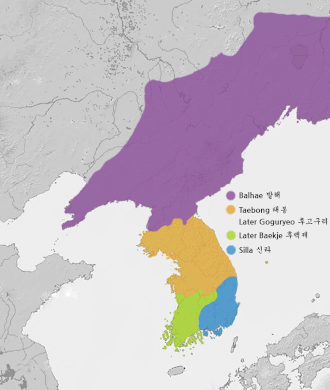
“From the ashes of a unified peninsula, three rival kingdoms rose — and only one would survive to forge a new Korea.”
In the late ninth and early tenth centuries, the Korean peninsula descended into one of its most turbulent eras. The kingdom of Unified Silla, which had dominated the peninsula since 668 CE, began to collapse under the weight of aristocratic infighting, regional rebellions, and economic hardship. What followed was a period historians call the Later Three Kingdoms — a time when three competing powers tore Korea apart and then, through decades of war and political maneuvering, forged it anew under a single dynasty that would define the very name of the country we know today.
This era, spanning roughly from 900 to 936 CE, is short in calendar years but enormous in historical significance. It marks the death of ancient Silla, the birth and destruction of two new kingdoms, and the rise of Goryeo — the state from which the name “Korea” is derived.
Quick Facts: The Later Three Kingdoms at a Glance
| Detail | Information |
|---|---|
| Period | Approximately 900–936 CE |
| Predecessor State | Unified Silla (668–935 CE) |
| Three Kingdoms | Later Silla, Later Baekje, Taebong (Later Goguryeo) |
| Key Figures | Gyeon Hwon, Gung Ye, Wang Geon |
| Outcome | Reunification under Goryeo in 936 CE |
| Location | Korean Peninsula |
| Historical Significance | Foundation of the Goryeo dynasty; origin of the name “Korea” |
The Collapse of Unified Silla
To understand the Later Three Kingdoms, one must first understand why Unified Silla fell apart. For over two centuries after its dramatic unification of the peninsula with Tang Chinese support, Silla had been a powerful and sophisticated state, centered on its magnificent capital Gyeongju. Silla’s bone-rank system — a rigid hereditary aristocracy — had long governed who could hold power, what rank they could achieve, and even what kind of house they could live in.
By the late ninth century, however, this rigid system had become a source of deep instability. Succession disputes among the Silla royal family grew violent and frequent. In the decades between 780 and 912, more than twenty kings sat on the throne — many through assassination or coup rather than orderly succession. Meanwhile, powerful regional lords, called hojok, had accumulated land, armies, and local loyalty, effectively becoming autonomous rulers in all but name.
The peasantry, crushed by heavy taxation and neglected by a central government consumed by its own power struggles, began to revolt. Bandit leaders and local strongmen seized territory. Into this fracturing landscape stepped two ambitious men who would each claim the mantle of a fallen ancient kingdom.
Three Powers Emerge: Who Were the Rivals?
The Later Three Kingdoms period takes its name from the three ancient kingdoms that had preceded Silla’s unification — Goguryeo, Baekje, and Silla — because the two new rebel states deliberately invoked those ancient identities to legitimize their claims.
Later Baekje was founded around 900 CE by Gyeon Hwon, a former Silla military officer who had risen to power in the southwestern region of the peninsula — the territory of the old Baekje kingdom. Gyeon Hwon was a formidable military commander with a deep personal grievance against the Silla aristocracy, and he declared himself the rightful successor to the ancient Baekje kings. His state was centered in the southwestern provinces, and at its height it was arguably the most militarily powerful of the three rivals. Gyeon Hwon launched devastating raids against Silla, including a shocking attack on the Silla capital Gyeongju in 927, during which he killed the reigning Silla king.
Taebong — also called Later Goguryeo or Majin at various points — was founded by a figure even more extraordinary and troubling: Gung Ye, a renegade Buddhist monk and alleged prince of the Silla royal family. Gung Ye built his power in the central and northern regions of the peninsula and declared himself the heir to Goguryeo. His reign, however, descended into erratic and brutal tyranny. He declared himself a living Buddha, demanded that his subjects bow to his “revelations,” and executed officials and family members on suspicion of disloyalty. His own generals eventually turned on him, and in 918 CE they overthrew Gung Ye and placed one of their own — a man named Wang Geon — on the throne.
Later Silla — the original Silla kingdom, now greatly weakened — clung to survival in the southeastern corner of the peninsula. Its kings were by this point largely powerless figures presiding over a shrinking realm, relying on the goodwill of local strongmen rather than any real royal authority.
“Wang Geon understood that conquest alone could not unify Korea — he also needed legitimacy, mercy, and the loyalty of people who had every reason to distrust a new ruler.”
Why Did Wang Geon Succeed Where Others Failed?
The rise of Wang Geon — posthumously known as Taejo of Goryeo, meaning “Grand Progenitor” — is one of the most studied questions in Korean medieval history. He came from a prosperous maritime trading family in the Kaesong region and had served as a capable general under Gung Ye. When his fellow generals installed him as king in 918, they were betting on his reputation for competence and decency over the madness of his predecessor.
Wang Geon renamed his kingdom Goryeo — a shortened form of Goguryeo — signaling both continuity with the northern kingdom’s legacy and a fresh start. He moved the capital to his home base of Kaesong (then called Songak). But it was his political strategy, not just his military campaigns, that ultimately determined the outcome of the Later Three Kingdoms struggle.
Several factors explain Wang Geon’s success:
4 Reasons Wang Geon Reunified the Peninsula
- Strategic leniency toward rivals. Wang Geon pursued a deliberate policy of mercy and accommodation toward those who submitted to Goryeo. Rather than executing or humiliating defeated leaders, he incorporated them into his court, gave them titles, and in many cases married into their families. He is recorded as having taken wives from numerous powerful regional clans — a form of political alliance-building through marriage that helped secure the loyalty of local strongmen across the peninsula.
- The surrender of Silla. In 935 CE, the last Silla king, Gyeongsun, voluntarily surrendered his kingdom to Goryeo. This was an extraordinary moment: a dynasty that had lasted for nearly a thousand years simply handed itself over. Wang Geon treated Gyeongsun with great honor, gave him a royal title, and allowed him to retain status and land. This peaceful absorption of Silla gave Goryeo enormous legitimacy and prevented a costly final war in the southeast.
- The self-destruction of Later Baekje. Gyeon Hwon, despite his military strength, was undone by a family crisis. In 934–935 CE, his sons engaged in a violent succession struggle. One son seized power, imprisoned Gyeon Hwon, and executed his brothers. Gyeon Hwon himself escaped captivity and — in a remarkable reversal — defected to his old enemy Wang Geon, offering his knowledge of Later Baekje’s military to help destroy his own kingdom. Wang Geon received Gyeon Hwon respectfully and used his intelligence to devastating effect.
- Military capability combined with diplomatic patience. Wang Geon was a skilled general, but he chose his battles carefully. Rather than overextending in costly campaigns, he built his military strength steadily, secured alliances, and waited for rivals to weaken themselves. When the final campaign against Later Baekje came in 936 CE, Goryeo’s forces were victorious, and the era of the Later Three Kingdoms came to an end.
How Does the Later Three Kingdoms Compare to the Original Three Kingdoms?
| Feature | Original Three Kingdoms (57 BCE–668 CE) | Later Three Kingdoms (900–936 CE) |
|---|---|---|
| Duration | Approximately 700 years | Approximately 36 years |
| Origins | Gradual tribal consolidation | Collapse of Unified Silla |
| Key Powers | Goguryeo, Baekje, Silla | Taebong/Goryeo, Later Baekje, Later Silla |
| Outside Involvement | Significant (Tang China, Sui China) | Minimal foreign intervention |
| Outcome | Unified Silla under Silla kingdom | Goryeo dynasty under Wang Geon |
| Legacy | Defined early Korean state formation | Gave Korea its modern name |
The Legacy: Why Does This Period Still Matter?
The Later Three Kingdoms period may be brief compared to the centuries-long eras that preceded and followed it, but its legacy is profound and enduring. Most directly, it produced the Goryeo dynasty, which ruled the Korean peninsula from 918 to 1392 CE. It is from “Goryeo” that the Western name “Korea” ultimately derives — a linguistic thread connecting a tenth-century warrior-king’s choice of a name to the country’s identity today.
The period also established patterns of governance that Goryeo would carry forward. Wang Geon’s inclusive approach to unification — absorbing elites rather than destroying them, honoring traditions rather than erasing them — created a more broadly legitimate state than a purely military conquest would have allowed. His policies toward Buddhism, which he strongly patronized, set the tone for Goryeo’s deep identification with Buddhist culture and art.
The fall of Silla is also significant as a historical lesson. The bone-rank system, for all its early utility in organizing Silla society, became a fatal rigidity — a warning about what happens when hereditary privilege is so entrenched that it prevents capable people from rising and blocks necessary reform. The Later Three Kingdoms era was in many ways the inevitable result of Silla’s failure to adapt.
For modern Koreans, this period is also vivid in popular culture. The story of Wang Geon — his rise from general to king, his rivalry with the fearsome Gyeon Hwon, and the extraordinary moment when his former enemy defected to his side — has been dramatized in numerous Korean television historical dramas, novels, and films, keeping these tenth-century figures alive in the national imagination.
Archaeological and historical sites associated with this period, including the former Goryeo capital of Kaesong (now in North Korea), remain places of deep historical memory, even if access to them is restricted today.
Continue Exploring
Deepen your understanding of this pivotal era in Korean history with these carefully selected resources:
- Later Three Kingdoms — Wikipedia: Comprehensive overview of the period, its kingdoms, and key figures.
- Encyclopedia of Korean Culture (AKS): Authoritative Korean academic reference on the Later Three Kingdoms and the Goryeo founding.
- Wang Geon (Taejo of Goryeo) — Wikipedia: Detailed biography of the founder of the Goryeo dynasty.
- Korea: The Later Three Kingdoms — Britannica: Scholarly overview from Encyclopædia Britannica.
- National Museum of Korea: Explore artifacts from the Silla and early Goryeo periods in the museum’s online collections.
- Goryeo Dynasty — Asia Society: Introduction to the dynasty born from the Later Three Kingdoms unification.