“We hereby declare that Korea is an independent state and that Koreans are a self-governing people.”
Few moments in Korean history carry the emotional weight of the independence movement — a decades-long struggle by ordinary Koreans, exiled activists, students, farmers, and scholars who refused to accept the erasure of their nation. From the signing of the Japan-Korea Annexation Treaty in 1910 to the liberation of August 1945, Koreans at home and abroad mounted a remarkable, multifaceted resistance against one of Asia’s most powerful colonial empires. This is their story.
Quick Facts: The Korean Independence Movement
| Period | 1910–1945 (formal colonial period); resistance began as early as 1905 |
| Colonial Power | Empire of Japan |
| Key Event | March 1st Movement (Samil Movement), 1919 |
| Government in Exile | Provisional Government of the Republic of Korea, established Shanghai, April 1919 |
| Notable Figures | Yu Gwan-sun, Ahn Chang-ho, Kim Gu, Ahn Jung-geun |
| Liberation Date | August 15, 1945 |
| Modern Commemoration | March 1 is a national holiday in South Korea (Samil절) |
How Did Japan Come to Rule Korea?
To understand the independence movement, one must first understand how Korea lost its sovereignty. The process was gradual and deliberate. Following Japan’s victory in the Russo-Japanese War of 1904–1905, Korea was effectively reduced to a Japanese protectorate through the Eulsa Treaty of 1905, which stripped the Joseon court of its diplomatic autonomy. Korean Emperor Gojong refused to sign the treaty, declaring it invalid — but Japanese pressure proved insurmountable.
In 1910, the Japan-Korea Annexation Treaty formally absorbed Korea into the Japanese Empire. The Joseon Dynasty, which had governed the peninsula for over five centuries, was dissolved. Japanese authorities dismantled Korean institutions, suppressed the Korean language in schools and public life, and imposed a military-style administration known as the Government-General of Joseon. Land surveys conducted in the early colonial period dispossessed many Korean farmers, fueling deep rural resentment that would later energize mass protest.
Yet resistance began almost immediately. Righteous armies — uibyeong — that had first formed during the Japanese invasions of the 1590s were revived. Armed bands fought Japanese forces in the mountains and countryside, particularly between 1907 and 1910, before being suppressed with overwhelming military force. This early armed resistance gave way to new forms of struggle that would define the movement for decades.
The March 1st Movement: Korea’s Great Awakening
No single event defines the Korean independence movement more powerfully than the Samil (March 1st) Movement of 1919. The immediate context was the death of former Emperor Gojong in January 1919 and the global atmosphere created by Woodrow Wilson’s Fourteen Points, which promised national self-determination to peoples around the world. Korean activists, inspired by Wilson’s rhetoric and emboldened by grief over the emperor’s passing, organized a coordinated nationwide demonstration.
On March 1, 1919, thirty-three cultural and religious leaders — including Christians, Buddhists, and Cheondogyo followers — gathered in Seoul’s Taehwagwan restaurant and read aloud the Korean Declaration of Independence. Simultaneously, tens of thousands of Koreans took to the streets in Seoul and across the peninsula. The demonstrations spread rapidly: over the following weeks and months, protests erupted in cities, towns, and villages from Pyongyang to Busan. Historians estimate that somewhere between one and two million people participated in the movement across the country.
“Though we may be defeated in body, our spirit shall never be conquered.”
The Japanese colonial government responded with brutal force. Soldiers and police fired on crowds, massacred villagers, and burned churches where protesters had gathered. Estimates of those killed range from several hundred to several thousand, with tens of thousands arrested. Among the arrested was a nineteen-year-old student activist from Chungcheong Province named Yu Gwan-sun, who became one of the movement’s most enduring symbols. She continued to lead protests from inside prison and died in detention in September 1920 from injuries sustained during torture.
Despite its suppression, the March 1st Movement was not a failure. It forced Japan to shift from its harshest “military rule” phase to a somewhat more permissive “cultural rule” policy. More importantly, it galvanized Koreans worldwide and directly led to the establishment of the Provisional Government of the Republic of Korea.
The Provisional Government and the Diaspora Struggle
Just weeks after the March 1st Movement, Korean independence leaders meeting in Shanghai established the Provisional Government of the Republic of Korea in April 1919. This government-in-exile operated out of the French Concession in Shanghai for much of its existence, providing an organizational center for the independence movement and presenting Korea’s case to the international community.
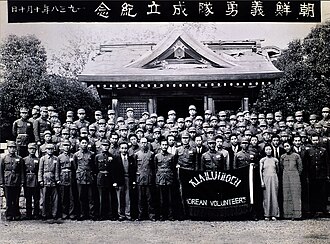
The Provisional Government appointed Syngman Rhee as its first president and later came under the leadership of Kim Gu, one of the most resolute independence advocates of the era. Kim Gu organized armed resistance operations, including the Korean Liberation Army, which cooperated with Allied forces during World War II. The Provisional Government formally declared war on Japan and Germany following the attack on Pearl Harbor in December 1941.
Independence activists operated not only from Shanghai but from communities across Manchuria, Siberia, the United States, and Hawaii. In Manchuria, Korean guerrilla units battled Japanese forces through the 1930s. Among the commanders of these units was a young man named Kim Il-sung, who would later emerge as the leader of North Korea — a reminder of how the independence movement produced figures whose legacies diverged sharply after liberation.
In the United States, Ahn Chang-ho founded the Heungsadan (Young Korean Academy) in 1913, promoting education, moral cultivation, and national consciousness among overseas Koreans. He argued that independence required not only political struggle but the deep transformation of Korean society and individual character. His philosophy influenced generations of Korean thinkers and activists.
3 Forms the Independence Struggle Took
1. Non-Violent Mass Protest
The March 1st Movement exemplified peaceful mass demonstration as a tool of resistance. Organizers explicitly instructed participants to remain nonviolent, and the Declaration of Independence itself called for orderly, dignified protest. This tradition of civic mobilization left a lasting imprint on Korean political culture.
2. Armed Guerrilla Resistance
Across Manchuria and the mountains of the Korean peninsula, Korean fighters engaged Japanese forces in direct combat. The Righteous Armies of the early colonial period gave way to more organized guerrilla units in the 1920s and 1930s. These fighters endured extraordinary hardship — brutal winters, constant Japanese pursuit, and limited supplies — in their determination to keep military resistance alive.
3. Diplomatic and Cultural Activism
Korean independence leaders worked tirelessly to bring their cause before the international community. Emissaries traveled to the Paris Peace Conference in 1919, though their appeals were ultimately ignored by the great powers. Writers, poets, and educators preserved the Korean language, history, and cultural identity as acts of quiet resistance against colonial assimilation policies. The preservation of Hangul — targeted by Japanese suppression — became a patriotic cause in itself.
Comparing Tactics: Inside Korea vs. The Diaspora
| Dimension | Resistance Inside Korea | Diaspora Resistance Abroad |
|---|---|---|
| Main Methods | Mass protests, strikes, cultural preservation, underground publishing | Diplomatic lobbying, guerrilla military units, fundraising, international advocacy |
| Key Organizations | Cheondogyo, Christian networks, student groups | Provisional Government (Shanghai), Heungsadan (USA), Manchurian guerrilla units |
| Greatest Risk | Arrest, torture, imprisonment, execution under Japanese colonial law | Statelessness, poverty, infiltration by Japanese intelligence |
| Symbolic Figures | Yu Gwan-sun, the Thirty-Three Representatives | Kim Gu, Ahn Chang-ho, Syngman Rhee |
| Impact | Demonstrated mass popular resistance; forced policy changes | Maintained international visibility of Korean cause; built liberation army |
Liberation and the Movement’s Contested Legacy
Korea’s liberation on August 15, 1945, came not through the independence movement’s military campaigns alone, but through Japan’s surrender to the Allied powers following the atomic bombings of Hiroshima and Nagasaki. This circumstance — liberation from outside rather than from within — has shaped debates about the movement’s legacy ever since.
Yet the significance of the independence movement extends far beyond its immediate military or political outcomes. It forged a modern Korean national consciousness, created the vocabulary of Korean republican democracy, and produced martyrs and heroes whose memory continues to anchor Korean identity. The Provisional Government’s records and philosophy directly informed the founding principles of the Republic of Korea established in 1948.
Today, March 1st — Samil-jeol — is one of South Korea’s most important national holidays. The thirty-three signatories of the Declaration of Independence are commemorated at Tapgol Park in Seoul, where the declaration was first read publicly. Yu Gwan-sun is honored as a national heroine, her image appearing in textbooks, museums, and public memorials across the country.
The independence movement also reminds us that history is rarely the work of a single hero or a single moment. It was sustained across decades by farmers who hid guerrillas in their barns, by teachers who secretly taught Korean children their own language, by poets who encoded resistance in verse, and by exiles who kept faith with a homeland they might never see again. Their collective determination is one of the most remarkable chapters in all of Korean history.
Continue Exploring
On Korea Through Time
- Yu Gwan-sun: The Student Who Defied an Empire
- The Fall of the Joseon Dynasty and the End of an Era
- Tapgol Park: Where Korea’s Independence Was Proclaimed