“We rise not to rebel, but to save the people and secure the nation.”
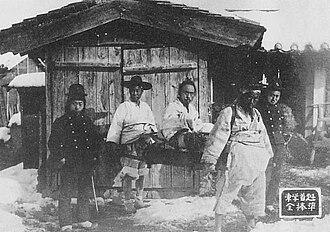
In the spring of 1894, a tide of popular anger swept across the Korean peninsula. Tens of thousands of farmers, artisans, and followers of a new religious movement called Tonghak took up arms against a corrupt government, foreign exploitation, and centuries of grinding poverty. The Tonghak Peasant Revolution — known in Korean as the Donghak Nongmin Hyeongmyeong — was one of the most significant mass uprisings in Korean history. It challenged the foundations of the Joseon dynasty, drew in the great powers of Japan and China, and ultimately helped set Korea on a collision course with the modern world.
Quick Facts: The Tonghak Peasant Revolution
| Date | 1894 (January – December) |
|---|---|
| Location | Joseon Korea, primarily Jeolla and Chungcheong provinces |
| Key Leaders | Jeon Bongjun (peasant commander), Choe Sihyeong (Tonghak religious leader) |
| Opposing Forces | Joseon government forces; later Japanese and Chinese troops |
| Ideological Roots | Tonghak religion (“Eastern Learning”), anti-corruption, anti-foreign sentiment |
| Outcome | Suppressed by Japanese forces; triggered the First Sino-Japanese War |
| Legacy | Foundational event in Korean nationalist memory |
What Was the Tonghak Movement?
To understand the revolution, one must first understand the religious and philosophical movement that gave it its name. Tonghak, meaning “Eastern Learning,” was founded in 1860 by Choe Je-u as a direct response to what he saw as the dangerous spread of Western ideas — particularly Catholicism — and the perceived weakness of Confucian orthodoxy in the face of foreign pressure. Drawing on elements of Confucianism, Buddhism, Shamanism, and Daoism, Tonghak offered a uniquely Korean spiritual vision centered on the inherent equality and dignity of all people.
Crucially, the Tonghak movement proclaimed that “humans are heaven” — a radical idea in a rigidly hierarchical society. This theology of human dignity resonated deeply with the rural poor, who suffered under a system of heavy taxation, corrupt local officials known as yangban magistrates, and foreign merchants who drained wealth from the countryside. By the early 1890s, Tonghak had attracted hundreds of thousands of followers across the southern and central provinces of Korea, despite repeated government persecution.
The Spark: Gobu County and the March of 1894
The immediate trigger for armed uprising came from Gobu County in North Jeolla Province. The local magistrate, Jo Byeong-gap, had become notorious for his systematic extortion of peasants — illegally taxing irrigation water, forcing unpaid labor, and embezzling public funds. Petitions to higher authorities went unanswered. In January 1894, a local Tonghak leader named Jeon Bongjun organized a crowd of farmers who stormed the county offices, destroyed records of illegal taxes, and distributed the magistrate’s hoarded grain to the hungry population.
The government’s response was swift and harsh. Rather than addressing the grievances, officials dispatched investigators who arrested and punished the very peasants who had complained. This crackdown transformed local protest into full-scale revolution. By March 1894, Jeon Bongjun had raised a peasant army under Tonghak banners and issued a formal call to arms across the southern provinces.
“The people are the root of the nation. If the root withers, the nation falls.”
Why Did the Revolution Spread So Quickly?
The revolution swept through Jeolla Province with remarkable speed. Several factors explain why so many ordinary Koreans joined the uprising within weeks:
- Decades of systemic corruption: The Joseon government’s administrative machinery had decayed badly by the late nineteenth century. Local magistrates routinely sold offices, collected illegal taxes, and enriched themselves at the expense of the farming population. The Tonghak movement had been documenting and protesting these abuses for years before the revolt.
- Economic crisis and foreign pressure: The opening of Korean ports to Japanese and Western trade following the 1876 Ganghwa Treaty had disrupted traditional markets. Japanese merchants dominated key sectors, and Korean grain was exported even during domestic food shortages, leaving rural communities impoverished and resentful.
- The Tonghak network as a ready-made organization: Unlike spontaneous peasant riots, the Tonghak revolution had an existing organizational framework. Religious cells across the provinces could be mobilized quickly, and the movement’s leaders had experience coordinating large gatherings from earlier petition campaigns in 1892 and 1893.
- Military success in early engagements: The peasant forces defeated government troops at the Battle of Hwangto Pass in April 1894, capturing the city of Jeonju — the provincial capital of Jeolla — in May. These victories gave the movement credibility and momentum, drawing in communities that might otherwise have remained on the sidelines.
The Jeonju Agreement and a Brief Peace
With the fall of Jeonju, the Joseon government faced a crisis it could not resolve militarily. Negotiations between the peasant army and government representatives produced the Jeonju Agreement of June 1894. Under this accord, the peasant forces agreed to withdraw from Jeonju in exchange for government promises of reform. The rebels were to be granted amnesty, corrupt officials were to be punished, and a series of administrative changes addressing peasant grievances would be implemented.
To oversee local governance and ensure the reforms were carried out, the Tonghak movement established jipgang — local administrative councils staffed by peasants and reform-minded community members. These councils, set up across dozens of counties in Jeolla Province, represented something genuinely new in Korean history: a form of grassroots self-governance that bypassed the traditional yangban administrative class.
However, the Jeonju Agreement proved short-lived. Even as the ceasefire held, events beyond Korea’s borders were rapidly overtaking the situation on the ground.
Foreign Intervention and the Road to War
The Joseon court, alarmed by the scale of the uprising, had made a fateful decision before the Jeonju Agreement was concluded: it formally requested military assistance from China under the terms of the 1885 Tianjin Convention, which required both China and Japan to notify each other before sending troops to Korea. China dispatched soldiers to the Korean coast in June 1894. Japan, citing the same convention, immediately sent its own, far larger force — without any genuine intent to withdraw.
Japan’s intervention was not simply a response to the peasant uprising. Tokyo had long sought a pretext to challenge Chinese influence over Korea and to assert its own dominance on the peninsula. The Tonghak Revolution provided the occasion. Japanese troops occupied Seoul’s royal palace in July 1894 and installed a pro-Japanese government. Within weeks, Japanese and Chinese forces were fighting each other on Korean soil — the opening shots of the First Sino-Japanese War.
| Factor | Korean Peasant Uprising | Japanese Intervention |
|---|---|---|
| Primary Goal | Reform, end corruption, protect peasants | Displace Chinese influence, control Korea |
| Ideological Basis | Tonghak religion, anti-foreign sentiment | Meiji expansionism, regional dominance |
| Attitude to Joseon Court | Critical but initially sought reform within Korea | Installed compliant government by force |
| Outcome | Suppressed by late 1894 | Decisive victory over China; dominant in Korea |
The Second Uprising and Final Defeat
When it became clear that Japanese forces had no intention of leaving Korea and were actively directing the Joseon government, Jeon Bongjun and the Tonghak leadership made the decision to rise again. In September 1894, the peasant army mobilized for a second time — now with an explicitly anti-Japanese character. Jeon called for a national defense against foreign occupation, and forces gathered from both the northern and southern Tonghak organizations, potentially numbering in the hundreds of thousands.
The second uprising, however, confronted a radically different military situation. Japanese troops, fresh from their campaign against China, were equipped with modern rifles and artillery. The decisive engagement came at the Battle of Ugeumchi in November 1894, near present-day Gongju in South Chungcheong Province. The peasant forces, armed largely with traditional weapons, launched repeated charges against well-fortified Japanese and government positions. They were repulsed with devastating casualties. The revolution was effectively over.
Jeon Bongjun was captured in December 1894 and executed in Seoul in March 1895. Choe Sihyeong, the Tonghak religious leader, was captured and executed in 1898. Thousands of Tonghak followers were killed in the reprisals that followed, and the movement’s organizational network was shattered.
Why Does the Tonghak Revolution Still Matter?
The Tonghak Peasant Revolution ended in military defeat, but its historical significance endures across multiple dimensions. First, it exposed the terminal weakness of the late Joseon state — a government so corrupt and so dependent on foreign powers that it could neither address the legitimate grievances of its own people nor defend its sovereignty against outside intervention. The revolution thus accelerated the crisis that would lead, within a decade, to the Japanese protectorate of 1905 and full annexation in 1910.
Second, the revolution’s ideology — its insistence on human equality, its rejection of foreign exploitation, and its vision of reformed governance — fed directly into the emerging currents of Korean nationalism. Later independence movement figures drew on the Tonghak legacy, and the April Revolution of 1960, which overthrew the Syngman Rhee government, has sometimes been interpreted through the same tradition of popular democratic resistance.
Third, the Jeonju Agreement and the jipgang councils represent an early, fragile experiment in participatory governance on the Korean peninsula — a historical precedent that Korean democrats would return to in spirit, if not in name, across the following century.
Today, the Tonghak Peasant Revolution is commemorated in South Korea as a foundational moment of national democratic consciousness. The Donghak Revolution Memorial Hall stands in Jeonju, and Jeon Bongjun is honored as a popular hero. Academic debate continues about its causes, character, and consequences — but its place in the Korean historical imagination is secure.