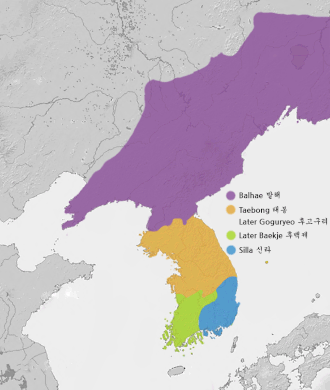
“From the ashes of Silla, three kingdoms rose — and from their conflict, one nation was forged anew.”
Few periods in Korean history are as dramatic, turbulent, and consequential as the Later Three Kingdoms era. Spanning the late ninth and early tenth centuries, this was a time when the once-mighty unified Silla kingdom fractured under the weight of internal rebellion, regional warlordism, and bitter civil war. Three rival states competed for dominance over the Korean peninsula, each claiming legitimacy and each determined to reunify the land under its own banner. Out of this crucible of conflict emerged Goryeo — the kingdom whose name would eventually give Korea its name to the world.
Understanding the Later Three Kingdoms is essential for anyone who wants to make sense of how Korea transitioned from the ancient Three Kingdoms period and unified Silla into the sophisticated medieval civilization of the Goryeo dynasty. It is a story of collapse and rebirth, of ambitious leaders and suffering peoples, and of a peninsula finding its identity through conflict.
Quick Facts: The Later Three Kingdoms at a Glance
| Detail | Information |
|---|---|
| Period | Late 9th century – 936 CE |
| Location | Korean Peninsula |
| Three States | Later Silla, Later Baekje, Taebong (Later Goguryeo) |
| Unifier | Wang Geon (Taejo of Goryeo) |
| Outcome | Establishment of the Goryeo Dynasty (918 CE) |
| Type of Conflict | Civil war, wars of succession |
The Collapse of Unified Silla: How Did the Later Three Kingdoms Begin?
The roots of the Later Three Kingdoms lie deep in the structural problems of the unified Silla state. After Silla completed its unification of the Korean peninsula in the late seventh century with Tang Chinese support, it governed for over two hundred years from its capital at Gyeongju. But by the ninth century, the kingdom was showing severe signs of strain. The aristocratic bone rank system, which rigidly determined social status and political access by birth, concentrated power in the hands of a narrow elite based in the capital. Regional elites and military commanders — the so-called hojok or local strongmen — accumulated their own power bases away from the center.
The result was a period of intense internal conflict. The Silla throne changed hands repeatedly through assassination and coup. Central authority withered, tax revenues collapsed, and peasant rebellions erupted across the countryside. Into this vacuum stepped ambitious regional leaders who were willing to claim independent authority and, eventually, to revive the memory of the ancient kingdoms that Silla had once destroyed.
Two figures in particular transformed regional discontent into outright state formation. Gyeon Hwon, a military commander of humble origin, established Later Baekje in the southwestern part of the peninsula in 900, explicitly invoking the memory and grievances of the old Baekje kingdom that Silla had conquered in the seventh century. Meanwhile, a charismatic figure known as Gung Ye — a former Buddhist monk and reputed prince of Silla blood — established a northern rival state, initially called Later Goguryeo and later renamed Taebong, around 901. He too claimed to be restoring the glory of a destroyed kingdom, this time Goguryeo in the north.
Later Silla, though technically still existing, was reduced to a shadow of its former self — controlling little beyond the southeastern region and steadily losing territory, population, and prestige. The peninsula was once again a land of competing kingdoms.
3 Key Forces That Shaped the Later Three Kingdoms
1. Regional Warlordism and the Breakdown of Central Authority
The fundamental driver of the Later Three Kingdoms period was the collapse of Silla’s ability to project authority across the peninsula. Local strongmen — rooted in regional landed power and military command — became the real power brokers. Both Gyeon Hwon and Gung Ye rose to prominence through this system, commanding loyalty through military success and the promise of restoring local identities that Silla’s aristocratic hierarchy had suppressed. The competition between warlords was not merely about territory; it was about legitimacy, ancestry, and the right to claim the Korean past.
2. The Revival of Ancient Kingdom Identities
One of the most striking features of this period is how its leaders deliberately reached back into history to justify their present ambitions. Gyeon Hwon of Later Baekje cast himself as an avenger for the old Baekje kingdom’s defeat, tapping into regional memories and cultural identity in the southwest. Gung Ye similarly invoked Goguryeo in the north. This was not mere rhetoric — it reflected genuine regional identities that had survived Silla’s unification and now found political expression. The past was a weapon in the wars of the present.
3. The Rise of Wang Geon and the Goryeo Solution
The figure who ultimately resolved the conflict was Wang Geon, a general who served under Gung Ye in Taebong. When Gung Ye’s erratic and increasingly tyrannical rule alienated his own followers, Wang Geon was placed on the throne by his officers in 918. He renamed the state Goryeo — a deliberate echo of Goguryeo — and pursued a very different strategy from his rivals. Where Gung Ye had been harsh and Gyeon Hwon aggressive, Wang Geon cultivated alliances, offered amnesty to rivals, and eventually received the voluntary surrender of the last Silla king in 935. He defeated Later Baekje in 936, completing reunification. His approach blended military strength with political conciliation, setting Goryeo on a stable foundation.
The Three Rival States: A Closer Look
| State | Leader | Region | Ancient Kingdom Invoked | Fate |
|---|---|---|---|---|
| Later Baekje | Gyeon Hwon | Southwest Korea | Baekje | Defeated by Goryeo in 936 |
| Taebong (Later Goguryeo) | Gung Ye | Central and northern Korea | Goguryeo | Replaced by Goryeo in 918 |
| Later Silla | Various kings | Southeast Korea | Silla (direct continuation) | Surrendered to Goryeo in 935 |
“Wang Geon’s genius was not merely military — it was his understanding that lasting unity required the consent, not just the conquest, of those he sought to rule.”
Why Does the Later Three Kingdoms Period Matter for Korean History?
The Later Three Kingdoms era is far more than a chapter of chaos sandwiched between two stable dynasties. It was a formative crucible that shaped Korean civilization in lasting ways.
First, it established Goryeo as the successor state to all three kingdoms — not just Silla. By invoking Goguryeo in its name and absorbing the populations and elites of Baekje and Silla, Goryeo was able to present itself as a genuinely pan-Korean state in a way that unified Silla never quite managed. The regional identities that had fueled the Later Three Kingdoms conflict were gradually integrated into a broader Korean identity under Goryeo rule.
Second, the period demonstrated the enduring power of historical memory in Korean political culture. Leaders of the Later Three Kingdoms period understood that the past mattered — that invoking the names and grievances of ancient kingdoms could mobilize populations and legitimize authority. This use of historical narrative as political tool would recur throughout Korean history.
Third, the military and political innovations of the period — the rise of regional strongmen, the importance of winning elite defections, the use of amnesty and alliance alongside military force — shaped the governance strategies of the early Goryeo dynasty. Wang Geon’s careful management of former rivals and regional power brokers was essential to Goryeo’s stability in its early decades.
Finally, the Later Three Kingdoms period is a reminder that Korean history has never been a simple, unbroken narrative of unity. Like many great civilizations, Korea has experienced profound fragmentation — and found ways to reconstitute itself. The story of the Later Three Kingdoms is, at its heart, a story about how a people reconstruct identity and governance after collapse.
The Human Cost and Cultural Dimensions
Amid the political drama of competing kings and generals, it is important not to lose sight of the human dimensions of this era. The Later Three Kingdoms period was one of intense suffering for ordinary people on the Korean peninsula. Warfare, banditry, failed harvests, and the collapse of trade networks created widespread hardship. Peasants who had already suffered under Silla’s extractive tax system now faced the additional burden of military requisitions from multiple competing powers.
Buddhism, which had been deeply embedded in Korean society since the Three Kingdoms period, played a complex role during these decades. Buddhist monasteries were simultaneously centers of cultural preservation, economic power, and political influence. Some clerics allied themselves with regional warlords; others tried to maintain spaces of stability and learning amid the chaos. Gung Ye himself had a Buddhist background, though his later behavior alienated the monastic community. Wang Geon, by contrast, cultivated Buddhist institutions carefully, understanding their importance to social cohesion.
The arts and material culture of this transitional period are less well documented than those of the Goryeo dynasty that followed, but the Later Three Kingdoms era laid important groundwork. Craft traditions, architectural knowledge, and administrative practices that had developed under Silla were carried forward — sometimes through the movement of skilled personnel between competing courts — into the Goryeo period, where they would flourish in new forms.
Goryeo’s Unification: An End and a Beginning
When Wang Geon — now known by his posthumous title Taejo, meaning “Grand Progenitor” — completed the unification of the peninsula in 936, he did not simply end a war. He inaugurated one of the most culturally rich periods in Korean history. The Goryeo dynasty that he founded would rule for nearly five centuries, producing world-renowned celadon ceramics, developing movable metal type printing, and compiling the magnificent Tripitaka Koreana — a complete collection of Buddhist scriptures carved onto over eighty thousand wooden blocks, many of which survive to this day.
None of this would have been possible without the difficult, painful process of the Later Three Kingdoms period. The fragmentation and conflict of those decades forced Korean society to confront questions about identity, legitimacy, and governance that the unified Silla period had papered over. The answers that Wang Geon and the founders of Goryeo developed — a broader, more inclusive Korean identity, a more flexible relationship with regional elites, a deeper integration of Buddhist and Confucian values in governance — shaped Korean civilization for centuries to come.
The Later Three Kingdoms may have been a period of war, but it was also a period of profound political creativity. Understanding it means understanding how Korea became Korea.
Continue Exploring
Learn More on Coreaverse
- The Goryeo Dynasty: Korea’s Golden Age of Culture and Buddhism
- Unified Silla: The Kingdom That First United the Korean Peninsula
- The Original Three Kingdoms: Goguryeo, Baekje, and Silla