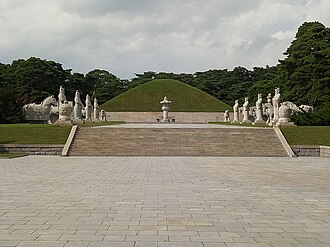
“Beneath the earth, the warriors, courtiers, and gods of Goguryeo still move across walls of painted stone — a kingdom frozen in colour for fifteen centuries.”
Long before the modern Korean peninsula took shape, the kingdom of Goguryeo dominated a vast stretch of northeast Asia. Powerful, martial, and culturally sophisticated, Goguryeo endured for roughly seven centuries before falling in 668 CE. Yet its kings and nobles left behind something extraordinary: hundreds of elaborately decorated underground tombs, many of them painted with murals of breathtaking vitality. Today, these tombs stand as one of East Asia’s most remarkable archaeological inheritances — and, since 2004, as a UNESCO World Heritage Site.
Quick Facts: The Goguryeo Tombs at a Glance
| Kingdom | Goguryeo (고구려) |
|---|---|
| Period Active | Approximately 37 BCE – 668 CE |
| Location of Tombs | Primarily in and around Pyongyang, North Korea; also near the Chinese border |
| Number of Known Tombs | Over 10,000 identified; approximately 90 contain murals |
| UNESCO Status | Inscribed 2004 (Complex of Koguryo Tombs) |
| Key Sites | Anak Tomb No. 3, Gangseo Large Tomb, Ssangyeong Tomb |
| Materials Used | Stone chambers, lime plaster, mineral pigments |
What Was Goguryeo, and Why Do Its Tombs Matter?
Goguryeo was one of the Three Kingdoms of ancient Korea, alongside Baekje and Silla. At its height, the kingdom controlled territory stretching from the northern Korean peninsula deep into Manchuria. Its capital shifted over the centuries, eventually settling at Pyongyang in 427 CE. Goguryeo was renowned for its fierce resistance to Chinese imperial expansion — it famously repelled invasions by the Sui and Tang dynasties — and for a rich artistic tradition that blended Korean sensibilities with influences from China and the steppe nomadic world.
The tombs are the most direct window we have into everyday Goguryeo life, belief, and aesthetics. Unlike texts, which were often written by rival kingdoms or later dynasties with their own agendas, the mural paintings inside these burial chambers were made by Goguryeo artists for Goguryeo patrons. They were never meant to be seen again after the tomb was sealed. That they survive at all — vivid, energetic, and often shockingly well-preserved — is a testament both to the craftsmanship of their creators and to the sealed, stable environment of the stone chambers.
Inside the Tombs: Architecture and Construction
Goguryeo tombs evolved significantly over the kingdom’s long history. Earlier examples from the first and second centuries CE tend to be simpler in structure — single stone chambers covered by earthen mounds. Over time, builders developed more complex layouts featuring multiple chambers, corbelled stone ceilings, and carefully fitted stone blocks that have endured centuries of pressure without mortar.
The most elaborate tombs contain an antechamber, a corridor, and a main burial chamber, all constructed from large flat stones. The walls of these interiors were coated with a layer of lime plaster, which provided the smooth surface on which artists painted their imagery. Some tombs also feature direct painting on dressed stone surfaces. The earthen mounds covering the stone chambers range from modest hillocks to imposing pyramidal shapes that dominate the surrounding landscape.
The sheer number of tombs — over 10,000 have been identified across the Goguryeo heartland — speaks to a society in which elaborate burial was a central cultural practice for the ruling and aristocratic classes. Not all tombs contain murals; the painted examples number approximately 90, but these are the ones that have drawn the most scholarly and popular attention.
The Murals: A World Painted Underground
The mural paintings of the Goguryeo tombs are among the most important surviving examples of early East Asian art. They cover a remarkable range of subjects, shifting in focus and style across different periods of the kingdom’s history.
Early murals, dated roughly to the fourth and fifth centuries CE, concentrate heavily on scenes of daily life. Banquets, hunting parties, wrestling matches, acrobatic performances, processions of officials and servants — all are rendered with confident, fluid brushwork. These images were not merely decorative. They expressed the belief that the deceased would continue to enjoy the pleasures and privileges of their earthly status in the afterlife. The tomb owner and his household appear again and again, frozen in the comfortable routines of aristocratic existence.
Later murals, from the sixth and seventh centuries, show a striking shift toward cosmological and religious imagery. The four directional guardian spirits — the Blue Dragon of the East, the White Tiger of the West, the Vermilion Bird of the South, and the Black Tortoise of the North — dominate the walls of major chambers. These figures, drawn from a shared East Asian cosmological tradition, were painted to protect the deceased and to orient the tomb within the sacred geography of the universe. The brushwork in these later examples is often even more assured, with the guardian animals rendered in swirling, dynamic compositions that fill entire wall surfaces.
“The four guardian spirits of the Gangseo Large Tomb are painted with such authority and movement that scholars still regard them as masterworks of early East Asian art — rivalling anything produced on the continent at the same time.”
Lotus flowers, celestial figures, and scenes from Buddhist and Daoist cosmology also appear in many tombs, reflecting the religious complexity of Goguryeo society. Buddhism had entered the kingdom in the fourth century CE and coexisted with older shamanic and nature-worship traditions. The murals do not always separate these belief systems neatly — a single tomb may contain Buddhist lotus motifs alongside indigenous Korean spirit figures and Chinese cosmological symbols.
Key Tombs: Three Sites Worth Knowing
1. Anak Tomb No. 3 — Dating to 357 CE, this is one of the oldest dated tombs in the Goguryeo corpus and one of the most elaborate. Its murals include a detailed portrait of the tomb owner seated in state, surrounded by attendants, as well as a famous procession scene depicting hundreds of soldiers, musicians, and servants. An inscription inside provides a date and personal name, making it invaluable for historians. Whether the occupant was a Goguryeo noble or a Chinese émigré official has been debated by scholars for decades.
2. Gangseo Large Tomb (Gangseo Daemyo) — Located near Nampo, this late Goguryeo tomb, likely from the early seventh century CE, is celebrated for the quality of its four directional guardian murals. Painted directly on polished stone rather than plaster, the images have retained their colour with exceptional fidelity. The Blue Dragon and White Tiger in particular are regarded as among the finest surviving examples of Goguryeo artistic achievement.
3. Ssangyeong Tomb (Twin Pillar Tomb) — Named for the painted columns that frame its entrance, this tomb offers a different aesthetic — more geometric and architecturally focused — while still featuring the guardian spirit imagery characteristic of the later period.
UNESCO Recognition and the Challenge of Preservation
In 2004, the Complex of Koguryo Tombs was inscribed on the UNESCO World Heritage List, making it the first site in North Korea to receive this designation. The inscription acknowledged the tombs as outstanding examples of the artistic and cultural achievements of the Goguryeo civilisation and noted their importance as a record of the beliefs, social structures, and daily life of an ancient Korean kingdom.
Preservation, however, presents ongoing challenges. The very act of opening tombs for study and tourism exposes the murals to changes in humidity, temperature, and light that can accelerate deterioration. Biological growth — algae and bacteria — has damaged murals in several sites. North Korea has worked with international organisations on conservation efforts, though access for outside researchers remains limited by political circumstances. The murals that have survived fifteen centuries sealed in darkness now face new threats in an era of opening and examination.
Why the Goguryeo Tombs Still Resonate Today
The Goguryeo tombs matter for reasons that go beyond art history and archaeology. Goguryeo holds a special place in Korean historical memory as a symbol of ancient power, territorial reach, and cultural pride. The tombs are physical evidence that a distinctly Korean civilisation — sophisticated, cosmopolitan, and artistically ambitious — flourished long before the Joseon dynasty or the modern nation-state.
They also matter because they are, in a very real sense, irreplaceable. No texts describe the banquets painted in Anak Tomb No. 3 from the perspective of those who attended them. No chronicle captures the swirling energy of the Blue Dragon of Gangseo the way the anonymous artist who painted it did. The tombs are primary sources in the truest sense: unmediated records of a world that has otherwise largely vanished.
For students of Korean history, the murals offer evidence about social hierarchy, gender roles, military organisation, religious syncretism, and aesthetic values in ways that written records alone cannot. For anyone drawn to the deep roots of Korean culture, these painted chambers beneath the hills of the western Korean peninsula are an essential destination — even if, for most of us, that journey must begin with photographs and scholarship rather than in person.