“The brush is mightier than the sword — in Joseon, a single examination could determine the fate of a family for generations.”
For nearly a millennium, the gwageo (과거) — Korea’s imperial civil service examination — stood as the most consequential institution in Korean public life. Introduced during the Goryeo dynasty and refined across five centuries of Joseon rule, this elaborate system of written tests determined who would govern the kingdom, who would earn prestige and rank, and which families would rise or fall in the intricate hierarchy of Korean society. Understanding the gwageo is, in many ways, understanding the backbone of premodern Korean civilization itself.
Quick Facts: The Gwageo at a Glance
| Detail | Information |
|---|---|
| Korean Name | 과거 (gwageo) |
| Introduced | 958 CE, during the reign of Goryeo King Gwangjong |
| Abolished | 1894 CE, during the Gabo Reform period |
| Duration | Approximately 936 years |
| Dynasties Active | Goryeo and Joseon |
| Primary Influence | Tang dynasty China’s imperial examination system |
| Main Subject Areas | Confucian classics, literary composition, law, military arts |
Origins: How Did the Gwageo Come to Korea?
The gwageo did not emerge in a vacuum. Its roots stretch back to Tang dynasty China, where the imperial examination system had been used since the 7th century to select bureaucratic officials on the basis of merit rather than solely bloodline. Korean rulers, long in intellectual and diplomatic contact with the Chinese court, were keenly aware of how such a system could centralize power and standardize governance.
It was King Gwangjong of Goryeo who formally introduced the gwageo to Korea in 958 CE. Advised by a Chinese scholar named Shuang Ji who had come to the Goryeo court, Gwangjong saw in the examination system a powerful tool: a way to diminish the power of the entrenched aristocratic clans who had long dominated the peninsula’s political landscape. By creating a pathway to office based on demonstrated knowledge of the Confucian classics and literary skill, the king could theoretically build a corps of loyal, educated officials whose positions depended on royal favor and personal merit rather than inherited privilege alone.
The move was bold, and its consequences were profound. Though the old aristocracy — the powerful bone-rank and later the hyangni class — did not vanish overnight, the gwageo introduced a new logic into Korean political culture: the idea that learning, discipline, and intellectual accomplishment could earn a man a place at the highest levels of power.
5 Key Features That Defined the Gwageo System
1. A Tiered Structure of Examinations
The gwageo was not a single test but a cascading series of examinations. In the Joseon period, the system was most elaborately developed, featuring preliminary local examinations, regional tests, and finally the prestigious metropolitan and palace examinations held in the capital. Candidates who cleared each stage advanced to the next, with the final examinations held directly under royal supervision. The most coveted degree, the munkwa or civil examination, tested mastery of the Confucian Four Books and Five Classics, as well as the ability to compose elegant literary essays and policy arguments.
2. Multiple Examination Categories
The gwageo was not limited to civil administration. The system encompassed the munkwa (civil service examination), the mukwa (military examination), and the japkwa (miscellaneous examinations for technical fields such as medicine, law, accounting, and foreign languages). This breadth meant that the examination system touched virtually every branch of government function, though the civil examination consistently carried the most prestige and social reward.
3. The Role of Confucian Education
Preparation for the gwageo was inseparable from Confucian education. Candidates spent years — often decades — studying at private village schools called seodang, at regional schools called hyanggyo, and at the national Confucian academy in Seoul, the Sungkyunkwan. The curriculum centered on memorizing and interpreting the classical Chinese texts that formed the foundation of East Asian intellectual life. This meant that the gwageo simultaneously functioned as an engine of Confucian cultural transmission, ensuring that Korea’s ruling class shared a common body of classical knowledge and ethical framework.
4. Social Access — and Its Limits
In theory, the gwageo was open to any free man. In practice, participation was heavily shaped by social class. Members of the yangban — the hereditary aristocratic class of the Joseon period — had by far the greatest access to the years of private education required to prepare for the examinations. Commoners could and occasionally did pass, but the economic and social barriers were formidable. Slaves and the lowest social classes were formally excluded. The examination system thus occupied a fascinating middle ground: meritocratic in principle, aristocratic in practice.
5. The Ceremony and Drama of Results
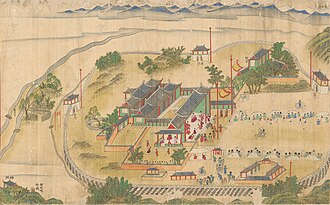
When results were announced, the successful candidates — jinsa at the lower level, and munkwa passers at the higher — were celebrated with elaborate ceremonies. The highest scorers in the palace examination received their results directly from the king. Successful candidates were given a red certificate and rode on horseback through the capital in a procession called yugsinje, receiving public honor and family glory. For the candidate’s family and home village, a successful gwageo passage was among the most significant events imaginable.
“To pass the munkwa was not merely personal achievement — it was the fulfillment of a family’s generational investment in learning, sacrifice, and hope.”
The Gwageo in the Joseon Dynasty: Peak and Tensions
While the Goryeo dynasty established the gwageo, it was during the Joseon dynasty (1392–1897) that the system reached its fullest development and greatest social importance. The Joseon state was explicitly built on Neo-Confucian principles, and the gwageo was the institutional embodiment of those values: learning was the highest virtue, and public service through government was the scholar’s noblest calling.
Under Joseon, the munkwa examination was held every three years as a regular cycle, with additional special examinations called byeolgwa convened to mark royal events such as coronations, royal birthdays, and military victories. Over the five centuries of Joseon rule, thousands of men passed through the system and entered government service as officials at various levels of the bureaucratic hierarchy.
Yet tensions were inherent in the system. The concentration of preparation resources among the yangban class meant that, over generations, certain powerful families came to dominate the examination results and the senior offices to which they led. Regional disparities also emerged, with candidates from the capital and its surrounding provinces consistently outperforming those from more distant regions. Critics within the Joseon bureaucracy periodically raised concerns about favoritism, regional bias in grading, and the gap between the rarefied literary knowledge tested in the examinations and the practical administrative skills actually needed to govern effectively.
How Did the Gwageo Compare to China’s Imperial Examinations?
| Feature | Korean Gwageo | Chinese Imperial Examination (Keju) |
|---|---|---|
| Origin | 958 CE (Goryeo) | 605 CE (Sui dynasty) |
| Core Texts | Confucian Four Books, Five Classics | Confucian Four Books, Five Classics |
| Social Access | Limited by yangban class dominance | Broader in theory; still limited in practice |
| Military Exam | Yes (mukwa) | Yes (wuju) |
| Abolished | 1894 (Gabo Reform) | 1905 (late Qing reform) |
| Anonymous Grading | Practiced in some periods | Practiced widely |
The parallels between the Korean gwageo and the Chinese keju system are unmistakable — both drew from the same Confucian intellectual tradition and served similar state-building purposes. Yet the gwageo developed its own distinctive character shaped by Korean social structures, particularly the enduring power of the hereditary yangban aristocracy, which had no precise equivalent in China’s more fluid scholar-gentry society.
The End of the Gwageo: Reform and Abolition in 1894
By the late 19th century, the gwageo faced mounting criticism from Korean reformers who argued that the system was ill-suited to the modern challenges facing the Joseon kingdom. Korea was confronting military pressure from Japan and the Western powers, internal political instability, and the urgent need to modernize its military, infrastructure, and administration. The classical literary skills prized by the gwageo seemed increasingly disconnected from the technical expertise the country desperately needed.
The Gabo Reform of 1894 — a sweeping set of modernizing reforms implemented under Japanese influence following the First Sino-Japanese War — formally abolished the gwageo. In its place, the reformers introduced a new system of government appointments based on modern credentials and examinations more aligned with Western administrative models. The abolition marked not just the end of an institution but the close of an entire era of Korean intellectual and political culture that had been sustained for nearly a thousand years.
The passing of the gwageo was mourned by many within the traditional literati class, for whom the examination system had been the central organizing framework of educated life. Yet for others, its abolition opened the door to a new conception of education and public service that would gradually take shape in the turbulent decades that followed.
The Gwageo’s Lasting Legacy in Korean Culture
Even after its abolition, the gwageo left deep marks on Korean society that persist to this day. The intense emphasis on education as the primary path to social mobility and public honor — a value so prominent in contemporary Korean culture that it is remarked upon by observers worldwide — has deep roots in the gwageo tradition. The notion that rigorous examination performance is the legitimate measure of a person’s worthiness for public roles remains powerfully embedded in Korean attitudes toward education, employment, and social status.
The gwageo also left a rich documentary legacy. The names of successful candidates were recorded in official registers, and many of these records have survived, providing historians with valuable windows into the social history of Goryeo and Joseon. Museums and academic institutions in Korea preserve examination papers, study materials, and records associated with the gwageo, allowing researchers and the public to engage directly with this extraordinary institution.
Continue Exploring
- Gwageo — Wikipedia: Full overview of the Korean civil service examination
- Encyclopedia of Korean Culture (AKS) — In-depth entries on Joseon institutions
- Civil Service Examination — Britannica: East Asian examination traditions in context
- National Museum of Korea — Collections related to Joseon bureaucracy and education
- Asia Society: Confucianism and Its Role in East Asian Governance
- Academy of Korean Studies — Research resources on the gwageo and Joseon society