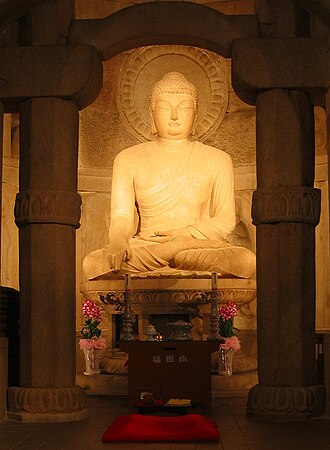
“Buddhism is not merely a religion in Korea — it is a living thread woven through seventeen centuries of history, art, and national identity.”
Few traditions have shaped Korea as deeply and as durably as Buddhism. Arriving on the peninsula during the fourth century CE, Buddhism transformed Korean civilization — inspiring breathtaking temples, founding monastic universities, guiding royal courts, and giving rise to some of the most remarkable religious art and literature in all of East Asia. To understand Korea is, in no small part, to understand Korean Buddhism.
Quick Facts: Korean Buddhism at a Glance
| Fact | Detail |
|---|---|
| Approximate Arrival | 4th century CE, during the Three Kingdoms period |
| First Kingdom to Adopt | Goguryeo (traditionally 372 CE) |
| Major Schools | Seon (Zen), Hwaeom, Pure Land, Cheontae |
| Golden Age | Unified Silla and Goryeo periods (668–1392 CE) |
| Period of Suppression | Joseon Dynasty (1392–1897), Neo-Confucian state |
| Modern Representative Body | Jogye Order of Korean Buddhism |
| UNESCO Heritage Connection | Bulguksa Temple and Seokguram Grotto (World Heritage Site) |
How Did Buddhism First Arrive in Korea?
Buddhism entered the Korean peninsula via China along the Silk Road networks that connected Central Asia, China, and East Asia during the fourth century CE. The traditional account records that in 372 CE, the Chinese monk Sundo arrived at the court of Goguryeo, the northernmost of the Three Kingdoms, bearing Buddhist scriptures and images as gifts from the Former Qin state. Just twelve years later, in 384 CE, the Indian monk Marananta brought Buddhism southward to Baekje, the southwestern kingdom. The southeastern kingdom of Silla, more isolated geographically, accepted Buddhism officially somewhat later — in 528 CE — following the martyrdom of the court official Ichadon, whose death, according to tradition, was accompanied by miraculous signs that convinced the Silla king to embrace the new faith.
This staggered adoption across the Three Kingdoms meant that each realm developed its own early Buddhist character, influenced by proximity to China, existing shamanistic traditions, and the particular needs of its ruling class. From the very beginning, Korean rulers recognized Buddhism not simply as a spiritual path but as a civilizing force — a vehicle for statecraft, legitimacy, and cultural prestige.
The Golden Age: Unified Silla and the Goryeo Dynasty
When Silla unified the peninsula in 668 CE, Korean Buddhism entered its first great flowering. The Unified Silla period produced some of the most celebrated monuments in Korean history. Bulguksa Temple, constructed in the eighth century near the Silla capital of Gyeongju, stands as a masterpiece of Buddhist architecture and landscape design. Nearby, the Seokguram Grotto houses a magnificent stone Buddha sculpture, regarded as one of the finest examples of Buddhist art in all of Asia. Both sites were inscribed as UNESCO World Heritage Sites in 1995, a recognition of their outstanding universal value.
Silla also produced towering intellectual figures. The monk Wonhyo (617–686 CE) was among the most original thinkers in the history of East Asian Buddhism. He sought to reconcile competing Buddhist doctrines through his concept of hwajaeng (harmonization of disputes), arguing that different schools of Buddhist thought were not contradictory but complementary expressions of a single truth. His prolific writings influenced Buddhist thought not only in Korea but also in China and Japan. His contemporary Uisang (625–702 CE) traveled to China to study under the Huayan patriarch Zhiyan and returned to establish the Hwaeom (Huayan) school in Korea, founding the great monastery of Buseoksa.
The Goryeo Dynasty (918–1392 CE) elevated Korean Buddhism to an unparalleled position of state patronage and cultural production. Buddhism functioned virtually as a state religion during Goryeo, with royal families sponsoring enormous temple complexes, monastic schools, and manuscript projects. The dynasty’s most extraordinary achievement was the Tripitaka Koreana — a complete carving of the entire Buddhist canon onto more than 80,000 wooden printing blocks. Compiled twice (the first set was destroyed during the Mongol invasions of the thirteenth century, and the second set was completed between 1237 and 1248 CE), the Tripitaka Koreana is preserved today at Haeinsa Temple and is itself a UNESCO World Heritage Site, recognized both as a spiritual artifact and as a triumph of medieval scholarship and craftsmanship.
“The Tripitaka Koreana — over 80,000 hand-carved wooden blocks recording the entire Buddhist canon — remains one of the most extraordinary intellectual achievements of the medieval world.”
Goryeo Buddhism also saw the rise of the Seon (known in Japan as Zen) school, which emphasized direct meditative experience over textual study. The monk Jinul (1158–1210 CE) became the most influential figure in Korean Seon, founding the Songgwangsa monastery and developing a synthesis of Seon practice with Hwaeom philosophy. Jinul’s approach — combining sudden enlightenment with gradual cultivation — became the defining characteristic of Korean Buddhism and remains foundational to the Jogye Order, Korea’s largest Buddhist denomination, to this day.
Suppression Under the Joseon Dynasty
The establishment of the Joseon Dynasty in 1392 CE brought a dramatic reversal of Buddhism’s fortunes. The new dynasty’s founding ideology was Neo-Confucianism, and its rulers viewed Buddhist monasteries — wealthy, politically connected, and exempted from taxation — with deep suspicion. Over the course of the fifteenth and sixteenth centuries, successive Joseon kings enacted a series of measures to curtail Buddhist power: monasteries were stripped of their lands, monks were barred from entering capital cities, and the number of officially recognized temples was drastically reduced.
Buddhism was, in effect, pushed out of the cities and into the mountains. Paradoxically, this exile preserved a certain vitality. Mountain monasteries became centers of learning, artistic production, and meditative practice, insulated from the political pressures of court life. The monk Hyujeong (1520–1604 CE), also known as Seosan Daesa, became one of the most celebrated figures of this era. During the Japanese invasions of Korea (the Imjin War, 1592–1598 CE), Hyujeong led armies of monk-soldiers — ŭisŭng — in defense of the country, a moment that paradoxically restored some of Buddhism’s public prestige even while Confucian ideology remained dominant.
Three Reasons Korean Buddhism Survived the Joseon Suppression
- Mountain Refuge: Forced out of urban centers, Buddhist communities retreated to remote mountain monasteries where they could maintain practice, scholarship, and artistic traditions far from the scrutiny of Neo-Confucian officials.
- Royal Women’s Patronage: Despite official ideology, many Joseon queens, queen mothers, and aristocratic women remained devoted Buddhist patrons, funding the construction and maintenance of temples and the production of religious art throughout the dynasty.
- The Monk-Soldiers of the Imjin War: The heroic role of Buddhist monk-soldiers in resisting the Japanese invasions of the 1590s gave Buddhism a renewed claim to patriotic legitimacy, making total suppression politically difficult even for the most ardent Confucian administrators.
Korean Buddhism in the Modern Era
The late nineteenth and twentieth centuries brought new challenges and transformations. During the Japanese colonial period (1910–1945), the Japanese colonial government imposed its own administrative structures on Korean Buddhism, forcing Korean monasteries to align with Japanese Buddhist sects and permitting — indeed encouraging — monks to marry, a practice alien to the Korean monastic tradition. The legacy of this colonial interference created deep divisions in Korean Buddhism that persisted for decades after liberation.
Following the Korean War (1950–1953), a protracted dispute over temple administration and monastic celibacy culminated in the formal establishment of the Jogye Order as the dominant representative body of Korean Buddhism in 1962. The Jogye Order upholds the tradition of celibate monasticism and the synthesis of Seon meditation with doctrinal study that traces its lineage back to Jinul. Today, the Jogye Order oversees hundreds of temples across Korea and maintains active international outreach programs.
Korean Buddhism today is a living tradition, not merely a historical artifact. Major temples such as Haeinsa, Tongdosa, and Songgwangsa — collectively known as the sambo saChal (Three Jewel Temples) — attract hundreds of thousands of visitors and practitioners each year. Temple-stay programs, developed in the early 2000s, invite both domestic and international visitors to experience monastic life firsthand, offering meditation, chanting, communal meals, and the rhythms of daily practice.
The Artistic Legacy of Korean Buddhism
No account of Korean Buddhism is complete without acknowledging its extraordinary artistic legacy. From the gilt bronze Buddhas of the Three Kingdoms period to the celadon incense burners of Goryeo, from the wooden block prints of the Joseon era to the painted silk Buddhist banners (gwaebul) used in outdoor ceremonies, Korean Buddhist art represents one of the great visual traditions of world civilization. Buddhist influence also permeates Korean music, poetry, and narrative literature. The tradition of pansori — Korea’s dramatic vocal art — has Buddhist themes woven through some of its foundational repertoire. The great literary monks of the Goryeo and Joseon periods produced poetry of lasting beauty, and the monastic libraries of Korea’s mountain temples preserve manuscripts of incalculable historical and cultural value.