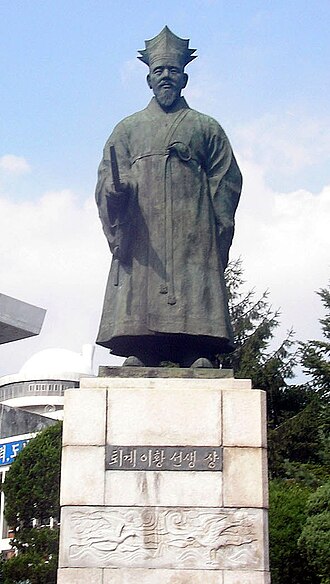
“Learning is not merely the accumulation of knowledge — it is the transformation of the self.”
— Attributed to Yi Hwang (Toegye), 16th-century Joseon scholar
In the long and storied history of Korean intellectual life, few figures stand as tall as Yi Hwang, known by his pen name Toegye (退溪, meaning “Retreating Creek”). Born in 1501 in the Andong region of what is now North Gyeongsang Province, Yi Hwang dedicated his life to the study, teaching, and systematic refinement of Neo-Confucian philosophy during the Joseon dynasty. His legacy is so enduring that his portrait has graced the 1,000-won banknote, and his name remains synonymous with moral scholarship, quiet wisdom, and the pursuit of self-cultivation.
To understand Yi Hwang is to understand a pivotal chapter in Korean intellectual history — one that shaped how Korean scholars, officials, and ordinary people thought about ethics, governance, and the human heart for centuries to come.
Quick Facts: Yi Hwang at a Glance
| Detail | Information |
|---|---|
| Born | 1501, Andong, Joseon Korea |
| Died | 1570 |
| Pen Name | Toegye (退溪) |
| Era | Joseon Dynasty (16th century) |
| Field | Neo-Confucian philosophy, poetry, education |
| Notable Work | Ten Diagrams on Sage Learning (Seonghak sipdo) |
| School Founded | Dosan Seowon (Dosan Confucian Academy) |
| Legacy | Portrait on the South Korean 1,000-won note |
A Scholar Born in Turbulent Times
Yi Hwang was born in 1501, during the reign of King Yeonsangun — one of the most turbulent and tyrannical rulers of the Joseon dynasty. The political climate of the early sixteenth century was characterized by factional strife, purges of Neo-Confucian literati, and deep instability at court. These so-called “literati purges” (sahwa) scarred an entire generation of Korean scholars, and Yi Hwang was not untouched by them.
Growing up in Andong — a region that would become historically associated with conservative Confucian scholarship and aristocratic yangban culture — Yi Hwang received a rigorous classical education from an early age. He passed the state civil service examinations and entered government service, as was expected of a learned man of his class. Yet despite his success in the bureaucratic world, Yi Hwang was repeatedly drawn back to private study, teaching, and philosophical reflection.
He held various official positions throughout his career but consistently sought permission to retire from public duties and return to his homeland. His reluctance to engage in the dangerous, often treacherous world of court politics was not mere timidity — it reflected a deeply held conviction that genuine moral cultivation required withdrawal from worldly ambition and distraction. In this, he embodied one of the central tensions of Neo-Confucianism: the duty to serve the state versus the imperative to perfect the self.
Why Did Yi Hwang Retreat from Court Life?
This is one of the most revealing questions we can ask about the man. Yi Hwang’s repeated requests to withdraw from official duties — often denied by kings who valued his counsel — were rooted in his philosophical convictions. He believed that the scholar’s primary task was moral self-transformation, and that the corrupting influences of court politics made this nearly impossible.
He watched colleagues fall victim to factional purges. He saw how power distorted judgment and corrupted character. Rather than participate in a system he found ethically compromising, Yi Hwang sought the mountains and streams of his native Andong, where he could teach students, read, write, and cultivate the inner life he considered paramount.
This retreat was not passive resignation. It was, in its own way, a profoundly political act — a statement that moral authority does not flow from official rank but from the quality of one’s character and the depth of one’s learning.
“The sage does not withdraw from the world because he dislikes it — he withdraws so that he may serve it more truly.”
— Neo-Confucian principle central to Yi Hwang’s philosophy
The Philosophy of Toegye: Heart, Principle, and Moral Feeling
Yi Hwang’s philosophical contribution centred on a profound engagement with the Neo-Confucian framework established by the Chinese Song dynasty thinker Zhu Xi (1130–1200). Zhu Xi’s system organized the universe around two fundamental concepts: li (理, principle or reason) and qi (氣, material force or vital energy). All things in the universe, including human beings, were understood through the interplay of these two forces.
Where Yi Hwang made his distinctive mark was in the famous “Four-Seven Debate” — a philosophical exchange with his younger contemporary Gi Daeseung that became one of the most celebrated intellectual controversies in Korean history. The debate concerned the relationship between the “Four Beginnings” (four moral sprouts described by the ancient philosopher Mencius) and the “Seven Emotions” (joy, anger, sorrow, fear, love, hatred, and desire).
Yi Hwang argued that the Four Beginnings — compassion, shame, modesty, and moral discernment — are issuances of li (pure moral principle), while the Seven Emotions arise from qi (material force). His position emphasized the independent moral agency of principle, asserting that li is not merely passive but can actively issue forth as genuine moral feeling. This was a subtle but enormously important departure from a strictly orthodox reading of Zhu Xi, and it gave Korean Neo-Confucianism a distinctive character that would influence generations of scholars.
His masterwork, the Seonghak sipdo (聖學十圖, Ten Diagrams on Sage Learning), composed late in his life and presented to the young King Seonjo, distilled his entire philosophical vision into ten carefully arranged diagrams accompanied by explanatory texts. It remains one of the foundational documents of Korean intellectual history.
3 Reasons Yi Hwang’s Legacy Has Endured for Five Centuries
1. He Made Philosophy Accessible Through Teaching
Yi Hwang was not merely a theoretical philosopher locked away with his books. He was a committed and influential teacher who attracted students from across the Joseon kingdom. He founded the Dosan Seowon — the Dosan Confucian Academy — near Andong, which became one of the most prestigious centres of Neo-Confucian learning in Korea. The seowon system of private Confucian academies was itself a vital institution of Joseon intellectual life, and Dosan Seowon stands as one of the finest surviving examples. In 2019, it was inscribed as part of the UNESCO World Heritage Site Seowon, Korean Neo-Confucian Academies.
2. His Thought Shaped Korean Political Culture
The philosophical framework Yi Hwang developed — with its emphasis on moral self-cultivation, the primacy of ethical principle, and the responsibility of the educated to model virtue — deeply influenced how Korean officials, kings, and intellectuals understood the purpose of government. The idea that a ruler must first be a morally cultivated person before he can govern justly was not merely abstract: it informed debates, memorials to the throne, and the education of generations of Joseon statesmen.
3. His Legacy Was Preserved and Transmitted by Dedicated Disciples
Yi Hwang’s school of thought — known as the Yeongnam School or the Toegye School — was carried forward by devoted disciples who preserved his writings, debated his ideas, and applied his principles in their own work. The rival school of Yi I (Yulgok, 1536–1584) engaged in sustained philosophical debate with the Toegye lineage, and this productive tension drove Korean Neo-Confucian thought to remarkable levels of sophistication that were unique in East Asia.
Yi Hwang and Yi I: Two Giants of Joseon Philosophy
| Category | Yi Hwang (Toegye) | Yi I (Yulgok) |
|---|---|---|
| Birth / Death | 1501 – 1570 | 1536 – 1584 |
| Pen Name | Toegye (退溪) | Yulgok (栗谷) |
| Home Region | Andong (Yeongnam) | Gangneung (Giho) |
| Philosophical Emphasis | Primacy and activity of li (principle) | Primacy of qi (material force) as the vehicle of li |
| School of Thought | Yeongnam / Toegye School | Giho / Yulgok School |
| Banknote Portrait | 1,000-won note | 5,000-won note |
| Major Academy | Dosan Seowon | Eunbyeongjeong area / Giho region |
Dosan Seowon: Where Toegye’s Spirit Lives On
Perhaps no place better captures the essence of Yi Hwang’s life and thought than Dosan Seowon, the Confucian academy he established near Andong along the banks of the Nakdong River. Yi Hwang personally oversaw its construction and design, insisting on simplicity and restraint in its architecture — a physical embodiment of his philosophical values. The buildings are modest, the setting serene, the landscape speaking of quiet contemplation rather than worldly ambition.
After Yi Hwang’s death in 1570, the academy was expanded and given an official royal charter, becoming a place of both worship and learning dedicated to his memory. It attracted scholars and students for centuries and remains today one of Korea’s most treasured cultural sites. Its inclusion in the UNESCO World Heritage inscription of Korean Seowon in 2019 recognized the outstanding universal value of these institutions as centres of Neo-Confucian education and cultural exchange.
Visiting Dosan Seowon today is an experience that connects the present to the world Yi Hwang inhabited five centuries ago. The wooden lecture halls, the stone-paved courtyards, and the surrounding mountains and river create an atmosphere of scholarly calm that seems unchanged from the sixteenth century.
Yi Hwang’s Final Years and Enduring Influence
Yi Hwang died in 1570, having spent his final years at Dosan engaged in teaching and writing. His death was mourned across the Joseon kingdom, and he was posthumously honoured with official titles. His writings were compiled and preserved, and his philosophical system continued to be developed and debated by subsequent generations of Korean scholars.
His influence extended beyond Korea’s borders. Japanese Neo-Confucian scholars of the Edo period studied his works with great interest, and his Ten Diagrams on Sage Learning circulated in Japan as an important philosophical text. In this sense, Yi Hwang was not merely a Korean thinker — he was a figure of East Asian intellectual significance.
Today, Yi Hwang’s image on the 1,000-won banknote ensures that his face remains familiar to every Korean. His ancestral home region of Andong continues to be regarded as a heartland of traditional Korean culture and Confucian heritage. Scholarly conferences, educational programmes, and cultural events dedicated to his memory are held regularly, reflecting the degree to which his thought remains a living presence in contemporary Korean intellectual and cultural life.
Continue Exploring
On Korea Through Time
- Dosan Seowon: The Confucian Academy That Shaped Korean Thought
- The Joseon Dynasty: Five Centuries of Korean Civilization
- Yi I (Yulgok): The Other Great Mind of Joseon Neo-Confucianism
- Seowon: Korea’s Confucian Academies and Their UNESCO Legacy