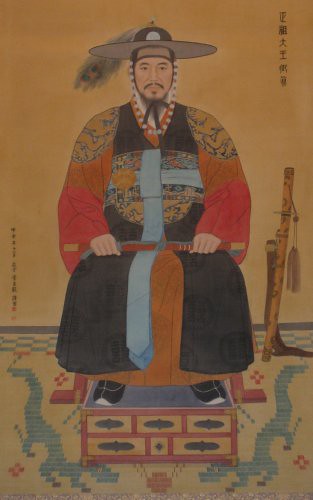
“I am the son of Prince Sado” — King Jeongjo, asserting his identity and challenging the factional politics that had defined his turbulent path to the throne.
Few rulers in the long history of the Joseon dynasty left as vivid and complex a legacy as King Jeongjo (정조), who reigned from 1776 to 1800. Coming to power under extraordinary personal and political circumstances, Jeongjo transformed his reign into one of the most remarkable periods of cultural and intellectual flourishing in Korean history. He was simultaneously a scholar-king, a political strategist, and a reformer who pushed against the entrenched power of the noble factions that had long dominated court life. To understand Jeongjo is to understand the Joseon dynasty at its most ambitious — and most fragile.
Quick Facts: King Jeongjo of Joseon
| Born | 1752 |
| Died | 1800 |
| Reign | 1776 – 1800 |
| Dynasty | Joseon |
| Father | Crown Prince Sado |
| Grandfather | King Yeongjo |
| Clan | Jeonju Yi clan |
| Key Achievement | Founded Gyujanggak Royal Library; built Hwaseong Fortress |
A Prince Born Into Tragedy
Jeongjo was born in 1752, the son of Crown Prince Sado and grandson of King Yeongjo. His early life was defined by one of the most haunting episodes in Korean royal history: the death of his father. Crown Prince Sado was killed in 1762 when King Yeongjo ordered him confined inside a rice chest, where he died over the course of eight days. The official explanations centered on erratic and violent behavior by the prince, but historians have long debated the extent to which factional court politics contributed to Sado’s downfall.
For the young Jeongjo, this event cast a permanent shadow. He grew up knowing that powerful factions at court had played roles in his father’s death, and that his own position as heir was never entirely secure. These circumstances shaped him into a cautious and deeply strategic thinker. By the time he ascended the throne in 1776, following the death of his grandfather Yeongjo, Jeongjo was prepared to use every tool available — cultural patronage, institutional reform, and careful political maneuvering — to consolidate royal authority and honor his father’s memory.
Why Did Jeongjo Create the Gyujanggak Royal Library?
One of Jeongjo’s first and most enduring acts as king was the establishment of the Gyujanggak (규장각), the royal library and academic research institute, in 1776. On the surface, the Gyujanggak was a repository for royal documents, books, and literary works. In practice, it served a far more ambitious political purpose.
The traditional Joseon bureaucracy was dominated by the entrenched aristocratic factions known as the 붕당 (bungdang). These factions controlled appointments, policy, and court opinion, leaving kings frequently hemmed in by competing noble interests. Jeongjo used the Gyujanggak to cultivate a new class of loyal scholars and officials who owed their positions directly to royal patronage rather than to factional networks. By recruiting talented men from outside the traditional elite — including those from lower-ranking noble families or previously marginalized groups — Jeongjo built a cadre of advisors and administrators personally loyal to the crown.
The Gyujanggak also became the intellectual engine of the Silhak (실학) movement, a school of practical Confucian scholarship that emphasized real-world utility over abstract classical study. Silhak thinkers questioned inherited social hierarchies, advocated practical improvements in agriculture and commerce, and even engaged with ideas arriving from China and beyond. Under Jeongjo’s sponsorship, the Gyujanggak published hundreds of texts and served as a home for some of the most brilliant minds of the era.
“The Gyujanggak was not merely a library — it was a statement of royal intent. Jeongjo was telling the factions that knowledge, and the power it carried, would now flow through the throne.”
3 Pillars of Jeongjo’s Reform Agenda
1. Curtailing Factional Power Through Royal Patronage
Jeongjo pursued a policy known as 탕평 (tangpyeong), originally introduced by his grandfather Yeongjo, which aimed to balance appointments among the competing factional groups rather than allowing any single faction to dominate. Jeongjo pushed this further, using the Gyujanggak and royal patronage networks to elevate officials who were loyal to him personally. He was not above using the symbolic weight of his father’s tragic death as a political rallying point, declaring himself publicly as the son of Prince Sado in a direct challenge to the factions who had opposed his father.
2. Hwaseong Fortress and the New Capital Vision
Perhaps the most dramatic expression of Jeongjo’s ambitions was the construction of Hwaseong Fortress in Suwon, begun in 1794 and completed in 1796. The fortress was intended not simply as a military installation but as the centerpiece of a new planned city. Jeongjo’s deeper intention was reportedly to eventually relocate the capital from Hanyang (present-day Seoul) to Suwon, removing the seat of power from the entrenched factional networks of the old capital. The construction incorporated both Korean architectural traditions and innovative new techniques, and the fortress remains one of the outstanding examples of 18th-century military architecture in East Asia. It was designated a UNESCO World Heritage Site in 1997.
3. Honoring Prince Sado and Rewriting the Historical Record
Jeongjo worked throughout his reign to rehabilitate the memory of his father, Crown Prince Sado. He relocated Sado’s tomb to a more prestigious location near Suwon and conducted elaborate ritual processions to pay his respects. These acts were simultaneously expressions of filial piety — a central Confucian virtue — and political statements asserting the legitimacy of his own lineage. By honoring Sado publicly and persistently, Jeongjo challenged those factions that had benefited from his father’s downfall.
The Cultural Renaissance of the Late Joseon Period
Jeongjo’s reign coincided with and actively promoted one of the most vibrant cultural periods in Korean history. Beyond the institutional achievements of the Gyujanggak, his era saw flourishing in literature, art, and popular culture. The genre of pansori — a form of dramatic musical storytelling performed by a single singer with a drummer — gained wider recognition during this period. Korean vernacular literature, written in Hangul rather than classical Chinese, reached broader audiences. Painters of the era, working in a style that captured scenes of everyday Korean life, produced some of the most beloved images in the Korean artistic tradition.
This cultural efflorescence was not coincidental. Jeongjo actively encouraged intellectual and artistic production, viewing cultural achievement as both an end in itself and as a means of legitimizing royal authority. A prolific writer himself, he composed thousands of poems and essays during his lifetime, leaving behind a personal literary corpus that speaks to his unusual depth as a ruler.
Jeongjo vs. Yeongjo: Two Reform-Minded Kings Compared
| Aspect | King Yeongjo (r. 1724–1776) | King Jeongjo (r. 1776–1800) |
|---|---|---|
| Factional Policy | Introduced tangpyeong (balance) policy | Extended tangpyeong; built royal patronage networks |
| Scholarly Institution | Reformed existing academies | Founded Gyujanggak Royal Library (1776) |
| Major Construction | Various palace restorations | Hwaseong Fortress (1794–1796) |
| Intellectual Climate | Supported orthodox Confucian scholarship | Patronized Silhak (practical learning) scholars |
| Legacy Controversy | Death of Crown Prince Sado | Mysterious death in 1800; unfinished reform agenda |
The Shadow at the End: Jeongjo’s Death in 1800
Jeongjo died in 1800 at the age of 48, under circumstances that have fueled historical debate for centuries. He had been in apparently good health for much of his reign, and his death came relatively suddenly. Contemporary accounts describe a rapid deterioration over a period of weeks. Some historians have suggested natural causes; others have pointed to the persistent influence of factional enemies who stood to lose the most from Jeongjo’s continued reforms. The exact circumstances remain contested.
What is beyond dispute is that Jeongjo’s death brought his reform program to an abrupt halt. His successor was a young child, and real power quickly fell into the hands of regents drawn from exactly the factional networks Jeongjo had spent his reign trying to limit. The progressive intellectual energy of the Gyujanggak was curtailed. The planned development of Suwon as a new political center was abandoned. In many respects, the decades following 1800 saw a rollback of the institutional changes Jeongjo had worked so hard to implement.
Why Jeongjo Still Matters in Korea Today
King Jeongjo occupies a unique place in Korean historical memory. He is remembered not merely as a successful monarch but as a symbol of what enlightened, reform-minded leadership might look like. His story — the son who honored his tragic father, the king who built a fortress city and a library to challenge entrenched power — resonates deeply in Korean culture. He has been the subject of novels, films, television dramas, and ongoing academic debate.
Hwaseong Fortress in Suwon stands today as one of the most visited historical sites in Korea, its walls and towers a tangible reminder of Jeongjo’s ambitions. The Gyujanggak, now housed at Seoul National University, continues to function as a research institute preserving and studying the royal archives of the Joseon dynasty. Every year, elaborate reenactments of Jeongjo’s royal procession to his father’s tomb draw thousands of visitors to Suwon, keeping alive the memory of a king who refused to forget where he came from.
Continue Exploring
On This Site
- Hwaseong Fortress: Jeongjo’s Dream in Stone
- The Gyujanggak: Korea’s Royal Library and Its Legacy
- Crown Prince Sado and the Rice Chest: A Royal Tragedy
- Silhak: The Practical Learning Movement of Joseon Korea