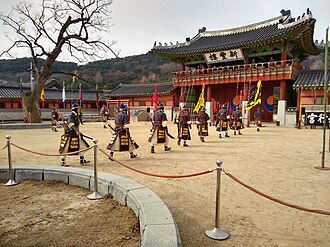
“A fortress is not merely walls and gates — it is the embodiment of a king’s will, his love for his people, and his vision for the future.”
Rising above the city of Suwon in Gyeonggi Province, Hwaseong Fortress stands as one of the most extraordinary achievements of the Joseon dynasty. Built in the final years of the eighteenth century, this magnificent walled city is not simply a military installation — it is a monument to royal ambition, filial devotion, and the remarkable ingenuity of Korean engineers. Today, it is recognised as a UNESCO World Heritage Site and remains one of the best-preserved fortress complexes on the Korean peninsula.
Quick Facts: Hwaseong Fortress at a Glance
| Location | Suwon, Gyeonggi Province, South Korea |
|---|---|
| Construction Period | 1794 – 1796 |
| Commissioned By | King Jeongjo (r. 1776–1800), Joseon dynasty |
| Perimeter | Approximately 5.7 kilometres |
| UNESCO Designation | World Heritage Site, inscribed 1997 |
| Coordinates | 37.272°N, 127.008°E |
| Designation (Korea) | Historic Site No. 3 |
Why Did King Jeongjo Build Hwaseong Fortress?
To understand Hwaseong Fortress, one must first understand the man who ordered its construction: King Jeongjo, one of the most celebrated monarchs of the Joseon dynasty. Jeongjo ascended to the throne in 1776 following a turbulent succession and spent much of his reign working to consolidate royal authority and reform the state’s bureaucratic and social structures. He was also a king deeply shaped by personal tragedy.
Jeongjo’s father, Crown Prince Sado, had died in 1762 under deeply distressing circumstances — confined within a rice chest on the orders of his own father, King Yeongjo. The memory of this event haunted Jeongjo throughout his life, and one of his most enduring acts of filial piety was the decision to relocate his father’s tomb to a site near Suwon — a place the king would make the centrepiece of a new planned city.
In 1794, construction began on a new fortress to encircle and protect this emerging city. The project was completed in just two years, in 1796 — a remarkable feat of organisation and engineering. The fortress was not simply conceived as a defensive perimeter. Jeongjo envisioned it as the heart of a new administrative capital that might eventually rival Hanyang (present-day Seoul), giving him greater independence from the powerful factional interests that dominated the capital.
A Fortress Born from Scholarship and Innovation
What makes Hwaseong Fortress truly exceptional is the intellectual rigour behind its design. King Jeongjo entrusted the project to Jeong Yakyong, one of the leading scholars of the Silhak (Practical Learning) movement — a school of thought that emphasised empirical knowledge and practical solutions over rigid adherence to classical texts. Jeong Yakyong drew on Chinese and Japanese military architecture, as well as contemporary Korean engineering knowledge, to produce a design that was both aesthetically sophisticated and functionally superior to earlier Korean fortress traditions.
One of Jeong Yakyong’s most celebrated contributions was the invention of the geojunggi, a pulley-based crane device used to lift and position the heavy stone blocks of the fortress walls. This innovation dramatically reduced the labour required and allowed construction to proceed at extraordinary speed. The use of such machinery reflected the broader Silhak commitment to applying rational, practical knowledge to real-world problems.
The construction records were meticulously preserved in a document known as the Hwaseong Seongyeok Uigwe — a comprehensive official record detailing every aspect of the building process, from the names and wages of individual workers to architectural blueprints and engineering diagrams. This document proved invaluable centuries later when restoration work was needed following damage sustained during the Korean War.
“The Hwaseong Seongyeok Uigwe is a document unlike almost any other in pre-modern East Asian history — a complete blueprint of a fortress and the human effort required to build it.”
The Architecture: Walls, Gates, and Watchtowers
The walls of Hwaseong Fortress extend approximately 5.7 kilometres around the city of Suwon, incorporating a varied landscape of hills, valleys, and flat urban terrain. The design is remarkable for the way it integrates natural topography into the defensive scheme, with walls rising and descending along ridgelines and incorporating the natural flow of streams.
Within and along the perimeter, the fortress contains an impressive array of military and administrative structures:
- Four main gates — the grand Paldalmun (south gate), Janganmun (north gate), Hwaseomun (west gate), and Changnyongmun (east gate) — each an imposing structure in its own right.
- Command posts and observation platforms — elevated positions allowing defenders to survey the surrounding landscape.
- Bastions and turrets — semi-circular extensions of the walls designed to allow flanking fire against attackers.
- Floodgates (Hwahongmun) — a particularly ingenious structure where the fortress wall crosses the Suwoncheon stream, incorporating a graceful arched watergate.
- Beacon towers — part of the nationwide communication network used to relay military signals across the peninsula.
The Hwahongmun floodgate is widely regarded as one of the most elegant structures within the complex. Its seven arched openings span the stream while its upper tier functions as a military observation platform — a seamless fusion of utility and beauty that epitomises the design philosophy of Hwaseong as a whole.
Joseon Military Architecture: How Does Hwaseong Compare?
| Feature | Hwaseong Fortress (1796) | Earlier Joseon Fortresses |
|---|---|---|
| Design Methodology | Silhak scholarly planning; drew on Chinese and Japanese examples | Largely traditional; based on established Korean precedents |
| Construction Records | Comprehensive Uigwe documentation preserved | Fragmentary or lost records for most sites |
| Worker Compensation | Workers paid wages; labour records kept | Predominantly corvée (compulsory unpaid) labour |
| Engineering Innovation | Geojunggi crane; advanced flanking bastions | Traditional stone and earthwork methods |
| Urban Integration | Designed as part of a planned new city | Typically defensive only; not city-planning focused |
One particularly progressive aspect of Hwaseong’s construction was the treatment of the workers who built it. Rather than relying on the traditional corvée system of compulsory unpaid labour, King Jeongjo ordered that all workers engaged in the construction be paid fair wages. Detailed records were kept of every individual employed on the project — a remarkable departure from standard practice that reflected the Silhak movement’s concern for the welfare of ordinary people.
The Fortress Through History: Survival and Restoration
Hwaseong Fortress survived the turbulent centuries following its completion largely intact, though it suffered considerable damage during the Korean War (1950–1953), when artillery and bombing destroyed several sections of the walls and a number of the gate structures. In the decades following the war, restoration work was undertaken using the extraordinarily detailed plans preserved in the original Hwaseong Seongyeok Uigwe. The availability of these records allowed restorers to rebuild damaged sections with a degree of historical accuracy that would have been impossible without them.
By the 1970s and 1980s, major restoration efforts had returned the fortress to something close to its original appearance. In 1997, this achievement was recognised internationally when Hwaseong Fortress was inscribed on the UNESCO World Heritage List. The UNESCO citation highlighted the fortress as an outstanding example of late eighteenth-century military architecture in East Asia and praised the integration of advances in science and technology with aesthetic considerations.
Hwaseong Today: A Living Heritage Site
Unlike many ancient monuments that exist purely as museum pieces, Hwaseong Fortress is woven into the daily life of Suwon, a city of more than a million people. Residents walk sections of the walls as part of their daily routines, and the fortress perimeter serves as a beloved urban park. The area within and around the walls contains traditional markets, restaurants, cultural venues, and the Hwaseong Haenggung — the detached palace compound where King Jeongjo would stay during his visits to Suwon to pay respects at his father’s tomb.
Cultural events tied to the fortress calendar draw visitors throughout the year. A re-enactment of King Jeongjo’s royal procession to Suwon — one of the great ceremonial events of the Joseon period — is staged annually, involving hundreds of participants in period costume. The Hwaseong Cultural Festival has become one of the most anticipated heritage events in the Gyeonggi region.
The fortress is also a popular destination for travellers exploring Korea’s heritage trail. It sits within easy reach of Seoul, making it one of the most accessible major historical sites on the peninsula, and it rewards visitors with sweeping views from its walls and a genuine sense of immersion in late Joseon history.
Continue Exploring
Deepen your understanding of Hwaseong Fortress and Korean history with these resources: