“Your divine strategy has plumbed the heavens; your subtle reckoning has exhausted the earth. You win every battle and your military merit is already high enough. Why not be content and stop the war?”
Battle of Salsu: How Goguryeo Stopped the Sui Empire
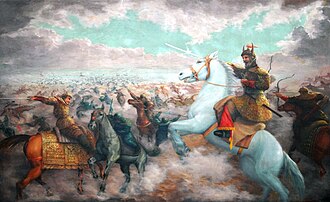
In the summer of 612 AD, one of the largest armies ever assembled in the ancient world marched toward the Korean peninsula. The Sui dynasty of China, at the height of its imperial power, had dispatched hundreds of thousands of soldiers to crush the kingdom of Goguryeo — a state that had long dominated the northern Korean peninsula and Manchuria and refused to submit to Sui authority. What followed was not a quick conquest but a catastrophic defeat for the invaders. At the Salsu River, a brilliant Goguryeo commander named Eulji Mundeok orchestrated a rout so devastating that it would be remembered for centuries as one of the defining moments of Korean resistance. The Battle of Salsu was not merely a military engagement — it was a declaration that Goguryeo could not be broken.
Quick Facts: Battle of Salsu
| Date | 612 AD |
|---|---|
| Location | Salsu River (believed to be the Cheongcheon River, in present-day North Korea) |
| Belligerents | Goguryeo vs. Sui China |
| Goguryeo Commander | Eulji Mundeok |
| Sui Commanders | Yu Zhongwen, Yuwen Shu |
| Result | Decisive Goguryeo victory |
| Significance | Contributed to the collapse of the Sui dynasty |
Background: Why Did the Sui Dynasty Invade Goguryeo?
To understand the Battle of Salsu, it is essential to appreciate the geopolitical tensions that had been building between Goguryeo and the newly unified Chinese empire. The Sui dynasty, founded in 581 AD, had ended nearly four centuries of division in China and set its sights on extending its authority across East Asia. Emperor Yang of Sui regarded Goguryeo’s independent stance as an affront to the imperial order he was trying to construct. Goguryeo, for its part, had been a powerful regional force for centuries, maintaining diplomatic and sometimes military relationships with various Chinese states, the Korean kingdoms of Baekje and Silla, and the steppe peoples of the north.
Earlier Sui attempts to bring Goguryeo to heel had already failed. Emperor Wen of Sui had launched a campaign in 598 AD that ended in disaster, with the Sui army suffering from disease and logistical collapse before it could engage Goguryeo’s forces in a major battle. This failure only intensified the desire of the Sui court to eventually settle the matter by force. When Emperor Yang came to power, he resolved to succeed where his predecessor had not. The 612 campaign would be the largest and most ambitious effort yet — a multi-pronged assault intended to overwhelm Goguryeo by sheer numbers.
The Scale of the Sui Invasion
Historical sources record the 612 invasion as a truly enormous undertaking. The Sui assembled a force that, including supply troops and support personnel, is said by Chinese chronicles to have numbered over a million men — though modern historians treat such figures with caution, recognizing that ancient sources often exaggerated military strength for rhetorical effect. Even accounting for such inflation, the army that crossed into Goguryeo territory was vast by the standards of the ancient world. The sheer logistical challenge of feeding, moving, and coordinating such a force across difficult terrain was staggering.
The Sui strategy involved a combined land and naval assault. A large fleet was dispatched to attack along the coast while the main land army pushed toward Goguryeo’s capital, Pyongyang. The plan was bold in conception but depended heavily on everything going according to schedule — a dangerous assumption when dealing with Goguryeo’s resilient and experienced defenders.
The Goguryeo defenders demonstrated that patience, strategic deception, and knowledge of one’s own terrain could defeat an enemy of far greater numerical strength.
Eulji Mundeok: The Architect of Victory
At the heart of Goguryeo’s response to the Sui onslaught was General Eulji Mundeok, one of the most celebrated military commanders in Korean history. His methods were not those of a commander who sought open battle against a superior force. Instead, he employed a strategy of deliberate retreat, harassment, and deception designed to exhaust the Sui army before delivering a decisive blow.
In a remarkable episode that illustrates his boldness, Eulji Mundeok reportedly visited the Sui camp under the guise of a diplomatic mission, personally assessing the condition and disposition of the enemy forces. Recognizing that the Sui army was overextended and suffering from supply shortages, he returned to his own lines and accelerated his strategy of controlled withdrawal, fighting skirmishes and then retreating to draw the Sui forces deeper into Goguryeo territory.
The poem he sent to Sui general Yu Zhongwen — quoted at the opening of this article — was not merely mockery. It was a calculated piece of psychological warfare, suggesting that the Sui forces had achieved enough glory and should withdraw, while also demonstrating Goguryeo’s confidence and composure. Yu Zhongwen, aware that the campaign was faltering and that his supply lines were strained to breaking point, eventually made the decision to turn back.
3 Key Reasons Goguryeo Won the Battle of Salsu
1. Strategic Exhaustion of the Enemy
Eulji Mundeok understood that the Sui army’s greatest weakness was not its fighting quality but its logistical vulnerability. By forcing the Sui forces to march deep into Goguryeo territory through difficult terrain, he ensured they arrived at the Salsu River already weakened by hunger, disease, and the strain of constant skirmishing. Records indicate that Sui soldiers were so short of food that many had discarded their rations to lighten their loads during the advance — a decision they would come to regret.
2. The River Trap
The killing blow was delivered at the Salsu River, believed by historians to correspond to the present-day Cheongcheon River in what is now North Korea. As the Sui army attempted to cross the river during its retreat, Goguryeo forces launched a ferocious attack. Some accounts describe a dam or barrier upstream being released to flood the crossing and disrupt the Sui formations, though the precise details vary across sources. What is agreed upon is that the Goguryeo assault at the river crossing turned an orderly retreat into a catastrophic rout.
3. Knowledge of Terrain and Home Advantage
Goguryeo’s commanders and soldiers knew their own land intimately. They understood the rivers, the valleys, the fortifications, and the seasonal conditions in ways that their invaders could not match. This geographical knowledge allowed Eulji Mundeok to choose precisely where and when to spring his trap, maximizing the damage inflicted on an enemy that was already disoriented and desperate.
The Aftermath: A Catastrophic Defeat
The scale of the Sui defeat at Salsu was staggering. Historical sources state that of the approximately 305,000 soldiers in the main Sui expeditionary column that had advanced toward Pyongyang, only around 2,700 returned. Even allowing for the likelihood of exaggeration in the sources, this figure suggests a defeat of extraordinary magnitude — a near-total destruction of one of the ancient world’s most powerful military forces.
The consequences extended far beyond the Korean peninsula. Emperor Yang of Sui launched two more campaigns against Goguryeo in 613 and 614, both of which also failed. The enormous cost in men, resources, and prestige severely weakened the Sui dynasty. Popular rebellions erupted across China, and the dynasty that had united the empire after centuries of division collapsed in 618 AD — just six years after the Battle of Salsu. The Tang dynasty that replaced it would also eventually clash with Goguryeo, but the Salsu victory had bought the kingdom decades of survival and demonstrated the limits of even the mightiest Chinese imperial power.
Comparison: Sui Invasions of Goguryeo
| Campaign | Year | Sui Emperor | Outcome |
|---|---|---|---|
| First Sui Invasion | 598 AD | Emperor Wen | Sui forces collapsed due to disease and logistics before major battle |
| Second Sui Invasion | 612 AD | Emperor Yang | Decisive Goguryeo victory at the Battle of Salsu; catastrophic Sui losses |
| Third Sui Invasion | 613 AD | Emperor Yang | Sui forces withdrew due to rebellion at home |
| Fourth Sui Invasion | 614 AD | Emperor Yang | Inconclusive; Sui dynasty collapsed four years later |
Legacy: Why the Battle of Salsu Still Matters in Korea
The Battle of Salsu occupies a singular place in Korean historical memory. Eulji Mundeok is remembered not just as a general but as a symbol of Korean ingenuity and determination in the face of overwhelming odds. His name has been attached to streets, institutions, and cultural references in modern Korea, and he is consistently ranked among the greatest military figures in Korean history.
The battle also raises important questions about the relationship between military victory and cultural survival. Goguryeo’s successful resistance to Sui allowed it to preserve its distinct political and cultural identity at a moment when absorption into the Chinese imperial system seemed possible. The kingdom would continue for another half century before eventually falling to a Tang-Silla alliance in 668 AD, but the events of 612 had already written one of its most glorious chapters.
For students of Korean history, the Battle of Salsu is also a reminder that the Korean peninsula has always been a place where world-historical forces collide — and where the people living there have often found ways to survive, resist, and endure. The genius of Eulji Mundeok was to understand his enemy’s weakness as well as his own kingdom’s strength, and to use both with devastating precision.