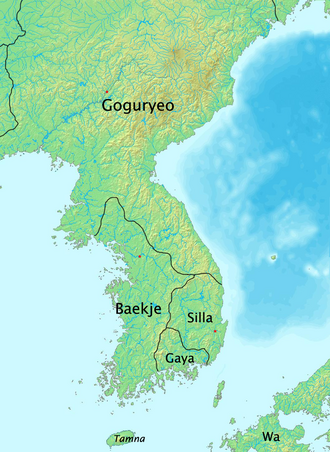
“Of the Three Kingdoms of ancient Korea, Baekje was perhaps the most cosmopolitan — a maritime kingdom whose art, Buddhism, and statecraft crossed the sea to reshape Japan and beyond.”
What Was the Kingdom of Baekje?
Among the Three Kingdoms of ancient Korea — Goguryeo, Silla, and Baekje — it is Baekje that often receives the least attention in popular history. Yet this southwestern kingdom, which endured for nearly seven centuries, left an extraordinary cultural and political legacy that stretched far beyond the Korean peninsula. Founded in 18 BC and finally conquered in 660 AD by a combined Silla-Tang Chinese alliance, Baekje was a sophisticated state that acted as a vital cultural bridge between the Korean peninsula, China, and the Japanese archipelago.
Baekje occupied the southwestern portion of the Korean peninsula, covering what is today the provinces of Gyeonggi, South Chungcheong, and North Jeolla. Its strategic position along the Yellow Sea made it a natural maritime power, fostering trade and diplomacy with the states of China and the islands of Japan. Over the centuries, Baekje moved its capital multiple times — from Wiryeseong (near modern Seoul) to Ungjin (modern Gongju) and finally to Sabi (modern Buyeo) — each relocation reflecting the shifting pressures of warfare and politics that defined this era.
| Founded | 18 BC (traditional date) |
| Dissolved | 660 AD |
| Period | Three Kingdoms of Korea |
| Capital Cities | Wiryeseong, Ungjin (Gongju), Sabi (Buyeo) |
| Territory | Southwestern Korean peninsula (modern Gyeonggi, South Chungcheong, North Jeolla provinces) |
| Religion | Buddhism (adopted officially in 384 AD); indigenous beliefs |
| Notable Neighbors | Goguryeo, Silla, Tang China, Yamato Japan |
| Conquered By | Silla–Tang alliance, 660 AD |
Origins and the Rise of a Kingdom
According to Korean historical tradition, Baekje was founded by Onjo, a son of Jumong — the legendary founder of Goguryeo. This origin story, preserved in the Samguk Sagi (History of the Three Kingdoms), speaks to the deep dynastic and ethnic connections that linked the kingdoms of ancient Korea even as they competed fiercely with one another. Whether the founding narrative is taken as literal history or as a legitimizing myth crafted by later court historians, it reflects the early importance of lineage and royal authority in Baekje’s political culture.
In its early centuries, Baekje expanded steadily, absorbing smaller tribal confederacies in the Han River basin area and eventually consolidating control over the rich agricultural lowlands of the southwest. This fertile heartland gave Baekje an economic foundation that supported a literate bureaucratic class, skilled artisans, and a powerful military. The kingdom’s ruling elite adopted Chinese administrative models and writing, channeling the sophisticated governance structures of the Han and later Chinese dynasties into a distinctly Korean context.
Buddhism, Art, and the Culture of Baekje
One of the most enduring contributions of Baekje to Korean and East Asian civilization was its role in transmitting Buddhism. Buddhism officially entered Baekje in 384 AD, when the monk Marananta arrived from the Eastern Jin dynasty of China. The royal court embraced the new faith with enthusiasm, and Buddhist monasteries, temples, and pagodas began to dot the landscape of the kingdom.
Baekje’s artistic tradition became celebrated for its elegance and refinement. The famous Baekje Smile — a serene, gentle expression found on Buddhist sculptures produced in the kingdom — came to symbolize the particular aesthetic sensibility that Baekje craftsmen brought to religious art. Stone Buddha statues, gilt-bronze incense burners, and intricately decorated roof tiles all reflect a culture that prized beauty and spiritual sophistication in equal measure.
“The Baekje Smile — that subtle, tranquil expression carved into stone and bronze — became one of the most recognizable artistic signatures of ancient Korea, reflecting a culture that elevated grace and serenity to a national ideal.”
Perhaps nowhere is Baekje’s cultural influence more dramatically visible than in Japan. The Yamato court of ancient Japan maintained close and warm relations with Baekje for centuries, and Baekje artisans, scholars, monks, and officials crossed the sea to settle in Japan and share their knowledge. It is recorded that Baekje transmitted Buddhism to Japan in the mid-sixth century, an event of world-historical importance. Baekje craftsmen helped construct some of Japan’s earliest Buddhist temples, and Baekje scribes introduced the Chinese writing system to the Japanese court. The influence of Baekje on early Japanese civilization — in religion, art, architecture, and statecraft — was so profound that Japan would later mourn the kingdom’s fall as if losing a close ally and cultural parent.
3 Reasons Baekje Mattered Beyond Korea
- Transmission of Buddhism to Japan: Baekje served as the primary conduit through which Buddhism traveled from the Asian continent to the Japanese archipelago. This religious transmission reshaped Japanese civilization, influencing art, philosophy, and politics for centuries to come.
- Maritime Diplomacy and Trade: Baekje’s Yellow Sea coastline made it a natural maritime hub. The kingdom maintained active diplomatic and trade relationships with multiple Chinese states simultaneously, absorbing continental culture and technology and acting as a relay station for ideas moving between China and Japan.
- Artistic Innovation: Baekje developed a distinctive artistic tradition — characterized by elegance, restraint, and spiritual depth — that influenced Korean and Japanese aesthetics for generations. The gilt-bronze Incense Burner of Baekje, discovered in the twentieth century, stands as one of the masterpieces of ancient East Asian metalwork.
Rivalry, War, and the Fall of Baekje
The history of Baekje is inseparable from the intense, often violent rivalry among the Three Kingdoms. Baekje and Goguryeo — despite sharing a legendary common ancestry — were frequently at war, and it was pressure from Goguryeo that forced Baekje to abandon its original capital in the Han River basin in the fifth century. The kingdom relocated its court southward to Ungjin (modern Gongju) in 475 AD after Goguryeo forces sacked the Baekje capital and killed King Gaegeun.
The kingdom later moved its capital again to Sabi (modern Buyeo), where it experienced a remarkable cultural renaissance in the sixth and early seventh centuries. New palaces, temples, and planned urban spaces transformed Sabi into one of the most sophisticated cities in East Asia. Yet even as Baekje’s culture flourished, its political position grew increasingly precarious. The kingdom found itself caught between the rising power of Silla to the east and the ever-present threat of Chinese imperial ambition from the west.
The end came swiftly. In 660 AD, a massive Tang Chinese naval force combined with Silla land armies to overwhelm Baekje’s defenses. The last Baekje king, Uija, was captured and taken to China, where he died in exile. Loyal Baekje officials and generals mounted a fierce resistance — including a dramatic but ultimately unsuccessful appeal to Japan for military assistance — but the kingdom could not be restored. Baekje was extinguished, its territory absorbed into what would eventually become a unified Korean state under Silla.
| Kingdom | Location | Founded | Fell | Key Legacy |
|---|---|---|---|---|
| Baekje | Southwest Korea | 18 BC | 660 AD | Buddhism to Japan; maritime culture; refined arts |
| Goguryeo | Northern Korea & Manchuria | 37 BC | 668 AD | Military strength; mural tombs; resistance to Chinese empires |
| Silla | Southeast Korea | 57 BC | 935 AD | Unification of peninsula; Gyeongju culture; gold artifacts |
Why Did Baekje Fall to the Silla-Tang Alliance?
Historians have long debated why Baekje — a kingdom of considerable cultural sophistication and military experience — fell so rapidly to the Silla-Tang coalition in 660 AD. Several factors appear to have contributed. Internal court factionalism weakened the kingdom’s ability to respond decisively to external threats in its final decades. King Uija, the last ruler, has been criticized in traditional Korean historical accounts for indulging in court excess and ignoring warnings from loyal ministers. Whether or not these characterizations are entirely fair, there is no doubt that the coordination between Silla and Tang China created a military force that Baekje could not match alone.
Japan’s military assistance, when it finally arrived in 663 AD at the Battle of Baekgang (Hakusonko), was defeated decisively by Tang naval forces. This battle — one of the largest naval engagements in early East Asian history — effectively ended any hope of Baekje’s restoration and also marked a turning point in Japan’s relationship with the continent, prompting the Yamato court to accelerate its own program of internal reform and consolidation.
The Legacy of Baekje Today
Though the kingdom itself vanished over thirteen centuries ago, the legacy of Baekje remains visible and celebrated. The modern South Korean cities of Gongju and Buyeo — sites of Baekje’s last two capitals — preserve extraordinary archaeological remains, including royal tombs, palace foundations, and temple ruins. In 2015, the Baekje Historic Areas were inscribed as a UNESCO World Heritage Site, recognizing the outstanding universal value of the archaeological sites associated with the kingdom’s final two capital cities and the surrounding region.
Museums in Korea hold remarkable Baekje artifacts: the gilt-bronze Baekje Incense Burner, discovered in 1993, is considered one of the finest examples of ancient Korean metalwork. Its elaborate imagery — featuring dragons, phoenixes, lotus blossoms, and celestial musicians — encapsulates the spiritual and artistic ambitions of a kingdom that, even in death, refused to be forgotten.
In Japan, the memory of Baekje (known in Japanese as Kudara) also persists. The Japanese proverb “Kudara nai” — meaning something is worthless or trivial — is sometimes interpreted as reflecting the historical esteem in which ancient Japanese courts held things of Baekje origin: if something did not come from Baekje, it was considered of lesser value. While the etymology is debated, the phrase itself gestures toward the remarkable depth of Baekje’s cultural prestige in the ancient Japanese world.
Continue Exploring
- Baekje — Wikipedia: Full historical overview of the kingdom
- Encyclopedia of Korean Culture (AKS) — Explore Baekje in depth
- Baekje Historic Areas — UNESCO World Heritage Site listing
- National Museum of Korea — Baekje artifacts and collections
- Baekje — Encyclopædia Britannica
- Visit Korea — Gongju and Buyeo: Baekje heritage sites to visit today