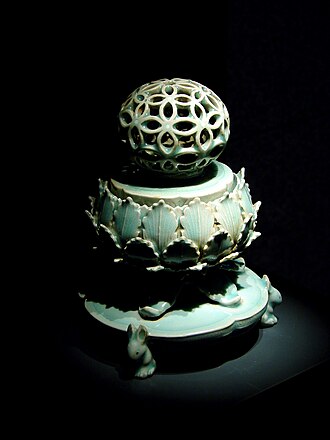
“The first is the azure sky after rain; the second is the antique mirror; the third is Goryeo’s celadon.” — A Chinese connoisseur’s ranking of the world’s most treasured objects, as recorded in historical sources
Few objects in Korean history have inspired as much admiration — or as much scholarly fascination — as Goryeo celadon. Produced during the Goryeo dynasty (918–1392), these ceramic vessels are celebrated for their distinctive jade-green glaze, their refined elegance, and above all for the sanggam inlay technique that made Korean ceramics unlike anything else in the world. Today, Goryeo celadon is recognized as one of the supreme achievements of Korean civilization, prized by collectors and museums from Seoul to New York to London.
Yet Goryeo celadon was not born fully formed. It evolved over centuries, drawing on Chinese influences before developing into something entirely its own — a ceramic tradition so distinctive that even Chinese officials of the Song dynasty reportedly marveled at its quality. To understand Goryeo celadon is to understand a great deal about the culture, values, and artistic sensibility of the Goryeo kingdom itself.
Quick Facts: Goryeo Celadon at a Glance
| Feature | Detail |
|---|---|
| Dynasty | Goryeo (918–1392) |
| Primary production period | 10th–14th centuries |
| Signature technique | Sanggam (inlaid) decoration |
| Distinctive color | Jade green (biridaek) |
| Main kiln sites | Gangjin and Buan, South Korea |
| Key influences | Chinese Yue ware and Ru ware of the Song dynasty |
| Current status | National treasures held in Korean and international museums |
Where Did Goryeo Celadon Come From? The Origins of a Ceramic Tradition
The story of Goryeo celadon begins with cultural exchange. When the Goryeo dynasty was established in 918 by Wang Geon, the Korean peninsula was already engaged in active trade and diplomatic contact with Tang and later Song dynasty China. Korean potters were well aware of Chinese celadon traditions — particularly the prized Yue ware of southern China, admired for its greenish glaze — and in the early Goryeo period, Korean ceramics showed strong Chinese influence.
The earliest Goryeo celadons, dating roughly to the late 10th and early 11th centuries, were close in style to their Chinese counterparts. Kilns in the southwestern regions of the Korean peninsula — particularly in what are now Gangjin in South Jeolla Province and Buan in North Jeolla Province — produced wares that closely resembled imported Song dynasty ceramics. Archaeologists have confirmed that these two regions remained the heartland of Goryeo celadon production throughout the dynasty’s history.
But Korean potters were not content to merely imitate. Over the course of the 11th and 12th centuries, they developed their own approaches to glaze chemistry, kiln technique, and decoration. The result was a glaze color that contemporaries described as biridaek — a subtle, luminous jade green that was distinctly Korean and widely regarded, even by Chinese observers, as superior in beauty to Chinese celadon glazes.
The Sanggam Technique: Korea’s Gift to World Ceramics
If the jade-green glaze made Goryeo celadon beautiful, it was the sanggam inlay technique that made it revolutionary. Developed by Korean potters during the 12th century, sanggam was an innovation with no true parallel in the ceramic traditions of China or anywhere else at the time.
The process was painstaking. Potters would first shape a vessel from clay and allow it to partially dry. They would then carve designs into the clay surface — delicate motifs such as cranes, clouds, lotuses, willow trees, and scrolling vines. Into these carved recesses, they pressed white or black slip (liquid clay). After the excess slip was scraped away, the surface was smooth, with the inlaid design flush with the vessel wall. The piece was then coated with the celadon glaze and fired in the kiln.
The result was extraordinary: after firing, the inlaid areas appeared as crisp white or dark designs beneath the translucent green glaze, creating an effect of remarkable subtlety and depth. Cranes seemed to float through misty skies. Lotus flowers bloomed with quiet grace. The sanggam technique allowed Korean potters to combine the sculptural and the painterly in a single ceramic object.
“Goryeo celadon represents a moment when Korean artisans took an imported tradition and transformed it into something entirely their own — a ceramic art of such refinement that it stands among the great achievements of world craft history.”
The range of objects produced using the sanggam technique was wide. Goryeo potters made celadon wine ewers, bowls, cups, incense burners, vases, pillows, and even roof tiles. Some of the most celebrated pieces take the form of vessels shaped like animals or natural objects — a famous example is the celadon ewer in the form of a bamboo shoot, or the iconic ewer shaped like a melon. These sculptural pieces demonstrate both technical mastery and a playful appreciation for natural forms.
Who Used Goryeo Celadon — and Why It Mattered
Goryeo celadon was not an everyday item. It was produced for the aristocracy, the Buddhist clergy, and the royal court. In the hierarchical society of Goryeo, the quality of the objects surrounding a person signaled their status and refinement. Celadon vessels were used in court rituals, Buddhist ceremonies, and elite dining. The finest pieces were reserved for royal use or presented as diplomatic gifts to foreign rulers and envoys.
Buddhism played a particularly important role in shaping the demand for celadon. The Goryeo dynasty was deeply Buddhist, and monasteries were major consumers of fine ceramics. Incense burners, ritual water vessels, and offering bowls of celadon were standard equipment in high-status Buddhist settings. Some of the most exquisite surviving pieces are clearly Buddhist in function and iconography.
The association of celadon with elite culture also meant that the finest kilns operated under close aristocratic and royal patronage. Official kilns — known as gwan yo — produced wares specifically for court use, and their output was of correspondingly high quality. The distinction between official and commercial kiln production is visible in surviving pieces: official wares tend to be more refined in shape, more carefully glazed, and more elaborate in their inlaid decoration.
Comparing Goryeo Celadon Across Its Golden Age and Decline
| Period | Approximate Dates | Characteristics |
|---|---|---|
| Early Period | Late 10th – early 12th century | Strong Chinese influence; plain or simply decorated wares; development of the jade-green glaze |
| Golden Age | Mid-12th – early 13th century | Peak refinement; sanggam inlay technique at its height; most celebrated surviving masterpieces date from this era |
| Middle Period | Mid-13th century | Continued high quality; some diversification of decorative motifs; effects of Mongol invasions begin to be felt |
| Late Period / Decline | Late 13th – 14th century | Decline in glaze quality and refinement; disruption of kiln operations due to Mongol invasions; gradual transition toward Joseon-era buncheong ware |
Why Did Goryeo Celadon Eventually Decline?
The golden age of Goryeo celadon came to an end not through any failure of artistic ambition, but through the catastrophic disruption of the Mongol invasions of Korea, which began in 1231 and continued intermittently for decades. The invasions devastated the Korean countryside, and the kiln districts of Gangjin and Buan were not spared. Skilled potters were killed or displaced. The patronage networks that had supported the finest celadon production were disrupted. The aristocratic and royal patrons who had driven demand for the highest-quality wares found their resources depleted by decades of warfare and tribute obligations to the Mongol Yuan dynasty.
The celadon produced in the late Goryeo period is visibly inferior to the masterpieces of the 12th century. Glazes became murkier. Inlay work grew cruder. The refined shapes of the golden age gave way to heavier, less graceful forms. By the time the Joseon dynasty replaced Goryeo in 1392, the celadon tradition was already fading, replaced gradually by the buncheong ware and then the white porcelain that would define Joseon-era Korean ceramics.
Yet even in decline, Goryeo celadon retained its prestige. The finest pieces had long since entered royal and aristocratic collections, where they were preserved with care. And the legacy of the sanggam technique, in particular, continued to influence Korean ceramic aesthetics for centuries afterward.
Goryeo Celadon Today: Treasures in Museums and Ongoing Discovery
Today, Goryeo celadon is one of the most sought-after categories of Korean art in the world. Major collections are held at the National Museum of Korea in Seoul, the Leeum Samsung Museum of Art, the Metropolitan Museum of Art in New York, the Victoria and Albert Museum in London, and many other institutions. Individual pieces regularly achieve record prices at international auction houses.
In Korea, many of the finest surviving pieces have been designated National Treasures or Treasures under the Cultural Heritage Protection Act. The kiln sites at Gangjin and Buan have been excavated by archaeologists, yielding thousands of ceramic fragments and providing detailed evidence of production techniques, kiln organization, and the range of forms produced. The Gangjin Celadon Museum, located near the historic kiln sites, preserves this heritage and offers visitors an opportunity to understand the full scope of the tradition.
Contemporary Korean potters continue to study and recreate the sanggam technique, and celadon revival has been an important thread in modern Korean craft practice. The legacy of Goryeo celadon is not merely historical: it remains a living part of Korean cultural identity, a symbol of the aesthetic refinement and technical mastery that Korean artisans achieved during one of the most brilliant periods in the peninsula’s history.
Continue Exploring
Deepen your understanding of Goryeo celadon and Korean ceramic history with these resources:
- Goryeo Ware — Wikipedia: A comprehensive overview of Goryeo ceramic history and technique.
- Encyclopedia of Korean Culture (encykorea.aks.ac.kr): Scholarly entries on Goryeo ceramics, kiln sites, and the sanggam technique.
- National Museum of Korea: Home to one of the world’s finest collections of Goryeo celadon.
- Cultural Heritage Administration of Korea: Official information on Goryeo celadon pieces designated as National Treasures.
- Celadon — Britannica: Broader context on celadon traditions in East Asia.
- Asia Society: Essays and exhibition resources on Korean art and ceramics.