“Between the great kingdoms of the peninsula, a federation of iron-masters built a civilization that history nearly forgot.”
For centuries, Korean history has been told as a story of three kingdoms — Goguryeo, Baekje, and Silla. Yet tucked along the fertile river valleys of the southern peninsula, a fourth power quietly flourished for nearly five hundred years. The Kaya Confederacy (also romanized as Gaya) was not a single unified state but a remarkable alliance of independent chiefdoms that together produced some of the finest ironwork in East Asia, traded across the seas, and left behind a cultural legacy that modern Korea is only beginning to fully reclaim.
Dismissed for generations as a minor footnote between more glamorous kingdoms, Kaya has experienced a dramatic reassessment. Archaeological excavations, renewed scholarly interest, and even UNESCO recognition have brought this “forgotten” federation back into the spotlight where it belongs.
Quick Facts: The Kaya Confederacy at a Glance
| Detail | Information |
|---|---|
| Also Known As | Gaya Confederacy; Karak |
| Period | Approximately 1st century CE – 562 CE |
| Location | Southern Korean peninsula, centered around the Nakdong River basin |
| Political Structure | Confederacy of independent chiefdoms, not a centralized monarchy |
| Key Polities | Geumgwan Gaya, Daegaya, Aragaya, Sogaya, and others |
| Known For | Iron production and trade, distinctive burial mounds, the gayageum instrument |
| End | Absorbed by Silla; final polity fell in 562 CE |
| Modern Recognition | Gaya Tumuli inscribed as UNESCO World Heritage Site in 2023 |
Origins: Where Did Kaya Come From?
The origins of the Kaya Confederacy are interwoven with legend and archaeology in equal measure. Traditional accounts, preserved in texts such as the Samguk Yusa (Memorabilia of the Three Kingdoms), describe the founding of Geumgwan Gaya — the earliest and most prominent of the Kaya polities — by a semi-divine king named Suro, who was said to have descended from the heavens in a golden egg. While modern historians treat such foundation myths with appropriate scholarly caution, the archaeological record confirms that the Kaya region was inhabited by sophisticated Iron Age communities well before the common era.
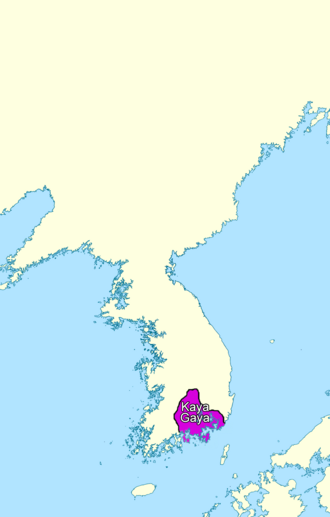
Geographically, the Kaya polities occupied the Nakdong River basin in what is today the southeastern corner of the Korean peninsula — roughly corresponding to the modern provinces of South Gyeongsang and North Gyeongsang. This location was not incidental. The river provided natural routes for trade and agriculture, and the surrounding mountains contained rich deposits of iron ore that would become the lifeblood of Kaya’s economy and regional influence.
Unlike the Three Kingdoms, which each eventually centralized power under strong monarchies, Kaya remained a confederacy throughout its existence. Individual chiefdoms maintained their own rulers, territories, and identities while cooperating — sometimes — on matters of shared interest. This political structure was both a strength and, ultimately, a vulnerability.
The Iron Economy: Why Kaya Mattered to East Asia
If there is one reason the Kaya Confederacy punched above its weight in ancient East Asia, it was iron. The chiefdoms of the Nakdong River basin sat atop some of the most productive iron ore deposits on the peninsula, and they developed the smelting and smithing technologies to exploit them with remarkable efficiency.
Kaya iron was not merely used locally. Archaeological and historical evidence shows that Kaya exported iron ingots and finished iron goods across a wide network that included the Korean peninsula, the Japanese archipelago, and parts of China. Iron served not only as a material for weapons and tools but also — fascinatingly — as a form of currency in ancient East Asia. Kaya’s control over iron production gave its chieftains economic leverage that translated into political and military influence far beyond what a simple map of the peninsula might suggest.
“Kaya iron did not merely build swords — it built relationships, alliances, and a trade network that stretched from the peninsula to the Japanese islands.”
The connections between Kaya and the Wa people of the Japanese archipelago are particularly significant and have been the subject of ongoing scholarly debate. Japanese and Korean archaeological sites have yielded strikingly similar artifacts — tomb goods, pottery styles, iron objects — that point to sustained cultural and commercial exchange. Some historians have argued that Kaya migrants and craftspeople played a meaningful role in the development of early Japanese material culture, though the precise nature and scale of this influence remain contested.
Life and Culture in the Kaya Chiefdoms
Beyond iron, the Kaya Confederacy produced a rich material culture that is only now receiving the scholarly attention it deserves. The most dramatic evidence of Kaya civilization survives in the form of burial mounds — enormous earthen tumuli that dot the landscape of the modern Gyeongsang provinces and which were inscribed as a UNESCO World Heritage Site in 2023 under the collective name Gaya Tumuli.
These burial mounds are treasure troves of information about Kaya society. Excavations have uncovered elaborate grave goods: iron armor, bronze ornaments, distinctive pottery with geometric patterns, glass beads traded from distant lands, and items that reveal a society far more cosmopolitan than its historical neglect might imply. The tombs of Kaya elites were large and elaborately constructed, signaling a society with clear hierarchies, significant agricultural surpluses, and sophisticated craft production.
One of the most enduring cultural contributions attributed to the Kaya region is the gayageum, a twelve-stringed zither that remains one of Korea’s most beloved traditional instruments. Historical tradition credits its creation to Ureuk, a musician from the Kaya region, who later brought the instrument and its musical tradition to the Silla court. Whether or not the gayageum originated entirely within Kaya, its name preserves the memory of the confederation in every performance to this day.
3 Reasons Kaya Was Overlooked for So Long
1. The Winners Write History
The most fundamental reason for Kaya’s historical marginalization is simply that it was absorbed — not a conqueror. When the Silla kingdom completed its unification of the peninsula in the seventh century, the historical narrative that emerged celebrated Silla, Goguryeo, and Baekje as the protagonists. Kaya, having been absorbed by Silla decades before unification, left no ruling dynasty to commission its own chronicles. The Samguk Sagi (History of the Three Kingdoms), compiled in 1145, structures Korean history around three kingdoms — and Kaya is not one of them.
2. A Confederacy Without a Unified Voice
Kaya’s political decentralization, which gave it flexibility and resilience for centuries, also meant that no single Kaya ruler or capital city dominated the historical memory. There was no equivalent of Goguryeo’s Pyongyang or Silla’s Gyeongju to serve as a focal point for heritage and identity. Without a centralized state to preserve archives, build grand palaces, or propagate a unified royal mythology, Kaya’s story was scattered across dozens of smaller sites.
3. Modern Nationalism and the Three Kingdoms Framework
The modern academic framework of Korean history, shaped significantly during the Japanese colonial period and the nationalist movements that followed, tended to organize the ancient past around the familiar Three Kingdoms narrative. This framework served important cultural and political purposes but left little room for the complexity that Kaya represented. Only in recent decades, as Korean archaeology matured and as post-nationalist historiography gained ground, has serious scholarly attention turned to recovering Kaya’s place in the story.
The Fall of Kaya: Absorbed, Not Conquered All at Once
The end of the Kaya Confederacy was not a single dramatic defeat but a gradual process of absorption that unfolded over more than a century. Caught between the expanding power of Silla to the east and Baekje to the west, and periodically subjected to pressure from the Wa of Japan and Goguryeo to the north, the individual Kaya chiefdoms found their room to maneuver steadily shrinking from the fifth century onward.
Geumgwan Gaya, the oldest and originally most powerful of the Kaya polities, was the first major chiefdom to fall, surrendering to Silla in 532 CE. Leadership of the confederation had by then passed to Daegaya, based further inland. But Daegaya too could not resist the relentless pressure of a Silla kingdom that was systematically consolidating control over the peninsula. In 562 CE, Daegaya fell to a Silla military campaign, and with it, the last significant Kaya polity was extinguished. The confederation that had endured for roughly five centuries was gone.
The absorption was not entirely violent. Elites from the Kaya chiefdoms were sometimes incorporated into the Silla aristocracy, and cultural practices — including music, pottery traditions, and ironworking techniques — survived the political transition. In this sense, Kaya did not simply disappear; it was folded into the larger civilization that would eventually become Korea.
Kaya’s Modern Revival: Heritage Reclaimed
The story of Kaya’s rediscovery is itself a significant chapter in Korean cultural history. From the late twentieth century onward, sustained archaeological excavation of sites across the Gyeongsang provinces began to reveal the true scale and sophistication of Kaya civilization. Museums in Gimhae, Haman, Goryeong, and other cities now house remarkable collections of Kaya artifacts that draw visitors from across Korea and beyond.
The UNESCO inscription of the Gaya Tumuli in 2023 marked the international recognition of what Korean scholars had been arguing for decades: that the burial mounds of the Kaya chiefdoms are monuments of outstanding universal value, representing a unique form of political confederation expressed through distinctive funerary culture. The inscription covers tumuli at multiple sites, reflecting the confederacy’s decentralized nature even in its most lasting physical remains.
For many Koreans, the renewed attention to Kaya is more than an academic exercise. It is an opportunity to complicate and enrich the national historical narrative — to acknowledge that the peninsula’s ancient past was more diverse, more contested, and more interesting than the tidy Three Kingdoms story sometimes implies.
Continue Exploring
Deepen your understanding of the Kaya Confederacy and its place in Korean history with these resources:
- Kaya Confederacy — Wikipedia: A comprehensive overview of the confederation’s history, politics, and culture.
- Encyclopedia of Korean Culture (AKS): Scholarly entries on Kaya polities, key rulers, and material culture.
- UNESCO World Heritage — Gaya Tumuli: Learn about the 2023 inscription of the Gaya burial mounds and what makes them significant.
- Kaya — Encyclopaedia Britannica: A concise reference entry on the Kaya states.
- National Museum of Korea: Explore collections of Kaya iron artifacts, pottery, and tomb goods.
- Visit Korea — Gyeongsang Heritage Sites: Plan a visit to the Kaya tumuli and regional history museums.