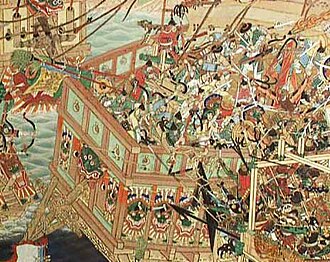
“I still have twelve ships.” — Admiral Yi Sun-sin, refusing to abandon the fight against overwhelming odds, 1597
In the autumn of 1597, Korea stood on the edge of collapse. The Japanese forces of Toyotomi Hideyoshi had launched a second devastating invasion of the Joseon dynasty, and the Korean naval force had been nearly wiped out through betrayal and mismanagement. Only a handful of warships remained. Against a Japanese fleet of more than 130 vessels, one admiral chose to stand and fight in a narrow strait where the tides themselves would become his greatest weapon. What followed was one of the most remarkable naval battles in world history — the Battle of Myeongnyang.
Quick Facts: The Battle of Myeongnyang
| Date | 26 October 1597 |
|---|---|
| Location | Myeongnyang Strait, near Jindo Island, southwestern Korea |
| Korean Commander | Admiral Yi Sun-sin |
| Korean Ships | 13 panokseon warships |
| Japanese Fleet Size | Approximately 133 warships (some sources cite over 300 support vessels) |
| Outcome | Decisive Korean victory |
| Significance | Halted Japanese westward advance; secured Korean supply lines |
| Context | Part of the Imjin War (1592–1598) |
The Road to Myeongnyang: How Korea’s Navy Was Nearly Destroyed
To understand why the Battle of Myeongnyang was so extraordinary, it is essential to understand the catastrophe that preceded it. Admiral Yi Sun-sin had been the dominant force in Korean naval resistance during the first Japanese invasion beginning in 1592. His brilliant tactical mind, combined with the effective use of the famous turtle ship (geobukseon), had repeatedly denied Japanese forces control of Korean waters and disrupted their supply lines to armies pushing northward through the peninsula.
However, political intrigue at the Joseon court proved as dangerous as any Japanese sword. Yi Sun-sin was accused of insubordination and treason, largely through the machinations of rivals and a Japanese deception operation. He was stripped of his command in 1597, tortured, and nearly executed. His replacement, Admiral Won Gyun, lacked Yi’s experience and tactical judgment.
The consequences were swift and catastrophic. At the Battle of Chilcheollyang in August 1597, Won Gyun led the Korean fleet into a trap. The Japanese navy destroyed almost the entire Korean naval force. Won Gyun was killed. Of the proud fleet that had protected Korean waters for years, only twelve or thirteen ships survived — depending on the source. The sea routes along the southern and western coasts of Korea were now open to Japanese domination.
In desperation, the Joseon court reinstated Yi Sun-sin as supreme naval commander. He inherited a shattered force, demoralized sailors, and almost no ships. Yet the Japanese western advance depended on controlling these sea lanes to supply their armies. If Yi could not stop them on the water, the entire strategic situation for Korea would become untenable.
Why Did Yi Sun-sin Choose the Myeongnyang Strait?
The selection of the Myeongnyang Strait as a battlefield was not accidental — it was a masterpiece of strategic thinking. The strait, located near Jindo Island off the southwestern tip of the Korean peninsula, is exceptionally narrow. At its tightest point, it measures only about 300 meters wide. This geographic feature was critical to Yi Sun-sin’s plan.
The Myeongnyang Strait is also known for its powerful, reversing tidal currents. The tides in this channel shift direction multiple times daily and can reach considerable speeds. Yi Sun-sin studied these patterns carefully. He understood that the same currents that might threaten his small fleet could be weaponized against a much larger enemy force. A fleet of 133 ships, or more when support vessels are counted, would struggle to maneuver in a narrow channel — particularly when the tide suddenly reversed.
By choosing this location, Yi Sun-sin neutralized Japan’s most decisive advantage: numbers. The Japanese could not bring their overwhelming fleet strength to bear all at once. They would have to fight in a constricted space where discipline, tactical skill, and knowledge of the local environment would count for more than sheer quantity of ships.
“On the day of battle, Yi Sun-sin positioned his flagship at the front, luring the Japanese fleet into the strait. When the tide turned, chaos engulfed the crowded Japanese vessels — and the Korean guns did the rest.”
The Battle: Thirteen Ships Against a Fleet
On 26 October 1597, the Japanese fleet advanced into the Myeongnyang Strait. Yi Sun-sin positioned his small squadron to hold the line, reportedly placing his own flagship at the foremost position when other commanders hesitated. His warships — sturdy panokseon vessels equipped with cannons — opened fire on the advancing Japanese ships as they funneled into the narrow passage.
The initial phase of the battle was grueling. Some accounts indicate that other Korean ships initially held back, unwilling to advance against such overwhelming odds. Yi’s flagship fought nearly alone for a critical period. Yet the Japanese fleet, compressed into the narrow strait, could not easily deploy its full force. Ships jostled against one another. The tight formation that might have been devastating in open water became a liability in the channel.
Then the tide turned — literally. The powerful tidal current of the Myeongnyang Strait reversed direction, striking the Japanese fleet from a new angle. Already crowded and struggling to maneuver, many Japanese ships were pushed against each other or became difficult to control. The Korean ships, which Yi Sun-sin had positioned to take advantage of this moment, intensified their cannon fire into the disordered enemy formation.
The result was remarkable. Japanese ships were sunk or disabled in significant numbers. The Japanese commander, Madashi Kurushima, was killed during the battle — his death dealt a significant blow to Japanese morale. Accounts of the battle record that the Japanese fleet eventually withdrew, having suffered substantial losses, while Yi Sun-sin’s thirteen ships remained intact. Not a single Korean warship was lost in the engagement.
Comparing the Forces: A Study in Asymmetric Warfare
| Factor | Korean Fleet | Japanese Fleet |
|---|---|---|
| Number of warships | 13 | ~133 |
| Commander | Yi Sun-sin | Kurushima Michifusa (Madashi Kurushima) |
| Primary weapon | Naval cannon (longer range) | Muskets and boarding tactics |
| Tactical environment | Familiar tidal strait | Unfamiliar, narrow channel |
| Outcome for commander | Victory; Yi survived | Kurushima killed in battle |
| Ships lost | 0 | Significant losses (estimates vary) |
What Made the Korean Warships Effective?
A crucial element in understanding the Battle of Myeongnyang is appreciating the technological and tactical difference between Korean and Japanese naval doctrine at this time. Japanese naval warfare traditionally emphasized bringing ships alongside the enemy and boarding them — a style of combat borrowed from land warfare and well-suited to their highly trained infantry. Korean naval tactics, refined under Yi Sun-sin, instead relied on standoff artillery. Korean panokseon warships carried multiple cannon that could engage the enemy at a distance, sinking ships before boarding could occur.
In open water with overwhelming numbers, Japanese forces might eventually have overwhelmed Korean cannon fire through sheer attrition. But in the Myeongnyang Strait, with ships packed together and tidal currents disrupting formation, the Japanese could not close to boarding distance in an organized manner. Yi Sun-sin’s choice of battlefield turned a potential slaughter into a tactical masterwork.
The Aftermath: Strategic Consequences for the Imjin War
The victory at Myeongnyang had consequences far beyond the immediate engagement. The Japanese plan for the second invasion had depended on a coordinated advance: armies pushing overland while the navy secured the western sea routes to supply them. By defeating the Japanese fleet and denying them control of the Myeongnyang Strait, Yi Sun-sin shattered this logistical strategy.
Japanese land forces continued to advance for a period, but the naval situation fundamentally constrained their options. The Joseon navy, despite its tiny numbers, had demonstrated that it could contest Japanese maritime dominance. Over the following months, Yi Sun-sin worked to rebuild Korean naval strength, recruiting sailors, gathering ships, and restoring morale.
The Imjin War itself concluded in 1598 following the death of Toyotomi Hideyoshi. Yi Sun-sin died in the final major engagement of the war — the Battle of Noryang in December 1598 — struck by a bullet as the Japanese fleet attempted to withdraw from Korea. His last recorded words reportedly asked that his death be concealed so as not to disrupt the battle. Even in death, the admiral placed the mission above himself.
Yi Sun-sin is remembered today as one of Korea’s greatest national heroes. His statue stands prominently in Gwanghwamun Square in Seoul, looking southward toward the sea he defended. The Battle of Myeongnyang remains a defining episode in Korean historical memory — a story of intellect, courage, and the refusal to surrender in the face of impossible odds.
3 Reasons the Battle of Myeongnyang Still Matters Today
- A lesson in asymmetric strategy: The battle demonstrates that tactical intelligence and knowledge of terrain can overcome numerical disadvantage. It is studied in military academies as a model of how to neutralize an enemy’s strengths by choosing the right battlefield.
- The foundation of Korean naval identity: Yi Sun-sin and the battles he fought are central to Korean national identity and to the traditions of the modern Republic of Korea Navy. The Myeongnyang victory in particular represents the idea that determination and ingenuity can preserve a nation against overwhelming force.
- A window into the Imjin War: The Battle of Myeongnyang is one of the most vivid episodes in the Imjin War — a conflict that reshaped the entire East Asian balance of power in the late sixteenth century and left deep marks on Korean, Japanese, and Chinese history alike.
Continue Exploring
Deepen your understanding of the Battle of Myeongnyang and the world that produced it with these resources: