“We herewith proclaim the independence of Korea and the liberty of the Korean people.”
— Opening words of the Korean Declaration of Independence, March 1, 1919
Few chapters in Korean history carry the emotional and historical weight of the independence movement — the decades-long effort by Koreans to reclaim sovereignty from Japanese colonial rule. Stretching from the forced annexation of 1910 through liberation in 1945, the movement drew in students, farmers, scholars, religious leaders, and exiled activists from every corner of Korean society. It was not a single event but a sustained, evolving struggle that defined what it meant to be Korean in the twentieth century.
Quick Facts: The Korean Independence Movement
| Fact | Detail |
|---|---|
| Period | 1910–1945 (core colonial era); roots from late 1800s |
| Trigger Event | Japan–Korea Annexation Treaty, August 29, 1910 |
| Most Iconic Moment | March 1st Movement (Samil Movement), 1919 |
| Provisional Government | Established in Shanghai, April 1919 |
| Key Figures | Yu Gwan-sun, An Jung-geun, Kim Gu, Syngman Rhee |
| Liberation Date | August 15, 1945 |
| Modern Commemoration | March 1st (Independence Movement Day) is a national holiday in South Korea |
The Road to Annexation: How Korea Lost Its Sovereignty
To understand the independence movement, one must first understand how Korea came to be colonized. Following the First Sino-Japanese War (1894–1895) and the Russo-Japanese War (1904–1905), Japan emerged as the dominant power on the Korean peninsula. The Eulsa Treaty of 1905 — signed under duress and widely regarded by Koreans as illegitimate — stripped Korea of its diplomatic sovereignty, making it a Japanese protectorate. Five years later, the Japan–Korea Annexation Treaty of 1910 formally ended the five-hundred-year-old Joseon dynasty and absorbed Korea entirely into the Japanese empire.
What followed was a sweeping reorganization of Korean life. Japanese colonial authorities replaced Korean governance with a military-style General Government. Korean land was systematically surveyed and redistributed, often dispossessing small farmers. The Korean language was suppressed in schools, Korean names were eventually pressured to be changed to Japanese ones, and Korean cultural institutions were placed under tight censorship. Yet these very acts of erasure created the conditions for resistance: the harder colonial authorities worked to eliminate Korean identity, the more fiercely Koreans clung to it.
Why Did the March 1st Movement Become the Symbol of Korean Resistance?
Of all the moments in the Korean independence movement, none resonates more powerfully than the Samil (March 1st) Movement of 1919. The name comes from the Korean words for “three” (sam) and “one” (il) — representing the date of March 1st on which the movement erupted across the country.
The immediate context was the death of Korea’s last emperor, Gojong, in January 1919. Rumors circulated that he had been poisoned by Japanese authorities, and grief quickly fused with political anger. Meanwhile, U.S. President Woodrow Wilson’s Fourteen Points — with their emphasis on national self-determination — had electrified colonized peoples around the world, including Korean activists who hoped the post-World War I international order might support their cause.
On March 1st, thirty-three Korean cultural and religious leaders — Christian and Cheondogyo (a Korean indigenous religion) figures among them — gathered at Taehwagwan restaurant in Seoul and read aloud the Korean Declaration of Independence. Simultaneously, coordinated public readings and demonstrations broke out across the peninsula. Crowds gathered in marketplaces, schoolyards, and on roadsides, waving handmade Korean flags and shouting “Manse!” (long live Korean independence).
“The Samil Movement was not merely a political protest — it was a declaration of cultural survival. Koreans were asserting that their language, their history, and their identity could not simply be legislated out of existence.”
The Japanese colonial response was brutal. Soldiers and police fired on unarmed crowds, arrested thousands, and burned villages suspected of harboring activists. Estimates of those killed range into the thousands, with tens of thousands more imprisoned. Among the most celebrated martyrs of this period was Yu Gwan-sun, a teenage student activist who organized demonstrations in her home region of Cheonan after schools were closed. Arrested and tortured, she died in prison in 1920 at the age of seventeen and has since become one of Korea’s most revered national heroes.
Three Pillars of the Independence Movement
1. The Provisional Government in Shanghai
One direct consequence of the March 1st Movement was the establishment of the Korean Provisional Government (KPG) in Shanghai, China, in April 1919. Operating in exile, the KPG attempted to function as a legitimate Korean government-in-waiting, lobbying foreign powers for recognition and coordinating resistance activities. Key figures included Kim Gu, who would become the KPG’s most prominent later leader, and Syngman Rhee, who served as its first nominal president while conducting diplomatic work in the United States. Though the KPG never achieved formal international recognition during the colonial period, it provided ideological continuity and organizational infrastructure for the resistance.
2. Armed Resistance and the Righteous Armies
Long before 1919, Koreans had taken up arms against Japanese encroachment. Following the 1905 protectorate treaty, irregular military units known as Uibyeong (Righteous Armies) fought guerrilla campaigns against Japanese forces across the peninsula. After annexation, many of these fighters relocated to Manchuria and the Russian Far East, where Korean exile communities sustained military resistance throughout the colonial period. Independence fighter An Jung-geun, who assassinated Japanese Resident-General Itō Hirobumi at Harbin station in 1909, became one of the movement’s most iconic figures — celebrated as a patriot in Korea and remembered as a complex historical figure across northeast Asia.
3. Cultural Nationalism and the Preservation of Korean Identity
Not all resistance took the form of protest or armed struggle. A quieter but equally vital strand of the independence movement focused on preserving Korean language, literature, and historical consciousness. Scholars worked to document and systematize the Korean language. Writers published works in Korean even as colonial authorities tightened restrictions. Historians argued for a distinctly Korean historical identity. This cultural resistance operated on the understanding that a colonized people who retained their language and memory could not be fully conquered — and that liberation, when it came, would require a living Korean culture to return to.
The Movement in the 1930s and 1940s: Hardship and Perseverance
The 1930s brought intensified repression as Japan moved toward total war footing. The “Cultural Policy” era of the 1920s, which had allowed limited Korean-language publications and cultural expression, gave way to policies of forced assimilation. Koreans were required to adopt Japanese names (sōshi-kaimei), worship at Shinto shrines, and speak Japanese in public settings. Korean-language newspapers were shut down. Hundreds of thousands of Koreans were conscripted as laborers and soldiers for Japan’s war effort across Asia.
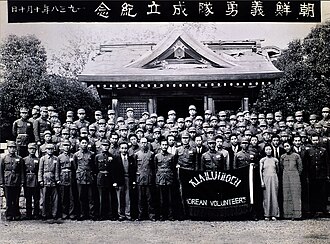
Yet resistance persisted. The Korean Restoration Army (Gwangbokgun), the military arm of the Provisional Government, was formally established in Chongqing, China, in 1940 and trained to fight alongside Allied forces. Plans for the army to participate in operations to liberate Korea were overtaken by Japan’s sudden surrender in August 1945, following the atomic bombings of Hiroshima and Nagasaki.
Comparing Approaches: Strategies Within the Movement
| Approach | Method | Key Figures | Strengths | Limitations |
|---|---|---|---|---|
| Diplomatic | Lobbying foreign governments and international bodies | Syngman Rhee, Kim Kyu-sik | Sought international legitimacy | Few major powers recognized KPG |
| Armed Resistance | Guerrilla warfare, military training in exile | An Jung-geun, Kim Gu, Gwangbokgun | Direct confrontation; sustained pressure | Outgunned; difficult logistics in exile |
| Mass Nonviolent Protest | Public demonstrations, strikes, declarations | Thirty-three signatories; Yu Gwan-sun | Mobilized broad public; attracted international attention | Subject to violent suppression |
| Cultural Nationalism | Language preservation, historical writing, literature | Scholars, writers, historians | Sustained Korean identity across generations | Less visible impact short-term |
Liberation and Legacy
Korea’s liberation came on August 15, 1945 — a date now celebrated as Gwangbokjeol (National Liberation Day) in both North and South Korea. Yet liberation did not immediately bring the unified, independent nation that activists had sacrificed so much to achieve. The peninsula was divided along the 38th parallel between Soviet and American occupation zones, a division that hardened into two separate states by 1948 and eventually produced the catastrophic Korean War of 1950–1953.
The legacy of the independence movement is therefore complex. Its heroes are honored across the Korean-speaking world: Yu Gwan-sun appears on school curricula and public memorials; An Jung-geun is commemorated in statues and a museum; March 1st is a solemn national holiday. The movement also remains a living political reference point — invoked in discussions of national identity, of Korean-Japanese relations (which still carry the weight of unresolved historical grievances), and of what Korean sovereignty means in the twenty-first century.
What the independence movement demonstrated, above all, was that Korean national identity could not be extinguished by colonial force. Across thirty-five years of occupation, through protest and poetry, through armed struggle and patient cultural work, Koreans insisted on their own existence as a people. That insistence, ultimately, outlasted the empire that sought to deny it.
Continue Exploring
On CoreAverse
- The Joseon Dynasty: Five Centuries of Korean Civilization
- Yu Gwan-sun: Korea’s Teenage Revolutionary
- The Korean Provisional Government in Shanghai