“The old order was swept away not by revolution from below, but by decree from above — and from the barrel of foreign influence.”
In the summer of 1894, Korea stood at a crossroads. The Joseon dynasty, which had ruled the peninsula for five centuries, found itself caught between the ambitions of neighboring powers, the pressures of a rapidly modernizing world, and the demands of its own restless population. Out of this volatile crucible emerged the Kabo Reform — a sweeping series of edicts and institutional changes that, in less than two years, attempted to dismantle an entire civilization’s worth of social, political, and legal tradition and replace it with something entirely new.
The Kabo Reform (갑오개혁, also romanized as Gabo Gaehyeok) takes its name from the year 1894 in the traditional Korean sexagenary calendar cycle, the year Gabo (甲午). Launched in the seventh lunar month of that year and continuing through 1895, it represents one of the most dramatic and contested episodes of institutional transformation in Korean history. To understand it fully, one must understand not only what changed, but why — and at whose behest.
Quick Facts: The Kabo Reform at a Glance
| Detail | Information |
|---|---|
| Korean Name | 갑오개혁 (Gabo Gaehyeok) |
| Period | 1894 – 1895 |
| Dynasty | Joseon (조선) |
| Trigger | First Sino-Japanese War & Japanese influence |
| Key Body | Deliberative Council (Gungukmueo Cheori Amun) |
| Total Edicts | Approximately 210 reform measures |
| Outcome | Abolished class system, modernized legal codes, restructured government |
The World That Made the Kabo Reform Necessary
By the early 1890s, the Joseon dynasty was under extraordinary pressure from multiple directions. Internally, the donghak peasant movement had erupted across the southern provinces, driven by economic hardship, official corruption, and popular resentment of foreign commercial encroachment. Externally, Korea had been forced open to trade through the 1876 Treaty of Ganghwa, signed with Japan, and had subsequently entered into treaties with Western powers throughout the 1880s. China and Japan both regarded Korea as a crucial buffer zone and economic market, and their rivalry over influence in Seoul had been simmering for years.
When the Donghak Peasant Rebellion reached a peak in the spring of 1894, the Korean government made the fateful decision to request military assistance from Qing China. Japan, invoking the terms of the Convention of Tientsin (1885), immediately dispatched its own troops. With both Chinese and Japanese forces on Korean soil, the stage was set for direct military confrontation. The First Sino-Japanese War broke out in July 1894, and Japanese forces quickly moved to occupy Seoul and seize effective control of the Korean government.
It was under these conditions — with Japanese soldiers stationed in the capital and Japanese advisors hovering over Korean ministers — that the Kabo Reform was launched. This context is essential. The reforms were not simply a homegrown Korean modernization movement, though reform-minded Korean officials did play meaningful roles in shaping and implementing specific measures. The overarching framework, timing, and direction of the reform were heavily conditioned by Japanese strategic interests in remaking Korea according to Meiji-era institutional models.
The Deliberative Council and the Machinery of Reform
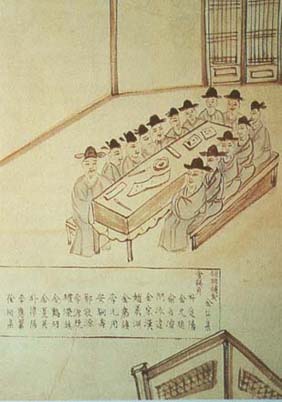
On 27 July 1894, a new governing body called the Gungukmueo Cheori Amun (軍國機務處), often translated as the Deliberative Council or the Office for the Management of State Affairs, was established. This council became the engine of the reform process during its first phase. Composed of progressive Korean officials — many of them members of the Gaehwapa, or Enlightenment Party — the council operated with unusual speed and decisiveness, issuing a torrent of reform edicts over the following weeks and months.
Among the most significant reforms enacted in this first phase were the formal abolition of the centuries-old gwageo examination system, which had long served as the primary pathway to government office and was steeped in classical Chinese learning. In its place, new criteria for government recruitment were to be established based on merit and practical competence rather than mastery of Confucian texts. This single measure struck at the heart of the Joseon social and political order, which had been organized around the Confucian scholarly ideal for half a millennium.
The council also moved swiftly to address the legal status of Korea’s rigid social hierarchy. The caste-like distinction between the yangban aristocracy, the commoner class, and the cheonmin (those of the lowest social status, including the baekjeong and hereditary slaves) was formally abolished. Hereditary slavery was declared illegal. The nobi system — under which large numbers of Koreans were bound in servitude to aristocratic households or to the state — was dismantled by decree.
“With a stroke of the official brush, bonds that had held Korean society in place for generations were declared void. Whether those declarations reached every village, every household, every master and servant was another matter entirely.”
What Did the Kabo Reform Actually Change?
The scope of the reforms was breathtaking on paper. Historians have catalogued approximately 210 separate reform measures enacted between 1894 and 1895. These touched on virtually every dimension of governance and social life. Understanding the reforms is easiest if we group them into key areas:
5 Pillars of the Kabo Reform
- Abolition of Social Status Distinctions: The legal framework underpinning Korea’s hereditary class system — including the privileges of the yangban and the bondage of the nobi — was formally ended. In principle, all Koreans were now legal equals before the state, regardless of birth.
- Restructuring of Government: The traditional Six Ministries system (Yukjo), inherited from the early Joseon period and rooted in Chinese administrative models, was replaced by a new cabinet structure of eight modern ministries modeled loosely on Meiji Japanese and Western precedents. The court and the government were formally separated, with the royal household budget distinguished from state finances.
- Legal and Judicial Reform: Collective punishment — under which the family members and relatives of a convicted criminal could also be punished — was abolished. The use of torture in judicial proceedings was prohibited. A modern legal code distinguishing civil and criminal matters was introduced.
- Economic Modernization: A unified national currency system was introduced, replacing the chaotic patchwork of coins and weights that had hampered commerce. The official unit of measurement was standardized. The government began laying the groundwork for a modern tax system.
- Social Customs Reform: Early marriage was prohibited; a minimum age for marriage was established. Widows were officially permitted to remarry — a significant break with Confucian norms that had stigmatized and in many cases economically ruined widowed women. The wearing of mourning dress in public offices was restricted to prevent it from disrupting official business.
Why Did the Kabo Reform Ultimately Fall Short?
The gap between edict and reality is one of the central themes of the Kabo Reform. Despite the extraordinary volume of legislation produced by the Deliberative Council and its successor bodies, the practical implementation of these measures across the Korean countryside was extremely uneven. Several factors help explain this shortfall.
First, the reform process was deeply tainted in Korean eyes by its association with Japanese coercion. The assassination of Queen Min (Empress Myeongseong) in October 1895 — carried out by Japanese agents and pro-Japanese Korean collaborators — shocked the Korean court and public and triggered a fierce conservative backlash. The murder of the queen in her own palace made it impossible for many Koreans to view the reform program as anything other than a vehicle for Japanese domination.
Second, the administrative infrastructure needed to implement such sweeping changes simply did not exist in most of the country. Reform decrees issued in Seoul had to filter through a local bureaucracy that remained largely unchanged in personnel, habit, and outlook. Yangban families who had lost their formal legal privileges did not simply accept their diminished status. Slavery was abolished on paper, but the economic dependencies that had sustained it did not vanish overnight.
Third, the reform process was itself politically unstable. The Deliberative Council was dissolved in December 1894, and subsequent phases of reform were driven by different coalitions and under changing conditions of Japanese influence. King Gojong’s flight to the Russian legation in February 1896 — the Agunwan Pacheon incident — effectively ended the reform era and signaled a decisive shift in the political winds.
Reform vs. Reality: A Brief Comparison
| Reform Decree | Stated Goal | Practical Reality |
|---|---|---|
| Abolition of the nobi system | End hereditary slavery | Economic dependencies persisted for decades |
| Ban on collective punishment | Individual legal accountability | Enforcement inconsistent outside Seoul |
| Abolition of the gwageo exam | Merit-based government recruitment | New system slow to take root; networks of privilege adapted |
| Permission for widow remarriage | Social equality for women | Social stigma remained powerful in rural communities |
| Unified currency system | Modernized national economy | Implementation hampered by institutional capacity and foreign interference |
The Kabo Reform’s Long Shadow
Despite its failures and contradictions, the Kabo Reform left a lasting imprint on Korean history. The formal legal abolition of the hereditary class system — however imperfectly implemented — marked a genuine watershed. The language of equality before the law, once written into official Korean documents, could not be entirely erased. Later reform movements, including those during the Korean Empire period (1897–1910) and the Korean independence movement, drew on the vocabulary and aspirations articulated during the Kabo years.
The reform also accelerated the pace of social and economic change in ways that outlasted the specific edicts. The weakening of the yangban’s legal monopoly on status and officeholding, even if incomplete, opened spaces for new social actors — merchants, military officers trained in modern methods, educated commoners — to begin asserting themselves in Korean public life. The institutional separation of the royal household from state finances, though imperfectly realized, pointed toward the kind of constitutional governance that reformers would continue to advocate in the years ahead.
Scholars continue to debate the Kabo Reform’s character: was it a genuine Korean modernization project that was hijacked by Japanese imperialism, or was it primarily an instrument of Japanese colonial preparation from the outset? The truth, as is often the case with complex historical events, resists simple categorization. Korean reformers who participated in the Deliberative Council had their own visions and agendas. Japanese advisors had theirs. The final product was a contested compromise shaped by both — and ultimately undone by the very power that had helped set it in motion.