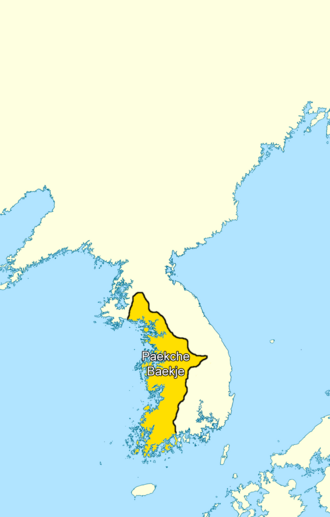
“Of the Three Kingdoms that shaped the Korean peninsula, none spread its cultural influence more boldly across the seas than Baekje — a kingdom whose art, religion, and diplomacy reached the shores of Japan and beyond.”
For nearly seven centuries, the kingdom of Baekje (also romanized as Paekche) stood as one of the three great powers of the Korean peninsula. Alongside Goguryeo in the north and Silla in the southeast, Baekje carved out a distinctive identity rooted in sophisticated culture, maritime trade, and artistic achievement. Founded according to tradition in 18 BC, the kingdom endured until its dramatic defeat in 660 AD — a fall that came not from internal collapse, but from the combined military might of Tang China and its old rival, Silla. Yet even in defeat, Baekje left an indelible mark on East Asian history, particularly through its role in transmitting Buddhism and continental culture to the Japanese archipelago.
Quick Facts: The Kingdom of Baekje
| Detail | Information |
|---|---|
| Founded | 18 BC (traditional) |
| Dissolved | 660 AD |
| Korean name | 백제 (Baekje / Paekche) |
| Location | Southwestern Korean peninsula |
| Capitals | Wiryeseong, Ungjin, Sabi |
| Historical era | Three Kingdoms of Korea |
| Key neighbors | Goguryeo, Silla, Tang China, Wa (Japan) |
Origins and the Three Kingdoms Context
Baekje is traditionally said to have been founded in 18 BC in the Han River basin — the region that today encompasses modern Seoul and its surroundings. According to historical accounts, its founding is linked to Onjo, a prince associated with the Buyeo lineage in the north. Whether or not this precise origin story reflects literal history, it speaks to a deeply felt cultural connection that Baekje’s ruling class maintained with the Buyeo kingdom — a connection they actively emphasized in their political identity for centuries.
The kingdom grew within the broader context of the Three Kingdoms period, a roughly six-century era during which Baekje, Goguryeo, and Silla competed, allied, and clashed across the Korean peninsula. Each kingdom developed its own distinct character: Goguryeo was a powerful continental warrior state in the north, Silla a more inward-looking kingdom in the southeast that would eventually outlast its rivals, and Baekje a culturally vibrant maritime power occupying the fertile southwest.
In its early centuries, Baekje expanded significantly, at times controlling large portions of the central and western peninsula. Its proximity to the Yellow Sea gave it natural advantages in trade and diplomacy, allowing it to maintain meaningful connections with Chinese states and, crucially, with the kingdoms of the Japanese archipelago.
Why Did Baekje Become a Cultural Bridge to Japan?
Perhaps no aspect of Baekje’s legacy has proven more enduring than its role as a cultural intermediary between the Asian continent and Japan. The kingdom occupied a strategic geographic position — its western coastline faced the Yellow Sea and offered relatively accessible maritime routes toward the Korean Strait and the Japanese islands beyond. This geography, combined with active diplomatic policy, made Baekje a key conduit for the transmission of continental civilization to Japan.
Among the most significant contributions attributed to Baekje’s influence on Japan was the introduction of Buddhism. While the precise dates and mechanisms of this transmission are debated by historians, traditional accounts place the formal introduction of Buddhism to Japan in the sixth century, with Baekje playing a central role. Alongside Buddhism came writing systems, Confucian texts, artistic techniques, and architectural knowledge. Craftspeople, scholars, and monks traveled from Baekje to the Japanese court, reshaping Japanese culture in profound ways that would be felt for generations.
“Baekje did not merely borrow from China and pass knowledge along unchanged — it filtered, adapted, and refined continental culture, creating a distinctive aesthetic tradition that left its signature on the art of both Korea and Japan.”
Baekje artisans were celebrated for their skill. Gilt-bronze artifacts, roof tiles, jewelry, and Buddhist sculptures recovered from Baekje sites display a refinement that set the kingdom apart. The famous Baekje Smile — a serene, gentle expression found on surviving Buddhist sculptures from the kingdom — has become an iconic symbol of the kingdom’s distinctive artistic spirit. Baekje’s influence on early Japanese Buddhist art is widely acknowledged by art historians, who note strong stylistic parallels between surviving works from both traditions.
The Shifting Capitals: Wiryeseong, Ungjin, and Sabi
A kingdom’s capital tells the story of its fortunes, and Baekje moved its capital three times over the course of its history — each move reflecting a moment of crisis or strategic recalculation. The original capital, Wiryeseong, was located in the Han River basin, the heartland of the kingdom’s early power. At its height, Baekje controlled this fertile central region and competed directly with Goguryeo for dominance over the peninsula’s core territories.
The pressure from Goguryeo, which expanded aggressively southward in the fifth century, eventually forced Baekje to abandon Wiryeseong. In 475 AD, Goguryeo forces sacked the capital and killed the Baekje king. The surviving court fled southward and reestablished the capital at Ungjin — modern Gongju in South Chungcheong Province. This move marked a dramatic contraction of Baekje’s power and territory, but also the beginning of a recovery.
In the early sixth century, the capital moved again — this time to Sabi, modern Buyeo, also in South Chungcheong Province. The Sabi period is generally considered the cultural apex of the Baekje kingdom. It was during this era that the kingdom’s artistic production flourished most brilliantly, diplomatic ties with China and Japan deepened, and the court embraced Buddhism with particular enthusiasm. The city of Sabi was laid out with careful urban planning, and its remains, along with those at Ungjin and other Baekje sites, were inscribed as a UNESCO World Heritage Site in 2015 under the name “Baekje Historic Areas.”
3 Defining Moments in Baekje’s History
-
The Loss of the Han River Basin (475 AD)
The Goguryeo king Jangsu launched a devastating assault on Baekje’s capital Wiryeseong in 475 AD, killing King Gaero and forcing the court’s southward retreat. This moment ended Baekje’s era as a major northern power and permanently altered the balance of the Three Kingdoms period. The loss of the Han River basin — one of the most agriculturally and strategically valuable regions on the peninsula — was a wound from which Baekje never fully recovered in territorial terms, even as it experienced cultural flourishing in subsequent decades.
-
The Sabi Renaissance (538–660 AD)
The relocation of the capital to Sabi in 538 AD ushered in an era of remarkable cultural productivity. Under kings such as Seong and Mu, Baekje rebuilt its diplomatic networks, sponsored ambitious Buddhist temple construction, and produced art of extraordinary quality. It was during this period that Baekje’s influence on Japan reached its peak, and the kingdom’s cultural reputation across East Asia was at its height. The Mireuksa temple complex — the largest Buddhist temple ever built in ancient Korea — was constructed during this era under King Mu.
-
The Fall of Sabi and the End of the Kingdom (660 AD)
In 660 AD, a joint military campaign by Tang China and Silla brought the kingdom to its end. Tang forces landed on the western coast while Silla attacked overland. Baekje’s last king, Uija, was captured, and the capital Sabi fell. Attempts at restoration — including appeals to Japan for military assistance — ultimately failed, and Baekje was absorbed into what would become the unified Silla state. The fall was swift and total, ending nearly seven centuries of royal history.
Baekje vs. Its Rivals: A Comparison
| Feature | Baekje | Goguryeo | Silla |
|---|---|---|---|
| Location | Southwestern peninsula | Northern peninsula and Manchuria | Southeastern peninsula |
| Known for | Art, Buddhism, maritime diplomacy | Military power, murals, continental reach | Gold jewelry, political consolidation |
| Relationship with Japan | Very close — cultural transmission | More limited | Occasionally adversarial |
| Fate | Conquered by Silla–Tang alliance (660) | Conquered by Silla–Tang alliance (668) | Unified the peninsula (~668) |
| UNESCO status | Baekje Historic Areas (2015) | Goguryeo Tombs (2004) | Gyeongju Historic Areas (2000) |
The Legacy That Outlasted the Kingdom
When Baekje fell in 660 AD, its people did not vanish from history. Many nobles and craftspeople fled to Japan, where they and their descendants continued to contribute to Japanese court culture. The cultural DNA of Baekje can be traced in early Japanese Buddhist architecture, sculpture, and ritual practice. Some Japanese noble families claimed Baekje ancestry for centuries, and in 2001, Japanese Emperor Akihito made a widely noted public statement acknowledging that the mother of Emperor Kammu — one of Japan’s most celebrated rulers — was of Baekje descent.
On the Korean peninsula itself, the memory of Baekje has experienced a significant revival in modern times. Excavations at Gongju (ancient Ungjin) and Buyeo (ancient Sabi) have unearthed extraordinary treasures, including the tomb of King Muryeong — discovered intact in 1971 — which yielded gold crowns, jewelry, and inscribed tablets that transformed scholarly understanding of Baekje’s royal culture. The Baekje Historic Areas, encompassing sites in Gongju, Buyeo, and Iksan, received UNESCO World Heritage recognition in 2015, cementing Baekje’s place in the global heritage conversation.
Today, the regions of South Chungcheong Province and North Jeolla Province that once formed the Baekje heartland embrace their ancient heritage proudly. Annual festivals, dedicated museums, and ongoing archaeological work continue to shed light on a kingdom that, for all its eventual defeat, shaped the cultural landscape of East Asia in ways that endure to the present day.
Continue Exploring
On CoreAverse
- The Three Kingdoms of Korea: An Introduction
- Baekje Historic Areas: Korea’s UNESCO Treasure in the Southwest
- How Silla Unified the Korean Peninsula