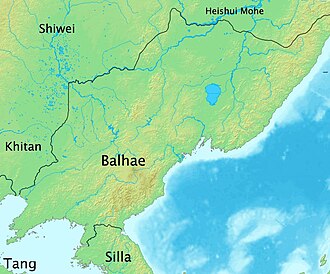
“To the east of the sea, there is a flourishing land — a kingdom rich in culture, strength, and the legacy of Goguryeo.”
Tucked between the competing empires of Tang China and unified Silla, there existed a kingdom that modern history has too often overlooked. Balhae — known in Korean as Balhae (발해) and in Chinese records as Parhae — was a powerful, sophisticated state that dominated the northeastern corner of Asia for more than two centuries. Founded in 698 CE and stretching across what is today northeastern China, the Russian Far East, and the northern part of the Korean peninsula, Balhae represented one of the great political and cultural achievements of the early medieval period in East Asia.
For Korean historians, Balhae occupies a deeply significant — and sometimes contested — place in the national narrative. It was a state founded by survivors of the fallen kingdom of Goguryeo, and its ruling class maintained cultural and political ties to that earlier Korean tradition. Yet its population was multiethnic, its territory vast, and its legacy claimed by multiple nations today. Understanding Balhae means wrestling with questions about identity, ethnicity, and what it means to belong to a historical tradition.
Quick Facts: The Kingdom of Balhae
| Fact | Detail |
|---|---|
| Founded | 698 CE |
| Dissolved | 926 CE |
| Duration | Approximately 228 years |
| Founder | Go of Balhae (Dae Joyeong) |
| Capital | Dongmo Mountain (early); later Sanggyeong |
| Territory | Manchuria, Russian Far East, northern Korean peninsula |
| Successor state | Khitan Liao dynasty (conquerors) |
| Korean designation | Included in Korean historical narrative as part of the “North-South States Period” |
The Rise of Balhae: Born from the Ashes of Goguryeo
To understand Balhae, one must first understand what was lost. In 668 CE, the mighty kingdom of Goguryeo — one of the Three Kingdoms of Korea, which had dominated the northern Korean peninsula and much of Manchuria for centuries — fell to a combined Tang Chinese and Silla alliance. Its people were scattered, its royal family taken captive, and its territory absorbed into the Tang Empire’s administration through a system of commanderies.
But the spirit of Goguryeo did not die easily. Among the displaced Goguryeo aristocracy and military leaders was a man named Dae Joyeong, who would become the founder of Balhae. Taking advantage of a major rebellion against Tang rule — led by the Khitan people in the 690s — Dae Joyeong led a coalition of Goguryeo refugees and Mohe tribespeople eastward, away from Tang control. In 698 CE, he established a new state called Jin (振) at Dongmo Mountain, in the region of present-day Jilin Province in China. This new kingdom would later be renamed Balhae.
The founding of Balhae was an act of extraordinary determination. Dae Joyeong and his followers had escaped Tang military pursuit and carved out a new political entity in challenging terrain, drawing on the military traditions and administrative knowledge inherited from Goguryeo. Korean historians have long pointed to this Goguryeo connection as evidence that Balhae belongs within the broader sweep of Korean history — a position that remains debated by Chinese scholars who emphasize the Mohe (Tungusic) ethnic component of the kingdom’s population.
Why Is Balhae Called the “Sea of Prosperity”?
At its height, Balhae was known among its neighbors and trading partners as a land of remarkable wealth and cultural sophistication. Tang Chinese sources referred to Balhae admiringly as the “flourishing land of the east” (haedong seongguk, 해동성국 in Korean), a title that speaks to the impression the kingdom made on the most powerful empire in Asia at the time.
“Haedong Seongguk” — the Prosperous Nation East of the Sea. This was the title Tang China bestowed upon Balhae at the height of its power, a recognition that still resonates in Korean historical memory.
This prosperity was not accidental. Balhae’s rulers invested heavily in developing their state along Tang Chinese institutional lines, while preserving distinct cultural traditions of their own. The kingdom adopted a central government structure modeled on the Tang system, with three chancelleries and six ministries managing state affairs. It established five capitals and organized its vast territory into fifteen administrative districts called bu (부), each subdivided into prefectures and counties.
Balhae became an active participant in the diplomatic and trade networks of East Asia. It sent regular embassies to Tang China, maintained complex relations with Silla to the south, and established maritime and overland trade routes that extended to Japan. Japanese records from this period document numerous Balhae diplomatic missions, offering a window into just how engaged this kingdom was with the broader world around it. The Balhae route to Japan, running across the Sea of Japan, became an important channel for cultural and commercial exchange.
Society, Culture, and the Question of Identity
One of the most fascinating aspects of Balhae is its multiethnic character. While the ruling aristocracy was predominantly of Goguryeo descent — maintaining Korean-linked cultural and possibly linguistic traditions — the broader population included large numbers of Mohe people, various Tungusic groups, and others drawn into the kingdom’s orbit through conquest and migration. This diversity gave Balhae a complex identity that defies easy categorization.
Culturally, Balhae absorbed significant influences from Tang China. Its elite class practiced Chinese-style governance, corresponded in classical Chinese, and admired Tang artistic and literary traditions. Archaeological excavations at Balhae sites have uncovered artifacts that show strong Tang influence in ceramic styles, architectural design, and decorative arts — alongside elements that appear distinctly local or that continue traditions from the Goguryeo period.
Buddhism played an important role in Balhae’s cultural life, as it had in Goguryeo before it. Temple sites have been identified across the former Balhae territory, and Buddhist art recovered from these sites displays a synthesis of Tang Chinese styles with earlier Korean Buddhist traditions. This religious and artistic continuity is one of the threads Korean historians use to connect Balhae to the broader story of Korean civilization.
How Did Balhae Fall? The Khitan Conquest of 926 CE
After more than two centuries of prosperity, Balhae’s end came with shocking speed. The Khitan people, who had been expanding their power across the steppes and forests of northeastern Asia, launched a devastating military campaign against Balhae in the winter of 925–926 CE. The attack was swift and overwhelming. Within a matter of weeks, the Balhae capital of Sanggyeong fell, and the last Balhae king, Dae Inseon, surrendered in 926 CE.
The speed of Balhae’s collapse has puzzled historians for centuries. A kingdom that had maintained itself for over two hundred years, that had successfully navigated the complex politics of Tang-era East Asia, and that had built a sophisticated administrative state — how could it fall so quickly? Various explanations have been proposed, including internal political divisions, the possibility of a weakened military, and the sheer military efficiency of the Khitan forces under their leader Abaoji, who would go on to found the Liao dynasty.
What is certain is that the fall of Balhae created a massive refugee crisis. Large numbers of Balhae aristocrats and their followers fled south to the kingdom of Goryeo, which had recently unified the Korean peninsula. The Goryeo king welcomed these refugees warmly, recognizing them as kin — another indication of the perceived Korean identity of Balhae’s ruling class. These refugees brought with them knowledge, culture, and a sense of connection to the Goguryeo tradition that enriched early Goryeo society.
Balhae in Korean Memory: A Kingdom Reclaimed
For much of its post-collapse history, Balhae existed in a kind of historical limbo. Chinese historiography tended to treat it as a regional regime under Tang suzerainty, while the dominant narrative of Korean history focused on the Three Kingdoms, Unified Silla, and Goryeo. It was not until Korean scholars of the eighteenth and nineteenth centuries — particularly the great historian Yu Deukgong — began to advocate for a broader understanding of Korean history that Balhae was systematically incorporated into the Korean historical narrative.
Yu Deukgong, writing in the late eighteenth century, proposed the concept of the “North-South States Period” (Nam-Buk guk sidae), arguing that the era when Silla controlled the south and Balhae controlled the north should be understood as a single chapter in Korean history, with both states as legitimate Korean successors to the Three Kingdoms. This framework has become widely accepted in South Korean historiography and is reflected in how Balhae is taught in Korean schools today.
The debate over Balhae’s national identity remains active and politically charged. China’s Northeast Project (Dongbei Gongcheng), a state-sponsored academic initiative from the early 2000s, controversially classified Balhae as a local regime of the Tang Empire and therefore part of Chinese history. This position has been strongly contested by Korean scholars and has contributed to ongoing tensions over the interpretation of shared historical heritage in Northeast Asia.
Comparing the Two States: Balhae and Unified Silla
| Feature | Balhae (698–926) | Unified Silla (668–935) |
|---|---|---|
| Geographic location | Manchuria, Russian Far East, northern peninsula | Southern and central Korean peninsula |
| Ethnic composition | Goguryeo descendants, Mohe, other Tungusic peoples | Predominantly Silla Korean |
| Predecessor state | Goguryeo | Silla (one of the Three Kingdoms) |
| Relationship with Tang China | Initially hostile; later diplomatic and tributary | Allied; close cultural ties |
| Religion | Buddhism; shamanistic traditions | Buddhism (state religion) |
| End | Conquered by Khitan (926 CE) | Peacefully ceded to Goryeo (935 CE) |
Why Balhae Still Matters Today
The story of Balhae is more than a historical curiosity. It raises profound questions about how nations construct their histories, about what criteria determine whether a state belongs to one national tradition or another, and about how multiethnic, multicultural societies fit within narratives that tend to favor clear ethnic or national categories.
For Korea, Balhae represents the northern dimension of a history that is too often imagined as confined to the Korean peninsula. It is a reminder that Korean civilization, in its formative centuries, extended far beyond its current borders — into the forests and river valleys of Manchuria, to the shores of the Sea of Japan, and into contact with the diverse peoples of the Asian continent. The refugees who fled Balhae’s fall and were absorbed into Goryeo carried with them traditions, bloodlines, and memories that became part of what Korea is today.
Archaeological work at Balhae sites continues in China, Russia, and North Korea, gradually filling in the gaps in our knowledge of this remarkable kingdom. Each new discovery — a temple foundation, a painted tomb, a cache of administrative documents — adds another piece to a puzzle that historians are still working to complete.
Balhae endured for 228 years. It built cities, traded across seas, welcomed Buddhist monks, and sent diplomats to the courts of Tang and Japan. It was, by any reasonable measure, a great kingdom — and one that deserves a central place in the story of Korean history and East Asian civilization.
Continue Exploring
On This Site
- Goguryeo: The Kingdom That Shaped the North
- How Goryeo United the Korean Peninsula
- The Three Kingdoms of Korea: An Introduction