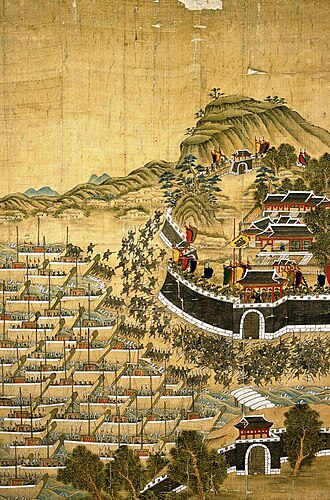
“The mountains and rivers are the same, but the country is a wasteland — castles and towns lie in ruin.”
Few events in Korean history have left as deep and lasting a scar as the Imjin War — the name given to the Japanese invasions of Korea that unfolded between 1592 and 1598. Named after the imjin year on the sexagenary cycle (corresponding to 1592), this catastrophic conflict drew in three of East Asia’s major powers: the Joseon dynasty of Korea, the Ming dynasty of China, and the newly unified Japan under the warlord Toyotomi Hideyoshi. The result was years of brutal warfare, mass displacement, famine, and cultural destruction that would define the Korean peninsula for generations to come.
Quick Facts: The Imjin War at a Glance
| Detail | Information |
|---|---|
| Dates | 1592–1598 |
| Korean name | Imjin Waeran (임진왜란) |
| Parties involved | Joseon Korea, Ming China (allied), Japan (Toyotomi forces) |
| Japanese commander | Toyotomi Hideyoshi |
| Key Korean naval figure | Admiral Yi Sun-sin |
| Major Korean battles | Battle of Busan, Battle of Hansan Island, Battle of Haengju, Battle of Noryang |
| Outcome | Japanese withdrawal; Joseon and Ming declared victory; enormous human cost |
| Legacy | Dramatic population loss, cultural destruction, reshaping of East Asian relations |
Why Did Toyotomi Hideyoshi Invade Korea?
By the late sixteenth century, Toyotomi Hideyoshi had achieved the remarkable feat of reunifying Japan after more than a century of civil war. Yet unification brought its own pressures. Hideyoshi faced a warrior class that had grown powerful through conflict and now expected rewards. His answer was breathtakingly ambitious: a military campaign to conquer the Korean peninsula, and from there, to march on Ming China itself.
Hideyoshi demanded that Korea allow his armies to pass through its territory on the way to China — a request the Joseon court refused. The Joseon dynasty had enjoyed nearly two centuries of relative peace since its founding in 1392, and its military readiness had declined significantly. Diplomatic negotiations broke down, and in the spring of 1592, a Japanese force estimated in the hundreds of thousands crossed the Korea Strait and landed at Busan, beginning one of the most destructive wars in Korean history.
The First Invasion: Swift Conquest and Korean Resistance
The initial Japanese advance was devastating in its speed. Equipped with firearms introduced through Portuguese contact, Japanese forces overwhelmed Joseon defenders who were largely unprepared for the scale and firepower of the assault. Busan fell within days. The Japanese army pushed rapidly northward, capturing the capital Hanseong (modern-day Seoul) within roughly three weeks and continuing toward Pyongyang. King Seonjo fled northward toward the Chinese border, a humiliating retreat that shook the legitimacy of the Joseon court.
Yet Japan’s rapid advance masked serious vulnerabilities. Korean naval forces, under the inspired command of Admiral Yi Sun-sin, began disrupting Japanese supply lines along the southern coast with devastating effectiveness. Yi’s fleet, including the celebrated geobukseon or “turtle ships” — armored warships fitted with iron plating — inflicted a series of costly defeats on Japanese naval forces. The Battle of Hansan Island in 1592 was a particularly decisive engagement, in which Yi’s use of the “crane wing” formation annihilated a significant Japanese fleet and effectively denied Japan control of Korean waters.
On land, Korean resistance stiffened. Volunteer militias known as uibyeong (righteous armies) rose across the country, harassing Japanese supply lines and garrisoned forces. Buddhist monks took up arms to defend their monasteries and communities. These irregular fighters, though lacking the equipment and training of regular armies, imposed a constant burden on Japanese forces trying to maintain an overextended supply chain.
“Yi Sun-sin is a man who gives no thought to his own life and death. He is a loyal, righteous, and courageous general — truly without equal in the world.”
China Enters the War: The Ming Intervention
The fall of Pyongyang and the approach of Japanese forces toward the Chinese border alarmed the Ming dynasty. China and Korea had long maintained a close tributary relationship, and a Japanese conquest of Korea would place a hostile military force directly on China’s northeastern frontier. In early 1593, a substantial Ming army crossed the Yalu River into Korea, and combined Joseon-Ming forces recaptured Pyongyang from the Japanese.
The war now entered a prolonged and complex phase. Japanese forces were pushed back toward the southern coast, and a series of difficult negotiations began. A fragile armistice held for several years, but the talks ultimately collapsed, partly because Hideyoshi’s territorial and political demands were impossible for Ming China to accept. In 1597, Hideyoshi launched a second invasion — known in Korean as the Jeongyu Waeran — with a renewed Japanese force landing again on the southern coast.
4 Turning Points That Shaped the Imjin War
- The Battle of Hansan Island (1592): Admiral Yi Sun-sin’s naval victory shattered Japanese hopes of using the sea to supply their advancing armies, fundamentally altering the strategic balance of the war.
- The Battle of Haengju (1593): A small Korean garrison commanded by General Gwon Yul held a mountain fortress against a much larger Japanese army, rallying Korean morale at a critical moment and demonstrating that determined defense could blunt the Japanese advance.
- The Collapse of Peace Talks (1596): Years of negotiations between Japan and Ming China ended in failure, as Hideyoshi’s demands — including the cession of Korean territory and a Korean royal hostage — were unacceptable. This led directly to the second invasion.
- The Battle of Noryang (1598): In the final major naval engagement of the war, a combined Joseon-Ming fleet under Admiral Yi Sun-sin inflicted heavy losses on Japanese forces attempting to withdraw. Yi was mortally wounded during the battle, his last reported words urging that his death be kept secret so as not to demoralize his men.
The Death of Hideyoshi and the End of the War
The war’s conclusion came not through decisive battlefield victory but through the death of its instigator. Toyotomi Hideyoshi died in September 1598, and the council of regents governing Japan in his name ordered the withdrawal of Japanese forces from Korea. The return of the Japanese armies was contested at sea — producing the Battle of Noryang — but by the end of 1598, the last Japanese troops had left Korean soil.
The human cost was staggering. Korean population estimates suggest that hundreds of thousands of people died from combat, famine, and disease over the course of the conflict. Entire cities and agricultural regions had been devastated. Japanese forces systematically looted cultural treasures, abducted skilled Korean craftspeople — particularly potters and printers — and destroyed countless books, artworks, and Buddhist temple complexes. The famous Korean Annals of the Joseon Dynasty, stored in archives across the country, were almost entirely lost; only the copies held at the Jeonju archive survived, preserved by a small group of scholars who carried them to safety.
The Legacy of the Imjin War in Korean Memory
Despite its devastation, or perhaps because of it, the Imjin War occupies a central place in Korean historical memory and national identity. Admiral Yi Sun-sin became — and remains — one of the most revered figures in Korean history, celebrated not only for his military genius but for his personal integrity, loyalty, and willingness to sacrifice his life for his country. A large bronze statue of Yi stands at the heart of Gwanghwamun Square in central Seoul, gazing southward toward the sea he defended.
The uibyeong volunteer fighters of the Imjin War are remembered as an early expression of popular resistance — ordinary Koreans from all walks of life taking up arms to defend their homeland when the state could not protect them. This tradition of civilian resistance would resonate in later periods of Korean history.
The war also reshaped the political landscape of East Asia. In Japan, the failure of Hideyoshi’s ambitions contributed to the eventual rise of the Tokugawa shogunate. In China, the enormous costs of the Ming intervention are considered by many historians to have accelerated the dynasty’s decline. And in Korea, the trauma of the war — combined with the subsequent Manchu invasions of the 1620s and 1630s — left a society profoundly altered in its relationship to warfare, statecraft, and national survival.
| Country | Short-Term Impact | Long-Term Consequence |
|---|---|---|
| Korea (Joseon) | Catastrophic loss of life, destruction of cities and farmland, cultural treasures looted | Long recovery period; deepened military reforms; Yi Sun-sin elevated as national hero |
| China (Ming) | Significant military expenditure; successful defense of tributary relationship | Financial and military strain widely seen as contributing to later dynastic decline |
| Japan | Costly campaign with no territorial gain; loss of tens of thousands of soldiers | Hideyoshi’s death ended campaign; Tokugawa shogunate rose to power; Korea-Japan relations severely damaged |
Continue Exploring
On This Site
- Admiral Yi Sun-sin: Korea’s Greatest Naval Commander
- The Joseon Dynasty: Six Centuries of Korean Civilization
- The Turtle Ship: Korea’s Legendary Armored Warship