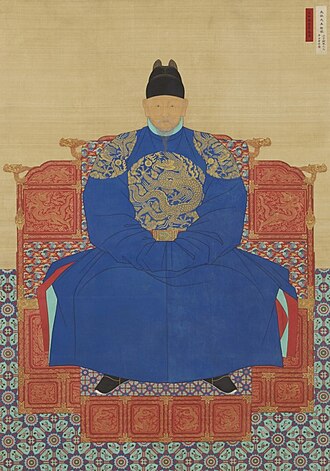
“A new dynasty must be built on new foundations — in land, in law, and in the loyalty of the people.”
Quick Facts: Taejo of Joseon
| Detail | Information |
|---|---|
| Born | 1335 |
| Died | 1408 |
| Reign as King | 1392–1398 |
| Dynasty Founded | Joseon |
| Previous Dynasty | Goryeo |
| Capital Established | Hanyang (modern Seoul) |
| Posthumous Title | Taejo (太祖), meaning “Grand Progenitor” |
From the Borderlands to the Battlefield
The story of Joseon — the dynasty that would define Korean civilisation for over five centuries — begins not in a palace, but on the military frontier. Yi Seonggye, later known by his royal title Taejo, was born in 1335 in the northeastern borderlands of the Goryeo kingdom. His family had roots in the region near what is now Hamgyong Province, an area where military skill was not merely valued but essential for survival. From an early age, Yi Seonggye proved himself an extraordinarily gifted soldier, developing a reputation as a commander of rare ability and personal courage.
Goryeo in the mid-fourteenth century was a kingdom under enormous stress. Decades of Mongol domination had hollowed out its political institutions, and the eventual loosening of Mongol control left a power vacuum that competing factions rushed to fill. The royal court was riddled with corruption, and land reform — one of the most urgent social issues of the era — remained hopelessly stalled. Powerful aristocratic families had accumulated vast estates, displacing ordinary farmers and undermining the state’s tax base. Into this volatile environment stepped Yi Seonggye, a military commander whose battlefield victories would eventually translate into political dominance.
Yi Seonggye distinguished himself in a series of campaigns, including actions against Red Turban invasions from the north and raids by Japanese pirates along the southern coast. Each victory added to his prestige and expanded his network of loyal followers within the military. By the 1380s, he had become one of the most powerful figures in the kingdom, commanding a personal following that rivalled the authority of the king himself.
The Turning Point: Wihwa Island and the March on the Capital
The moment that changed Korean history came in 1388. The Goryeo court, seeking to reassert influence over territories in Liaodong during a period of transition in China from the Yuan to the Ming dynasty, ordered a military expedition northward. Yi Seonggye was placed in command of this campaign, despite his strong reservations. He believed the expedition was strategically misguided — attempting to confront a rising Ming China while Goryeo itself was internally fragile seemed to him deeply unwise.
Yi Seonggye advanced his forces as far as Wihwa Island on the Amnok (Yalu) River, where he made a fateful decision. Rather than continuing north, he reversed his army and marched back toward the capital, Gaeseong. This act — known historically as the Wihwado Retreat — was a direct military challenge to the Goryeo throne. Yi Seonggye seized control of the government, removed King U from power, and positioned himself as the dominant political force in the kingdom.
“The Wihwado Retreat was not an act of cowardice — it was a calculated revolution, disguised as a military withdrawal.”
For the next four years, Yi Seonggye worked methodically to dismantle the old Goryeo order and prepare the ground for a new state. Alongside reformist scholar-officials, most notably Jeong Dojeon, he pushed through sweeping land reforms designed to break the power of the great aristocratic families and redistribute land to the state. These reforms, known as the gwajeon system, were among the most radical economic restructurings in Korean history up to that point. They also served Yi Seonggye’s political purposes: by weakening the old elites and rewarding his own supporters with land grants, he steadily consolidated power.
Why Did Yi Seonggye Found a New Dynasty Rather Than Reform Goryeo?
This is one of the most compelling questions in Korean history. The decision to found an entirely new dynasty rather than simply reform Goryeo from within was not inevitable. Several of Yi Seonggye’s contemporaries and allies favoured working within the existing royal framework. The reformist official Jeong Mongju, for instance, remained loyal to the Goryeo throne and actively resisted Yi Seonggye’s ambitions — a loyalty that ultimately cost him his life when he was assassinated in 1392, allegedly by Yi Seonggye’s son.
Several factors appear to have driven the decision toward founding a new dynasty. First, the Goryeo royal house had been so thoroughly compromised by Mongol intermarriage and political manipulation that it lacked genuine legitimacy in the eyes of many reformers. Second, Yi Seonggye and his key advisor Jeong Dojeon were committed Neo-Confucianists who believed that a genuinely Confucian state required not just new policies but a new mandate — a clean ideological break with the Buddhist-influenced Goryeo order. Third, the practical realities of power made it simpler to establish a new dynastic line than to rule indefinitely as a regent or strongman behind a discredited throne.
In 1392, Yi Seonggye formally accepted the throne, receiving endorsement from officials who declared the Goryeo mandate exhausted. He chose the dynastic name Joseon, consciously evoking the ancient kingdom of Gojoseon, one of the legendary founding states of Korean civilisation. This choice was deliberate: it positioned the new dynasty not as a break from Korean tradition but as a return to its deepest roots.
Building the New State: Confucian Governance and a New Capital
One of Taejo’s most consequential decisions was the relocation of the capital from Gaeseong — the old Goryeo capital, associated with the deposed dynasty and powerful entrenched interests — to a new site. After considerable deliberation, including consultations involving geomantic principles, the site of Hanyang was chosen. Today, this is the heart of Seoul, South Korea’s modern capital. The decision to build a new capital was both practical and symbolic: Hanyang’s location in the Han River basin offered strong natural defences and economic potential, while the new city itself would embody Joseon’s Confucian values through its planned layout, with palaces, altars, and administrative buildings arranged according to classical Chinese-derived principles.
Gyeongbokgung Palace, the grand primary palace of the Joseon dynasty, was constructed in Hanyang beginning in 1395. Its name means “Palace Greatly Blessed by Heaven,” and its design reflected the Confucian hierarchy that Taejo and his advisors sought to embed into every aspect of governance. The construction of the city walls, the royal ancestral shrine (Jongmyo), the altar of land and grain (Sajik), and the major government bureaus all proceeded rapidly in the early years of the dynasty, transforming a relatively undeveloped site into a functioning imperial capital within just a few years.
Alongside these physical achievements, Taejo’s government worked to establish the institutional foundations of Joseon governance. The examination system for recruiting officials was reformed and strengthened along Neo-Confucian lines. Buddhism, which had enjoyed royal patronage throughout the Goryeo period, was pushed to the social margins in favour of Confucian ritual and ethics. The Joseon wangjo sillok — the annals of the Joseon dynasty, one of the most remarkable documentary records in world history — would begin to be compiled under his successors, but the institutional culture that made such record-keeping possible was established in Taejo’s reign.
Taejo’s Later Years: Tragedy and Abdication
Despite his remarkable achievements, Taejo’s reign was cut short by bitter family conflict. The question of succession — specifically, which of his many sons would be designated crown prince — generated devastating conflict within the royal household. Taejo had sons by multiple consorts, and his later queen, Queen Sindeok, had borne him two sons whom some officials supported as successors. However, Yi Bangwon, one of Taejo’s sons by his first queen and perhaps his most politically capable child, had played a crucial role in eliminating rivals to the throne during the founding years.
In 1398, Yi Bangwon launched what became known as the First Strife of Princes, killing several rivals including Jeong Dojeon, the great architect of Joseon’s Confucian state. Taejo, devastated by the violence within his own family, abdicated the throne in 1398 after just six years of rule. He retired to his northeastern homeland, deeply estranged from the court that his ambition and skill had created. Yi Bangwon eventually took the throne as King Taejong in 1400, but relations with his father remained strained.
Taejo of Joseon died in 1408, at the age of seventy-four. His legacy, however, was immense and enduring. The dynasty he founded survived for over five hundred years, until 1897, making Joseon one of the longest-running dynasties in world history. The capital he built, Hanyang, remains the heart of modern Korea as Seoul. The Confucian institutional framework he established shaped Korean society, education, and governance for centuries.
3 Reasons Taejo’s Legacy Endures
- The Longevity of Joseon: The dynasty Taejo founded lasted from 1392 to 1897 — over five centuries. Few dynasties anywhere in the world can match this record of institutional continuity. The strength of Joseon’s founding structures, including its bureaucratic examination system and Confucian legal codes, created a framework resilient enough to survive internal crises, foreign invasions, and centuries of change.
- The Choice of Seoul: Taejo’s decision to locate the capital at Hanyang placed the political and cultural centre of Korea at the site of modern Seoul. That choice has proven extraordinarily durable: Seoul has been the capital of the Korean peninsula, in one form or another, for over six hundred years. Gyeongbokgung Palace and the historic district of Jongno still carry the physical imprint of Taejo’s founding vision.
- The Confucian Transformation of Korea: By adopting Neo-Confucianism as the official state ideology and systematically marginalising Buddhism from public life, Taejo’s dynasty fundamentally reshaped Korean culture. The values, social structures, family customs, and intellectual traditions of the Joseon period remain deeply embedded in Korean identity today, making Taejo’s ideological choices among the most consequential in Korean cultural history.
Continue Exploring
Learn more about Taejo of Joseon and the founding of the dynasty through these trusted resources: