“The rites performed at Jongmyo were not mere ceremony — they were the beating heart of Joseon’s moral and political order, connecting the living king to the ancestors who gave him the right to rule.”
In the heart of Seoul, surrounded by ancient trees and silent stone courtyards, stands one of the most important buildings ever constructed on the Korean peninsula. Jongmyo — the Royal Ancestral Shrine of the Joseon dynasty — has endured for more than six centuries as a place where Korea’s kings honored their forebears, where Confucian ritual shaped the identity of a nation, and where the sounds of one of the world’s oldest surviving court music traditions still echo across ceremonial grounds today.
For visitors and scholars alike, Jongmyo offers something rare: a living connection to a civilization that shaped East Asia for five hundred years. It is a UNESCO World Heritage Site, a repository of royal spirit tablets, and the stage for an annual ritual ceremony that UNESCO has separately recognized as an Intangible Cultural Heritage of Humanity. This is its story.
Quick Facts: Jongmyo at a Glance
| Location | Jongno District, Seoul, South Korea |
| Originally Built | 1395, early Joseon dynasty |
| Dynasty | Joseon (1392–1897) and Korean Empire (1897–1910) |
| UNESCO World Heritage | Inscribed 1995 |
| Type | Confucian royal ancestral shrine |
| National Treasure Status | Designated National Treasure of South Korea |
| Annual Ceremony | Jongmyo Jerye (held each May) |
Origins: Why Did the Joseon Dynasty Build Jongmyo?
When General Yi Seonggye overthrew the Goryeo dynasty and founded Joseon in 1392, he inherited not just a kingdom but an obligation. Confucian statecraft — the governing philosophy that would define Joseon for half a millennium — placed enormous weight on the veneration of ancestors. For a monarch, this was not a private family matter. It was a public, political, and spiritual duty that legitimized his right to the throne.
Yi Seonggye, who became King Taejo of Joseon, moved the capital from Gaegyeong (modern Kaesong) to Hanyang, the city we know today as Seoul. According to Confucian urban planning principles derived from ancient Chinese texts, a proper royal capital required two sacred installations placed in specific positions relative to the palace: the Sajikdan, an altar for the gods of earth and grain, and the Jongmyo, a shrine where the spirits of deceased kings and queens could be enshrined and regularly honored.
Construction of Jongmyo began almost immediately after the move to Hanyang. The original shrine was completed in 1395, just three years after the dynasty’s founding. The speed of its construction reflected how central ancestral rites were to the new kingdom’s identity. A king who neglected his ancestors was, in the Confucian worldview, a king who had forfeited his moral authority to rule.
Architecture: What Makes Jongmyo’s Design So Extraordinary?
Jongmyo is not a building that announces itself with soaring towers or dramatic ornamentation. Its power lies in its austerity. The shrine complex is deliberately restrained — built not to impress the living with spectacle, but to create a solemn and dignified environment suited to communion with the dead.
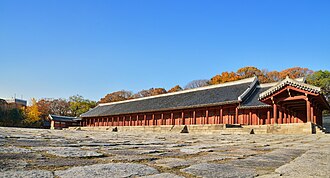
The main hall, known as Jeongjeon, is recognized as one of the longest wooden buildings in East Asia. It stretches in a single, low horizontal line, its columns spaced evenly along a raised stone platform. Inside, spirit tablets — wooden plaques inscribed with the posthumous names of kings and queens — are stored in individual chambers. Over the centuries of the Joseon dynasty, as the list of royal ancestors grew, Jeongjeon was expanded multiple times to accommodate new tablets. What began as a modest hall gradually became a structure of remarkable length.
A second hall, Yeongnyeongjeon, was constructed to house the spirit tablets of kings and queens who were considered of lesser ceremonial rank, including ancestors of Taejo who had never actually reigned. Together, the two halls form the ceremonial core of the complex, surrounded by auxiliary structures, stone-paved courtyards, and wooded grounds that create a sense of separation from the world outside.
The architectural philosophy underlying Jongmyo reflects a broader Joseon aesthetic: simplicity in service of solemnity. There are no golden roofs, no elaborate painted dragons in the style of Chinese imperial architecture. The shrine speaks in a quieter language — one of proportion, silence, and natural materials. Scholars have long noted that this restraint makes Jongmyo one of the most purely Confucian architectural expressions anywhere in East Asia.
“Jongmyo’s Jeongjeon hall is not merely a building — it is a statement of values: that order, restraint, and reverence for the past are the foundations upon which a civilized society must be built.”
5 Key Moments in Jongmyo’s Long History
1. The Founding of Joseon and the First Shrine (1395)
King Taejo completes the original Jongmyo just three years after founding the Joseon dynasty, establishing ancestral rites as a cornerstone of the new state’s identity and political legitimacy.
2. Destruction During the Imjin War (1592)
When Japanese forces under Toyotomi Hideyoshi invaded Korea in 1592 — the conflict known as the Imjin War — the royal capital of Hanyang was burned. Jongmyo was destroyed in the chaos and had to be painstakingly rebuilt after the war concluded. The reconstruction preserved the original layout while allowing for expansion of the main hall.
3. Expansion of Jeongjeon Hall
As the Joseon dynasty continued for generation after generation, the number of royal spirit tablets requiring enshrinement grew. Jeongjeon was expanded multiple times over the centuries to accommodate new chambers, ultimately reaching the extraordinary length that makes it one of the most architecturally distinctive structures in Korean history.
4. The End of the Monarchy and the Japanese Colonial Period (1910–1945)
When Japan annexed Korea in 1910, the ritual life of Jongmyo was effectively suspended. The colonial authorities transformed much of the grounds into a public park, and the royal ceremonies that had defined the shrine’s purpose for five centuries were discontinued. The spirit tablets remained, but the living tradition of their veneration was severed.
5. UNESCO World Heritage Inscription (1995)
In 1995, exactly six hundred years after its original construction, Jongmyo was inscribed as a UNESCO World Heritage Site. UNESCO’s recognition highlighted the shrine’s outstanding universal value as an exceptionally well-preserved example of a Confucian royal ancestral shrine, and noted that the Jongmyo Jerye ritual ceremony performed there represents one of the world’s oldest living royal ritual traditions.
The Jongmyo Jerye: A Living Ritual Tradition
What distinguishes Jongmyo from many other historic sites is that it remains, in a meaningful sense, alive. Each year on the first Sunday of May, the Jongmyo Jerye ceremony is performed within the shrine complex. The ritual brings together ritual specialists, musicians, and dancers in a ceremony that traces its origins directly to the Joseon royal court.
The musical component of the ceremony — known as Jongmyo Jeryeak — is particularly remarkable. It is considered one of the oldest surviving court music traditions in the world, and its instruments, melodies, and choreography have been transmitted across centuries with extraordinary fidelity. The slow, measured movements of the ritual dancers and the deep, resonant tones of ancient instruments create an experience that observers consistently describe as unlike anything else in Korea’s cultural calendar.
UNESCO recognized Jongmyo Jerye and Jongmyo Jeryeak as Masterpieces of the Oral and Intangible Heritage of Humanity in 2001, and they were subsequently incorporated into the Representative List of the Intangible Cultural Heritage of Humanity. This dual UNESCO recognition — for both the physical shrine and its living ritual — is a testament to Jongmyo’s unique position at the intersection of Korea’s tangible and intangible heritage.
Jongmyo in Context: How Does It Compare?
| Feature | Jongmyo (Korea) | Imperial Ancestral Temple, Beijing (China) |
|---|---|---|
| Dynasty | Joseon (1392–1910) | Ming and Qing dynasties |
| Architectural Style | Austere, horizontal, restrained | Elaborate, vertically accented, richly decorated |
| Living Ritual | Yes — Jongmyo Jerye held annually | Ritual discontinued; site now a public park |
| UNESCO Recognition | World Heritage Site (1995); Intangible Heritage (2001) | Part of broader Forbidden City inscription |
| Governing Philosophy | Neo-Confucianism | Confucianism / Imperial Chinese tradition |
Why Jongmyo Still Matters Today
In an age when Seoul is better known for its towering glass skyscrapers, its technology industry, and its globally influential pop culture, Jongmyo represents something quietly radical: a refusal to let the past be merely past. The shrine sits in Jongno District, surrounded by one of the world’s most dynamic modern cities, and yet within its wooded grounds, time moves differently.
For Korean society, Jongmyo carries layers of meaning that go beyond tourism or heritage preservation. The shrine embodies the Confucian values of filial piety and ancestral continuity that shaped Korean culture for centuries and that continue, in transformed ways, to influence Korean family and social life. The annual Jongmyo Jerye ceremony draws thousands of observers and remains a powerful expression of cultural identity.
There is also a political dimension to Jongmyo’s contemporary significance. The shrine was the spiritual heart of a royal system that was violently ended by Japanese colonization. The revival of the Jongmyo Jerye ceremony after Korea’s liberation in 1945, and its eventual UNESCO recognition, carries weight as an act of cultural reclamation — an assertion that the traditions suppressed under colonial rule had not been extinguished.
For international visitors, Jongmyo offers something that few historic sites can provide: the experience of a place that is simultaneously a museum, a functioning ritual site, and a meditation on the relationship between the living and the dead. It is one of the most important places in Korean history — and one of the most rewarding to visit.
Continue Exploring
On Coreaverse
- The Joseon Dynasty: Five Centuries That Shaped Korea
- King Taejo: The General Who Became a Dynasty’s Founder
- How Confucianism Shaped Korean Society
- Seoul’s Five Grand Palaces: A Complete Guide