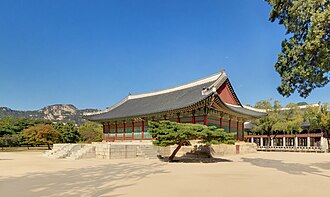
“The Hall of Worthies was not merely a library or a school — it was the beating intellectual heart of early Joseon Korea, a place where scholarship shaped a civilization.”
In the early fifteenth century, at the height of Korea’s Joseon dynasty, a remarkable institution quietly took root within the walls of Gyeongbokgung Palace in present-day Seoul. Known in Korean as Jiphyeonjeon (집현전), or the Hall of Worthies, this royal academy became one of the most consequential scholarly institutions in Korean history. It was here that some of Korea’s greatest intellectual achievements were conceived, debated, and produced — none more transformative than the creation of the Korean alphabet, Hangul.
To understand the Hall of Worthies is to understand the ambitions of King Sejong the Great, the fourth ruler of the Joseon dynasty, who believed deeply that a strong, literate, and well-governed kingdom depended on a foundation of rigorous scholarship. The institution he cultivated became the engine of a cultural renaissance that still shapes Korea today.
Quick Facts: The Hall of Worthies at a Glance
| Fact | Detail |
|---|---|
| Korean Name | Jiphyeonjeon (집현전) |
| Dynasty | Joseon |
| Founded / Reorganized | 1420 under King Sejong |
| Location | Gyeongbokgung Palace, Hanyang (modern Seoul) |
| Key Achievement | Development of the Hangul alphabet (1443) |
| Dissolved | 1456 under King Sejo |
| Notable Scholars | Jeong Inji, Seong Sam-mun, Park Paengnyeon |
The Origins of the Hall of Worthies
The concept of a royal research institute was not entirely new to Korea when Sejong reorganized the Jiphyeonjeon in 1420. Earlier versions of the institution had existed in prior Korean kingdoms, and Chinese dynasties had long maintained similar scholarly bodies attached to the imperial court. However, it was King Sejong who transformed the Hall of Worthies from a modest advisory office into a fully-funded, prestigious center for research and learning.
Sejong carefully selected young scholars of exceptional ability and placed them within the hall, granting them generous conditions that were almost unheard of in the rigid hierarchical society of Joseon. Scholars were given access to the royal library, provided with comfortable stipends, and — crucially — were sometimes granted paid leave to focus entirely on research. This policy, known as saagarok (賜暇讀書, or “reading leave”), allowed the most talented men to immerse themselves in study without the distraction of routine administrative duties.
The king’s intention was clear: he wanted scholars who could think deeply, advise wisely, and produce work that would benefit the kingdom for generations. The Hall of Worthies was not a ceremonial body. It was a working institution, and its members were expected to deliver.
What Did the Hall of Worthies Actually Do?
The scope of work undertaken by the scholars of the Jiphyeonjeon was remarkably broad. At its core, the hall served several overlapping functions for the Joseon court.
Royal Advisory and Research: Scholars provided the king with expert analysis on matters of governance, ethics, law, and history. They reviewed classical Chinese texts, compiled precedents, and helped formulate state policy grounded in Confucian principles. In a kingdom that placed enormous value on proper governance according to ancient models, this advisory function was politically critical.
Compilation of Official Records and Texts: The Hall of Worthies was responsible for editing and publishing a wide range of important texts. Scholars compiled historical records, agricultural manuals, medical encyclopedias, and ritual guides. These works were intended to standardize knowledge and make it accessible across the kingdom, strengthening both administrative efficiency and cultural cohesion.
Ceremonies and Ritual Guidance: Court ritual in Joseon was elaborate and deeply codified. Scholars from the Hall of Worthies helped ensure that state ceremonies followed proper precedent, drawing on both Korean tradition and Chinese classical models.
Scientific and Technological Research: Under Sejong’s reign, the hall was closely associated with a period of remarkable scientific innovation. While the inventors and engineers were not always hall scholars themselves, the intellectual environment fostered by the Jiphyeonjeon supported advances in astronomy, cartography, timekeeping, and agriculture. The famous Joseon celestial globe, rain gauges, and water clocks developed during this era emerged from the same culture of systematic inquiry that the hall embodied.
“King Sejong believed that ignorance was the enemy of good governance. The Hall of Worthies was his answer — a permanent institution dedicated to the pursuit of knowledge in service of the people.”
Why Did King Sejong Create the Hangul Alphabet?
Of all the achievements associated with the Hall of Worthies, none has had a more enduring impact than the creation of Hangul. To understand why this invention mattered so profoundly, it is necessary to understand the linguistic situation of fifteenth-century Korea.
At the time, the official written language of the Joseon court was classical Chinese — a system entirely unrelated to spoken Korean. While educated elites spent years mastering Chinese characters, the vast majority of Korea’s population was functionally illiterate. Ordinary farmers, artisans, and merchants had no practical means of reading royal proclamations, legal documents, or agricultural guides written in classical Chinese. This literacy gap was not merely a cultural inconvenience; it was a genuine barrier to justice and effective governance.
King Sejong was troubled by this situation. According to the preface of the Hunminjeongeum — the document promulgating the new alphabet in 1446 — Sejong stated that the Korean language differed fundamentally from Chinese, and that ordinary people had no way to express their thoughts in writing. His solution was to create an entirely new writing system, one that could be learned in days rather than years, and that would allow any Korean person to read and write in their own language.
Scholars of the Hall of Worthies, including Jeong Inji, Seong Sam-mun, and others, worked closely with the king on the development and refinement of this new script. The alphabet — originally called Hunminjeongeum, meaning “the correct sounds for the instruction of the people” — was announced in 1443 and officially promulgated in 1446. It consisted of 28 letters (later reduced to 24 in modern usage), each designed to reflect the shape of the mouth, tongue, and throat when producing the corresponding sound. It was a brilliantly systematic invention, unlike any alphabet then in existence.
3 Reasons the Hall of Worthies Changed Korean History
- It gave Korea a writing system of its own. The development of Hangul under the hall’s scholars was the single most democratizing act in Korean cultural history. For the first time, literacy was not the exclusive province of the educated elite. Hangul could be learned quickly and used by anyone, laying the foundation for a genuinely literate society across many centuries.
- It established a model of state-sponsored scholarship. The Hall of Worthies demonstrated that a government could invest in knowledge as a long-term strategy for stability and prosperity. This model influenced later Korean institutions and reinforced the deep Confucian respect for learning that characterized Joseon society for the next four centuries.
- It produced a body of knowledge that outlasted the institution itself. The texts, records, and systems compiled and created by Hall of Worthies scholars endured long after the hall was dissolved. Agricultural manuals improved crop yields. Medical encyclopedias guided physicians. Historical records shaped how Korea understood its own past. The institution’s legacy was embedded in the fabric of Joseon civilization.
The Scholars Who Shaped the Hall
The Hall of Worthies was only as powerful as the men who worked within it. King Sejong chose his scholars with great care, selecting individuals who combined intellectual brilliance with moral integrity — the Confucian ideal of the scholar-official made flesh.
Among the most celebrated was Jeong Inji, who eventually rose to become one of the most senior officials in the kingdom and is credited with writing the postface to the Hunminjeongeum. Seong Sam-mun, another prominent hall scholar, was deeply involved in the development of Hangul and later became one of the tragic figures of Joseon history, executed for his loyalty to the deposed King Danjong. Park Paengnyeon was likewise known for his scholarship and his steadfast refusal to transfer his loyalty to the usurper King Sejo.
The fates of these men point to a profound tension that would ultimately bring the Hall of Worthies to an end. Scholarship and political loyalty were never fully separable in the Joseon court, and the hall’s scholars were not merely intellectuals — they were political actors whose convictions carried life-or-death consequences.
The Dissolution of the Hall of Worthies
The Hall of Worthies met its end in 1456, just two years after King Sejo seized the throne from his young nephew, King Danjong, in a coup known as the Gye-yoo Jeongnan. Several scholars from the Jiphyeonjeon were implicated in a failed plot to restore Danjong to power. The conspiracy was discovered, and Sejo responded with brutal efficiency. The ringleaders were executed, and the Hall of Worthies itself was abolished.
The closure of the institution marked the end of one of the most intellectually fertile periods in Korean history. While later Joseon rulers maintained scholarly institutions, none quite recaptured the particular combination of royal vision, institutional support, and individual talent that had made the Jiphyeonjeon so remarkable during Sejong’s reign.
Yet the legacy of the Hall of Worthies proved impossible to dissolve by royal decree. Hangul survived and spread. The texts compiled by its scholars continued to circulate. And in the centuries that followed, the institution became a symbol of what Korean scholarship at its best could achieve — a reminder that intellect, when properly supported and directed, could transform a civilization.
The Hall of Worthies Today
Visitors to Gyeongbokgung Palace in Seoul today walk through the grounds where the Jiphyeonjeon once stood. The palace has been extensively restored following centuries of destruction and neglect, and while the original Hall of Worthies building no longer survives in its fifteenth-century form, the site remains a place of deep historical resonance.
The achievement most closely associated with the hall — Hangul — is celebrated every year on Hangul Day (한글날), observed on October 9th in South Korea. The day honors not just an alphabet but an act of governance rooted in compassion for ordinary people. That this act emerged from an institution dedicated to worthiness in scholarship makes the Hall of Worthies one of the most significant intellectual legacies in all of East Asian history.