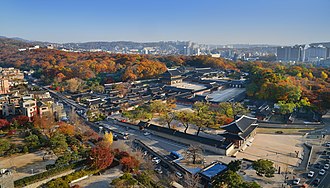
“Of all the palaces of the Joseon dynasty, Changdeokgung alone retains the harmony between human architecture and the living landscape that defined the Korean ideal of a royal residence.”
Nestled against the forested slopes of Bugaksan in the heart of Seoul, Changdeokgung — the Palace of Prospering Virtue — stands as one of the best-preserved royal complexes in East Asia. Unlike the grander, more symmetrical layout of Gyeongbokgung to its west, Changdeokgung was designed to follow the natural contours of the land, its buildings and gardens flowing organically with the hillside terrain. That distinctive philosophy earned it a place on the UNESCO World Heritage List and made it the favoured residence of Joseon kings for more than two and a half centuries.
To visit Changdeokgung today is to walk through layers of Korean history — from the early ambitions of the Joseon dynasty’s founding kings, through the devastation of foreign invasions, the resilience of reconstruction, and finally the quiet dignity of a palace that outlasted the dynasty it served.
Quick Facts: Changdeokgung at a Glance
| Detail | Information |
|---|---|
| Korean Name | 창덕궁 (昌德宮) |
| Meaning | Palace of Prospering Virtue |
| Location | Jongno District, Seoul, South Korea |
| Dynasty | Joseon (1392–1897) |
| Original Construction | 1405, reign of King Taejong |
| UNESCO Designation | World Heritage Site, 1997 |
| Notable Feature | Huwon (Secret Garden), a 78-acre rear garden |
| Coordinates | 37.579°N, 126.992°E |
Why Was Changdeokgung Built?
The Joseon dynasty, founded by General Yi Seonggye in 1392, established its capital at Hanyang — modern-day Seoul — and set about constructing the grand main palace of Gyeongbokgung. Yet dynastic politics and royal preference soon created a need for a second palace. In 1405, during the reign of King Taejong, the third monarch of Joseon, Changdeokgung was constructed to serve as an auxiliary palace — a secondary seat of royal power that could house the king and his court away from the main compound.
Taejong’s motivations were partly practical and partly political. Having seized power in a series of violent succession struggles known as the Strife of Princes, he was acutely aware of the dangers of concentrating all royal functions in a single location. A secondary palace offered flexibility and redundancy in governance. The site chosen, nestled at the foot of Bugaksan and Eungbong hills, was also considered highly auspicious according to the principles of geomancy, or pungsu — the Korean adaptation of feng shui — which guided the placement of all major Joseon structures.
From its earliest years, Changdeokgung was notable for what set it apart from Gyeongbokgung. Where the main palace followed rigid axial symmetry derived from Chinese imperial architectural traditions, Changdeokgung’s builders adapted their designs to the natural landscape. Buildings were angled to suit the slope of the terrain, courtyards were irregular in shape, and pathways wound through the hillside rather than marching in straight lines. This was not architectural improvisation — it was a deliberate expression of Korean aesthetic values that prized harmony with nature over the imposition of geometric order.
Destruction, Survival, and Reconstruction
The history of Changdeokgung is inseparable from the story of Korea’s most devastating foreign invasion. In 1592, the Japanese military leader Toyotomi Hideyoshi launched a massive campaign to conquer the Korean peninsula, beginning what Koreans call the Imjin War. Japanese forces swept northward with terrifying speed, and as they approached Seoul, the royal family fled. In the chaos that followed, both Gyeongbokgung and Changdeokgung were burned to the ground — a catastrophe that erased nearly two centuries of accumulated royal architecture in a matter of days.
The destruction was total, but the Joseon court was determined to rebuild. After the Japanese forces were eventually repelled — aided decisively by Chinese Ming dynasty troops and the legendary naval commander Admiral Yi Sunsin — reconstruction began. Gyeongbokgung, the main palace, proved too costly and politically complicated to restore immediately. Changdeokgung, by contrast, was rebuilt first, completed in 1610 during the reign of King Gwanghaegun. For the next 258 years, it would serve as the primary royal residence — a remarkable reversal of its original secondary status.
“Changdeokgung became the true heart of Joseon royal life not by design, but through the crucible of war and the pragmatic choices of reconstruction.”
The palace was damaged and repaired again on multiple occasions across the Joseon period, most notably during another Japanese invasion in 1597 and during various fires that periodically afflicted wooden palace buildings. Each reconstruction contributed new layers to the complex, and the Changdeokgung that visitors explore today represents the accumulated building campaigns of several centuries rather than the vision of any single reign.
The Architecture: 5 Defining Features of Changdeokgung
1. Donhwamun — The Great Gate
The main entrance to Changdeokgung is Donhwamun, a two-story wooden gate that dates in its current form to 1609, making it the oldest surviving palace gate in Seoul. Its name means Gate of Prospering Harmony. The gate’s towering wooden pillars, massive bracket sets, and sweeping tiled roofs exemplify the architectural grandeur of the Joseon court, and it has served as the ceremonial entrance to the palace for over four centuries.
2. Injeongjeon — The Throne Hall
At the ceremonial heart of the palace stands Injeongjeon, the main throne hall where kings were formally enthroned, received foreign envoys, and conducted the most solemn affairs of state. The current structure dates to 1804, rebuilt after fire damage. Its elevated position atop a broad stone platform, approached by a multi-tiered staircase flanked by stone markers indicating the ranked positions of court officials, communicates royal authority with architectural precision.
3. Seonjeongjeon — The Blue-Roofed Hall
Unusually among Korean palace buildings, Seonjeongjeon is roofed with glazed blue tiles rather than the standard grey ceramic. This was the hall where kings conducted everyday administrative business, consulting with ministers and issuing decrees. The blue roof, a rare and expensive luxury, marked the building’s special status within the palace complex.
4. Nakseonjae — The Intimate Quarters
Built in 1847 during the reign of King Heonjong, the Nakseonjae complex served as private residential quarters for the king and his concubines. Its relatively unadorned style — lacking the painted decorations that embellish most royal halls — reflects a deliberate aesthetic of refined simplicity. Nakseonjae holds particular poignancy because it was occupied by members of the last Korean royal family well into the twentieth century.
5. Huwon — The Secret Garden
Perhaps no feature of Changdeokgung captures the imagination more completely than Huwon, the rear garden, sometimes translated as the Secret Garden or Forbidden Garden. Covering approximately 78 acres behind the palace buildings, Huwon is one of the finest surviving examples of a traditional Korean garden, blending forested hillside, man-made lotus ponds, open pavilions, and carefully placed rocks and trees into a landscape of extraordinary tranquility. The garden contains dozens of pavilions built across different reigns, each positioned to maximize views of the seasonal landscape. It was reserved exclusively for the royal family and remained off-limits to ordinary Koreans for centuries — hence its evocative nickname.
Changdeokgung vs. Gyeongbokgung: A Palace Comparison
| Feature | Changdeokgung | Gyeongbokgung |
|---|---|---|
| Built | 1405 | 1395 |
| Role | Secondary, later primary palace | Main palace of Joseon |
| Layout | Irregular, follows natural terrain | Symmetrical, axial grid |
| Garden | Huwon (Secret Garden), 78 acres | Gyeonghoeru Pavilion pond |
| UNESCO Status | World Heritage Site (1997) | Not separately listed |
| Current Status | Open to public; guided tours for Huwon | Fully open to public |
| Architectural Style | Nature-integrated Korean aesthetic | Chinese-influenced imperial symmetry |
The UNESCO Designation: Why Changdeokgung Was Chosen
In 1997, UNESCO inscribed Changdeokgung on its World Heritage List, recognising it as an outstanding example of Far Eastern palace architecture and garden design. The committee specifically cited the way the palace complex integrates its buildings with the surrounding natural landscape as an exceptional achievement — one that distinguishes Changdeokgung from other East Asian royal complexes and makes it uniquely expressive of Korean cultural values.
UNESCO’s assessment highlighted the palace’s authenticity: unlike many historical sites that have been heavily reconstructed or modified in modern times, Changdeokgung retains a high degree of integrity in its surviving structures, spatial arrangements, and garden landscape. The criterion of outstanding universal value was met not merely because the palace is old or impressive, but because it embodies a coherent and distinctive philosophy of how human beings should inhabit the natural world — with sensitivity, not dominance.
The designation has brought both benefits and challenges. International recognition has increased visitor numbers substantially, prompting careful management of the Huwon garden in particular, which continues to be accessible only through guided tours to limit the impact on its delicate ecosystem. The balance between preservation and access remains an ongoing conversation between heritage authorities and the public.
The End of a Dynasty, the Survival of a Palace
When the Joseon dynasty formally ended in 1897 — transformed briefly into the Korean Empire before Japanese annexation in 1910 — Changdeokgung did not simply become a museum piece. Members of the Korean imperial family continued to reside within parts of the complex, most notably in the Nakseonjae quarters. The last crown princess of Korea, Yi Bang-ja (née Masako Nashimoto), lived in Nakseonjae until her death in 1989, giving the palace a living connection to the royal past that persisted into the late twentieth century.
During the Japanese colonial period (1910–1945), the palace was opened to the public for the first time — a move that mixed genuine public access with a colonial agenda of reframing Korean royal sites as tourist attractions and historical curiosities rather than living symbols of Korean sovereignty. After liberation in 1945 and the establishment of the Republic of Korea, the government undertook systematic efforts to restore and preserve Changdeokgung, a process that continues to the present day under the Cultural Heritage Administration of Korea.
Visiting Changdeokgung Today
Changdeokgung is located in the Jongno District of central Seoul, easily accessible by subway. The main palace buildings are open to independent visitors, while the Huwon garden requires joining a guided tour — a policy that both manages visitor numbers and enriches the experience through expert interpretation. Tours are available in Korean, English, Chinese, and Japanese, reflecting the palace’s status as one of Seoul’s premier international heritage destinations.
The best seasons to visit are spring, when cherry blossoms and flowering trees transform the garden into a canvas of pink and white, and autumn, when the forested hillside erupts in deep reds and golds. The combination of historic architecture and living seasonal landscape makes Changdeokgung one of those rare heritage sites where the visitor’s experience is fundamentally shaped by the time of year — exactly as its original designers intended.
Continue Exploring
- On This Site: The Joseon Dynasty: Five Centuries of Korean Civilization
- On This Site: The Imjin War: When Japan Invaded Joseon
- On This Site: Inside Huwon: A Walk Through Korea’s Secret Garden
- Wikipedia: Changdeokgung — Wikipedia
- UNESCO: Changdeokgung Palace Complex — UNESCO World Heritage
- Encyclopedia of Korean Culture: Changdeokgung — Academy of Korean Studies
- Visit Korea: Changdeokgung Official Tourism Information
- Cultural Heritage Administration: Korea Cultural Heritage Administration — Changdeokgung