“In carving these sacred texts, we do not merely copy words — we invoke the protection of the Buddha for all the people of Goryeo.”
Deep in the mountains of South Korea, inside the ancient monastery of Haeinsa, rest more than 81,000 wooden printing blocks — each one hand-carved with extraordinary precision, each one a page of one of humanity’s most ambitious intellectual and spiritual projects. The Tripitaka Koreana, known in Korean as Palman Daejanggyeong (팔만대장경), is the world’s most complete and accurate version of the Buddhist Tripitaka canon in classical Chinese. Created during the Goryeo dynasty over the course of the 13th century, it stands today not only as a treasure of Korean Buddhism but as a monument to human perseverance, devotion, and craft.
Inscribed on UNESCO’s Memory of the World Register and enshrined within a UNESCO World Heritage Site, the Tripitaka Koreana continues to astonish historians, Buddhist scholars, and visitors alike. How was it made? Why was it created — twice? And what makes it so extraordinary, nearly eight centuries later?
Quick Facts: The Tripitaka Koreana at a Glance
| Fact | Detail |
|---|---|
| Korean Name | 팔만대장경 (Palman Daejanggyeong) |
| Dynasty | Goryeo (고려) |
| Number of Woodblocks | Approximately 81,350 |
| Number of Characters | Approximately 52 million |
| Carving Period (Second Set) | 1236–1251 CE |
| Current Location | Haeinsa Temple, Hapcheon, South Gyeongsang Province |
| UNESCO Status | Memory of the World Register; housed in a World Heritage Site |
| National Treasure | South Korea National Treasure No. 32 |
A Nation Under Siege: Why Was the Tripitaka Koreana Created?
To understand the Tripitaka Koreana, one must first understand the desperate circumstances that gave rise to it. The Goryeo dynasty (918–1392 CE) was a deeply Buddhist kingdom, one in which state and faith were profoundly intertwined. Korean rulers looked to Buddhism not merely as personal spiritual guidance but as a source of national protection — a divine shield against foreign aggression.
The first set of Tripitaka woodblocks was created during the early 11th century, when the Goryeo kingdom faced repeated invasions by the Khitan people from the north. Goryeo’s King Hyeonjong commissioned the carving of the entire Buddhist canon as an act of devotion, seeking the Buddha’s protection for his people. That first set, completed over several decades, was housed at Buinsa Temple in what is today North Korea.
Then came the Mongols. Beginning in 1231, the forces of the Mongol Empire launched a series of devastating invasions of the Korean peninsula. By 1232, the Mongol armies had ravaged much of the country, and in that same year, the original Tripitaka woodblocks housed at Buinsa were destroyed by fire — likely burned during the Mongol campaigns. It was a catastrophic loss, both culturally and spiritually.
The Goryeo court, which had retreated to the island of Ganghwado to escape the Mongol onslaught, made a remarkable decision: they would carve the entire canon again. This second — and surviving — set of woodblocks was produced between 1236 and 1251, a period of fifteen years during which the peninsula was still under intermittent Mongol attack. The act was simultaneously one of national defiance, religious devotion, and extraordinary cultural ambition.
“The Tripitaka Koreana was not simply copied — it was corrected, refined, and made more complete than any Buddhist canon that had come before it.”
The Making of 81,000 Woodblocks: Craft and Devotion
The sheer scale of the Tripitaka Koreana’s production is staggering. The project involved carving approximately 81,350 individual wooden printing blocks, each one measuring roughly 70 centimetres in length and 24 centimetres in width. Together, they contain approximately 52 million individual Chinese characters — every one of them carved by hand.
The wood used for the blocks was carefully selected and prepared over a multi-year process. Scholars believe the timber — primarily birch wood — was first soaked in seawater for several years, then boiled in salt water, then left to dry slowly in the shade. This painstaking preparation prevented the wood from cracking or warping over time, a process that has proven extraordinarily effective: the blocks remain in excellent condition nearly 800 years later.
Each block was then coated with a lacquer made from poisonous sumac to repel insects and further preserve the surface. Metal corner fittings were added to each block for additional protection. The result was a printing technology that was both sophisticated and supremely durable.
What truly distinguished the Tripitaka Koreana from earlier Buddhist canons, however, was not merely its physical craftsmanship but its scholarly ambition. The Goryeo monks who oversaw the project, most notably the monk Sugi, compared the existing Chinese and Khitan versions of the Tripitaka against each other and produced a corrected, unified text. Sugi reportedly compiled a separate catalogue noting all discrepancies found between the different versions and the corrections made. The resulting canon is considered by modern scholars to be the most accurate and complete surviving version of the Chinese Buddhist Tripitaka.
Remarkably, despite the scale of the project and the number of carvers involved, the uniformity of the calligraphic style across all 81,000 blocks is so consistent that some scholars have marvelled at it as one of the great mysteries of the work. Each character maintains the same size, spacing, and style throughout the entire canon.
3 Reasons the Tripitaka Koreana Remains Extraordinary
1. Unmatched Scholarly Accuracy
Unlike earlier versions of the Buddhist Tripitaka, the Goryeo edition was produced through a systematic collation of Chinese, Khitan, and Song Chinese sources. The monk Sugi’s careful editorial work resulted in a text that scholars to this day regard as the most reliable surviving edition of the Chinese Buddhist canon. It has been used as the standard reference text for East Asian Buddhism for centuries.
2. Extraordinary Physical Preservation
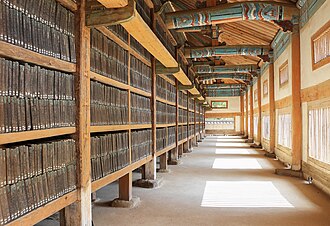
The woodblocks have survived for nearly 800 years in nearly perfect condition. This is partly due to the extraordinary care taken in preparing and treating the wood, and partly due to the unique architecture of the storage halls at Haeinsa Temple. The Janggyeong Panjeon — the depository buildings constructed in the late 15th century to house the blocks — were designed with a sophisticated natural ventilation system. Vents of different sizes on opposite walls create airflow that regulates temperature and humidity, keeping the wooden blocks from deteriorating. This system was so effective that no modern climate control has ever been needed.
3. A Testament to Korean Resilience
The blocks were carved during one of the most traumatic periods in Korean history, while the Goryeo kingdom was fighting for its very survival against the Mongol Empire. That a nation under existential military threat could simultaneously produce one of the world’s greatest feats of cultural and scholarly achievement speaks to the depth of Goryeo civilisation and the central role Buddhism played in Korean identity and statecraft.
From Ganghwado to Haeinsa: The Journey of the Woodblocks
After the completion of the second set of woodblocks in 1251, they were stored on Ganghwado Island, where the Goryeo court had taken refuge from the Mongols. The woodblocks remained there for well over a century. It was not until 1398, in the early years of the newly established Joseon dynasty, that they were transferred to their current home at Haeinsa Temple in the Gayasan mountains of South Gyeongsang Province.
The Janggyeong Panjeon — the four depository halls built to house the woodblocks at Haeinsa — were constructed in the late 15th century and are themselves a masterpiece of functional architecture. Their ingenious ventilation design has kept the wooden printing blocks in a stable environment for over five centuries. In 1995, the Janggyeong Panjeon at Haeinsa was inscribed as a UNESCO World Heritage Site in recognition of their outstanding universal value. The Tripitaka Koreana woodblocks themselves were separately inscribed on UNESCO’s Memory of the World Register in 2007.
Comparison: First and Second Tripitaka Sets
| Feature | First Tripitaka (11th Century) | Second Tripitaka (13th Century) |
|---|---|---|
| Reason for Creation | Khitan invasions; seeking Buddhist protection | Mongol invasions; replacing destroyed first set |
| Storage Location | Buinsa Temple (modern North Korea) | Ganghwado Island, then Haeinsa Temple |
| Current Status | Destroyed (burned during Mongol campaigns, 1232) | Survives intact at Haeinsa, South Korea |
| Scholarly Methodology | Based primarily on Chinese sources | Collated from Chinese, Khitan, and Song sources; corrected by monk Sugi |
| UNESCO Recognition | None (lost) | Memory of the World Register (2007); housed in World Heritage Site (1995) |
The Tripitaka Koreana Today
Today, Haeinsa Temple remains one of Korea’s most visited and revered Buddhist monasteries, and the Tripitaka Koreana is its greatest treasure. The depository halls are open to viewing, though the woodblocks themselves are carefully protected. Visitors can observe row upon row of the ancient printing blocks — their characters still crisp and legible after nearly eight centuries — through the open-latticed doors of the Janggyeong Panjeon.
The woodblocks have also been digitised in recent years, making the entire text of the Tripitaka Koreana accessible to scholars and practitioners worldwide. The digital project has confirmed the extraordinary consistency and accuracy of the original carving work, vindicating the scholarship and devotion of the Goryeo monks who oversaw its creation.
For scholars of East Asian Buddhism, the Tripitaka Koreana remains the authoritative reference edition of the Chinese Buddhist canon. Its influence has extended across Korea, Japan, China, and the broader Buddhist world. Many editions of Buddhist scriptures printed in East Asia over the past several centuries have been based, directly or indirectly, on the Goryeo canon.
In an age of digital information, it is humbling to stand before these ancient wooden blocks and consider what their creation required: the collective labour of thousands of craftspeople, the scholarly dedication of monks who compared and corrected texts across multiple national traditions, and the spiritual conviction of a people who believed that, even in the midst of devastating war, the carving of sacred words could call forth protection and peace.
Continue Exploring
On Korea Through Time
- Haeinsa Temple and the Heart of Goryeo Buddhism
- The Goryeo Dynasty: Faith, Culture, and Survival
- The Mongol Invasions of Korea: Crisis and Resistance