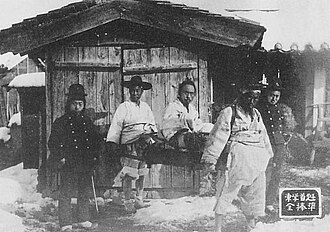
“We raise our righteous army to save the people. Drive out the corrupt officials and open the way for the people to live.”
— Proclamation of the Tonghak Peasant Army, 1894
In the spring of 1894, tens of thousands of Korean farmers, laborers, and religious followers took up arms against a government they could no longer endure. What began as a local protest in the southwestern province of Jeolla had transformed, within months, into one of the largest popular uprisings in Korean history. The Tonghak Peasant Revolution — also romanized as the Donghak Peasant Revolution — shook the very foundations of the late Joseon dynasty and sent shockwaves far beyond Korea’s borders, directly triggering the First Sino-Japanese War and accelerating the collapse of a five-hundred-year-old kingdom.
To understand why hundreds of thousands of ordinary Koreans were willing to fight and die in 1894, we must look not only at the immediate causes of the rebellion but at the deeper currents of inequality, foreign pressure, and spiritual longing that had been building for decades.
Quick Facts: The Tonghak Peasant Revolution
| Date | January – December 1894 |
| Location | Korean Peninsula, primarily Jeolla Province |
| Key Figures | Jeon Bong-jun (peasant leader), Choe Je-u (Tonghak founder) |
| Opposing Forces | Joseon government troops, Chinese Qing forces, Japanese Imperial Army |
| Outcome | Revolution suppressed; triggered First Sino-Japanese War (1894–1895) |
| Legacy | Considered a forerunner of Korean nationalism and democratic consciousness |
The World the Farmers Inhabited: Late Joseon in Crisis
By the 1880s and early 1890s, the Joseon dynasty was a kingdom under siege — not yet by foreign armies, but by the weight of its own internal contradictions. The rigid social hierarchy known as the bone rank system had long given way to a slightly more fluid but still deeply inequitable structure. The ruling class of Confucian scholar-officials, the yangban, continued to dominate land ownership, tax collection, and local governance, while the vast majority of Koreans — farmers who worked the land and paid taxes in rice — lived lives of grinding poverty.
Corrupt local magistrates known as suryeong routinely extracted illegal fees and bribes on top of already heavy official taxes. Grain loan programs meant to help farmers in lean years were manipulated to extract even more wealth from the rural poor. Meanwhile, the central government in Seoul was paralyzed by factional rivalry, and foreign powers — Japan and China in particular — were competing aggressively for influence over the peninsula. The opening of Korean ports to Japanese trade following the 1876 Treaty of Ganghwa had allowed Japanese merchants to purchase Korean grain cheaply, creating food shortages in the countryside just as tax burdens increased.
It was into this world of despair and injustice that a new religious movement offered an alternative vision.
Tonghak: The Eastern Learning That Ignited a Revolution
The word Tonghak means “Eastern Learning” — a deliberate counterpoint to Seohak, or “Western Learning,” the term used for Roman Catholicism, which had been spreading through Korea and attracting government persecution. Tonghak was founded in 1860 by Choe Je-u, a man of fallen aristocratic background who claimed to have received a divine revelation calling him to synthesize Confucianism, Buddhism, Taoism, and Korean shamanistic traditions into a new faith centered on the inherent divinity of every human being.
Choe Je-u’s core teaching — that heaven and humanity are one, and that each person contains within them the divine — was revolutionary in a society defined by rigid hierarchy. It implied that the poor farmer and the corrupt magistrate were equally children of heaven, a message that carried obvious political implications. The Joseon government recognized the danger: Choe Je-u was executed in 1864, just four years after founding his movement.
But execution only spread the faith. By the 1890s, Tonghak had hundreds of thousands of followers across the Korean peninsula, organized into local cells and regional networks. When crisis came, those networks would form the backbone of a revolutionary army.
“Heaven and humanity are one. To harm a person is to harm heaven itself.”
— Core teaching attributed to Choe Je-u, founder of Tonghak
Why Did the Tonghak Peasant Revolution Erupt in 1894?
The immediate trigger came in Gobu County, North Jeolla Province, where a particularly notorious magistrate named Jo Byeong-gap had been squeezing the local population through illegal water-use fees and forced labor. In January 1894, a local Tonghak leader named Jeon Bong-jun led a group of farmers in seizing the county office and redistributing hoarded grain to the poor. The Joseon government’s response — sending investigators who punished the protesters rather than the corrupt magistrate — transformed a local grievance into a province-wide uprising.
Jeon Bong-jun, who would become the revolution’s most celebrated leader, was not a yangban or an educated official. He was a man of the people, stocky and energetic, known for his charisma and tactical boldness. Under his leadership, the Tonghak peasant army achieved a stunning early victory at the Battle of Hwangtojaegi in late March 1894, defeating a government force and establishing control over much of Jeolla Province.
By May 1894, the rebel army had captured Jeonju, the provincial capital — a feat that shocked the Joseon court. The rebels issued a set of demands that amounted to a comprehensive reform program: abolish social discrimination, punish corrupt officials, cancel illegal debts, redistribute land more equitably, and expel foreign merchants who were impoverishing Korean farmers. These demands reveal how the Tonghak Revolution was not merely a religious uprising or a simple peasant jacquerie — it was a coherent political program for a more just society.
The International Catastrophe: From Revolt to World War
Facing a rebel army it could not defeat, the Joseon government made a fateful decision: it requested military assistance from China under the terms of an existing treaty. Qing China dispatched troops to Korea in June 1894. Japan, citing its own treaty rights, immediately sent a much larger force — and made clear it had no intention of leaving once the rebellion was suppressed.
Alarmed by the prospect of a full Japanese military occupation, the Tonghak leadership negotiated a ceasefire with the government in late May 1894, known as the Jeonju Treaty. Both sides agreed to a set of reforms, and the peasant army dispersed — but the foreign troops did not leave. Japanese forces seized the Joseon royal palace in July, installed a pro-Japanese government, and used Korea as the staging ground for their war against China. The First Sino-Japanese War (1894–1895) had begun, with the Korean peninsula as its primary theater.
Comparison: First and Second Phases of the Revolution
| Aspect | First Phase (Jan–June 1894) | Second Phase (Sept–Dec 1894) |
|---|---|---|
| Primary Goal | Domestic reform; end corruption | Expel Japanese forces; protect national sovereignty |
| Enemy | Joseon government troops | Japanese Imperial Army and allied Joseon forces |
| Key Battle | Battle of Hwangtojaegi (March 1894) | Battle of Ugeumchi (November 1894) |
| Outcome | Rebel success; Jeonju captured; ceasefire agreed | Crushing defeat; revolution suppressed |
| Character | Social reform movement | Anti-imperialist resistance |
The Second Rising and the Battle of Ugeumchi
When Japanese troops seized the Korean royal palace and war broke out between Japan and China, Jeon Bong-jun called his forces to arms again in September 1894. This second phase of the revolution was explicitly anti-imperialist in character — the peasant army was now fighting not corrupt Korean officials but Japanese soldiers equipped with modern rifles and artillery.
The decisive engagement came at the Battle of Ugeumchi in November 1894, near present-day Gongju in South Chungcheong Province. The Tonghak forces, estimated at tens of thousands, confronted a combined Japanese and pro-government Korean force armed with vastly superior weapons. The peasant fighters, many armed with little more than farm tools and old-fashioned firearms, launched repeated assaults over several days but were cut down by modern weaponry. The battle was a catastrophic defeat. Jeon Bong-jun fled south but was captured in December 1894. He was executed in Seoul in March 1895.
The reprisals that followed were brutal. Japanese forces and pro-government troops swept through Jeolla and Chungcheong provinces, killing an estimated 30,000 to 50,000 people associated with the rebellion. The Tonghak movement as a unified organization was effectively destroyed, though its spiritual descendants would later reorganize as Cheondogyo, a religion that continued to play a role in Korean nationalist movements, including the March 1st Movement of 1919.
Why the Tonghak Revolution Still Matters in Korean History
The Tonghak Peasant Revolution holds a complicated and powerful place in Korean historical memory. For decades under authoritarian governments in South Korea, it was regarded with some ambivalence — a dangerous precedent of popular revolt. But since the democratic opening of the late 1980s and 1990s, Korean historians and the public have increasingly embraced the revolution as a foundational moment in the long struggle for democracy and national self-determination.
Several aspects of the revolution’s legacy stand out:
1. It Was the First Mass Democratic Movement in Korean History. The Tonghak rebels’ demands — for equal treatment of people regardless of social class, for accountable government, for an end to exploitation — anticipated many of the principles of modern democratic governance. The revolutionary assembly (jipgang) that the Tonghak forces established in occupied areas of Jeolla Province operated as a form of local self-government, settling disputes and implementing reforms that the central government had refused to enact.
2. It Accelerated the End of the Joseon Dynasty. The revolution exposed the Joseon government’s inability to maintain order without foreign military assistance — a humiliation from which it never fully recovered. The Gabo Reforms that the Japanese-backed government implemented in the aftermath of the revolution abolished the traditional examination system, ended legal slavery, and eliminated some class distinctions, but these reforms were imposed from above by a compromised government, not won from below by the people who had fought for them.
3. It Directly Triggered the First Sino-Japanese War. The arrival of Chinese and Japanese troops — invited and uninvited — transformed a domestic Korean crisis into an international conflict that would redraw the map of East Asia. Japan’s decisive victory over China in 1895 ended Chinese suzerainty over Korea and set Japan on the path toward colonization of the peninsula, completed in 1910.
4. It Planted the Seeds of Modern Korean Nationalism. The second phase of the revolution, in which the Tonghak forces explicitly fought to expel Japanese forces and defend Korean sovereignty, marks one of the earliest expressions of modern Korean nationalism — the idea that Korea’s fate should be decided by Koreans alone. That idea would inspire the generations of resistance fighters and independence activists who followed.
Continue Exploring
Deepen your understanding of the Tonghak Peasant Revolution and the turbulent late Joseon era with these resources:
- Tonghak Peasant Revolution — Wikipedia
- Encyclopedia of Korean Culture (AKS) — Detailed entries on Tonghak and Joseon history
- Donghak Peasant Revolution — Britannica
- National Museum of Korea — Collections from the late Joseon period
- Asia Society — Korean history and culture resources
- Korea Heritage Service — Sites related to the Tonghak Revolution
On Korea Through Time, also explore our articles on the Gabo Reform, the founding of Cheondogyo, and the March 1st Movement of 1919 — all deeply connected to the legacy of 1894.