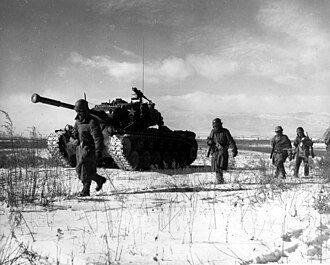
“We are not at war. We are engaged in a police action.” — A phrase that belied the devastating reality of a conflict that would claim millions of lives and permanently divide a nation.
Few conflicts in the twentieth century carry the weight of the Korean War. Fought between June 1950 and July 1953, it pitted North and South Korea against each other in a brutal struggle that drew in the United States, China, the Soviet Union, and sixteen other nations under the United Nations banner. Yet despite its massive scale — millions of casualties, cities reduced to rubble, and a peninsula transformed forever — the Korean War is often called the “Forgotten War,” overshadowed in Western memory by World War II and Vietnam. For Koreans, however, it is anything but forgotten. It reshaped the political, social, and physical landscape of the peninsula in ways that endure to this day.
Quick Facts: The Korean War at a Glance
| Dates | 25 June 1950 – 27 July 1953 |
|---|---|
| Location | Korean Peninsula |
| Main Belligerents | North Korea, China, USSR (North) vs. South Korea, USA, UN forces (South) |
| Outcome | Armistice Agreement; no formal peace treaty |
| Boundary | Demilitarized Zone (DMZ) near the 38th Parallel |
| Civilian Casualties | Estimated 2–3 million dead, wounded, or missing |
| UN Member Nations | 16 countries contributed combat forces |
How Did Korea Come to Be Divided?
To understand the Korean War, one must first understand how the peninsula came to be split in two. For centuries, Korea had existed as a unified kingdom — most recently under the Joseon Dynasty (1392–1897) and then the Korean Empire (1897–1910). Japan’s annexation of Korea in 1910 brought thirty-five years of colonial rule that left deep scars on Korean society. When Japan was defeated in 1945 at the end of World War II, liberation came swiftly — but so did division.
In a hastily drawn agreement, the United States and the Soviet Union divided the peninsula along the 38th Parallel as a temporary administrative measure. The Soviets would oversee the surrender of Japanese forces in the north; the Americans would do the same in the south. What was intended as a temporary line hardened rapidly into a political boundary. The Soviet-backed Democratic People’s Republic of Korea (DPRK) was established in the north under Kim Il-sung in September 1948, while the American-supported Republic of Korea (ROK) was founded in the south under Syngman Rhee that same year. Two ideologically opposed states now faced each other across a thin stretch of land that would soon become one of the most militarized borders on earth.
Tensions along the 38th Parallel were high throughout the late 1940s, with frequent skirmishes and cross-border raids. Both governments claimed legitimacy over the entire peninsula. The stage was set for open conflict.
The Outbreak: June 25, 1950
In the early hours of 25 June 1950, North Korean forces — equipped with Soviet-supplied tanks and artillery — crossed the 38th Parallel in a massive coordinated assault. The attack caught South Korean and American officials almost entirely by surprise. Seoul, the South Korean capital, fell within three days. The Republic of Korea’s army was pushed back rapidly, and within weeks, UN and South Korean forces were clinging to a small defensive perimeter around the southeastern port city of Busan, known as the Busan Perimeter.
The United Nations Security Council, in the absence of the Soviet Union (which was boycotting the Council at the time over the exclusion of the People’s Republic of China), authorized member states to aid South Korea. U.S. President Harry S. Truman committed American forces, and eventually troops from sixteen nations would serve under the UN Command, led by General Douglas MacArthur.
“In Korea the government forces, which were armed to prevent border raids and to preserve internal security, were attacked by invading forces from North Korea.” — United Nations Security Council Resolution 82, June 1950
3 Turning Points That Defined the War
1. The Incheon Landing (September 1950)
When the war appeared nearly lost for the UN and South Korean forces, General MacArthur executed a bold and risky amphibious landing at Incheon, on the western coast near Seoul. The landing, carried out on 15 September 1950, was a stunning tactical success. It cut off North Korean supply lines and allowed UN forces to break out from the Busan Perimeter. Seoul was recaptured, and by October, UN forces had crossed the 38th Parallel and were advancing deep into North Korea, approaching the Yalu River — the border with China.
2. China Enters the War (October 1950)
As UN forces pressed northward, the People’s Republic of China issued repeated warnings that it would not tolerate a hostile military presence on its border. Those warnings were not heeded. In late October 1950, hundreds of thousands of Chinese People’s Volunteer Army troops crossed the Yalu River into North Korea. The intervention was overwhelming. UN forces were pushed back southward in bitter winter fighting. Seoul fell again to communist forces in January 1951, before being retaken once more in March 1951. The war had transformed from a rapid campaign of movement into a grinding war of attrition.
3. Stalemate and Armistice Negotiations (1951–1953)
By mid-1951, the front lines had stabilized roughly along the 38th Parallel — not far from where the war had begun. Both sides dug in. Armistice negotiations began in July 1951 but dragged on for two more years, complicated by thorny issues including the repatriation of prisoners of war. Meanwhile, fighting continued at heavy cost. An armistice was finally signed on 27 July 1953 at Panmunjom, creating the Demilitarized Zone (DMZ) and halting active hostilities. No formal peace treaty was ever signed. Technically, the two Koreas remain in a state of war to this day.
The Human Cost: Devastation Across the Peninsula
The statistics of destruction are staggering. Estimates of total casualties — military and civilian, across all nations involved — range into the millions. Korean civilian deaths alone have been estimated at between one and two million. The fighting affected virtually every part of the peninsula. Cities were bombed, villages destroyed, and roughly ten million Koreans were separated from family members on the other side of the new dividing line — a wound that remains open for many families today.
The physical destruction of the peninsula was immense. Pyongyang and Seoul both suffered catastrophic damage from repeated changes of occupation. Agricultural land was devastated, infrastructure shattered. South Korea in the immediate post-war years was among the poorest nations in Asia. That the country eventually rose to become one of the world’s major economies within a few decades — a transformation known as the “Miracle on the Han River” — is a testament to extraordinary resilience and effort, though that recovery would take years of hardship first.
Korea Before and After: A Comparison
| Aspect | Before the War (pre-1950) | After the Armistice (post-1953) |
|---|---|---|
| Political Status | Two rival governments since 1948, division seen as temporary | Permanent de facto division; two internationally recognized states |
| Boundary | Administrative line at 38th Parallel | Armistice line / DMZ, slightly different from 38th Parallel |
| Seoul | Capital of ROK, largely intact | Heavily damaged; rebuilt over subsequent decades |
| US Military Presence | Withdrawn from South Korea by 1949 | Permanent US military presence in South Korea |
| International Status | Cold War proxy rivalry intensifying | Key Cold War flashpoint; peninsula central to East Asian security |
| Family Unity | Movement between North and South still possible for some | Families permanently separated; no free movement across DMZ |
Why Is the Korean War Called the “Forgotten War”?
In the United States and much of the West, the Korean War has long occupied an uncomfortable middle space in collective memory. It came after the triumphant narrative of World War II and before the divisive, heavily documented conflict in Vietnam. It ended not in victory or defeat but in armistice — a ceasefire that satisfied no one and resolved little. American veterans of Korea often returned home to find the public had already moved on.
For Koreans, of course, the war is not forgotten. It is woven into the fabric of national identity on both sides of the DMZ. In South Korea, it is formally remembered as the 6.25 War (유월 이십오일), after the date of the North Korean invasion. Monuments, museums, and annual commemorations keep the memory alive. The Korean War Memorial in Seoul stands as a solemn reminder of the generations affected. The war’s legacy shapes South Korean politics, security policy, and its ongoing relationship with the North to this day.
Internationally, the war was significant as the first major armed conflict of the Cold War and the first test of the newly formed United Nations’ collective security framework. It demonstrated that superpower rivalry could spill into devastating hot wars, and it set the pattern for subsequent Cold War proxy conflicts across Asia, Africa, and Latin America.
The Armistice and Its Aftermath
The Armistice Agreement signed on 27 July 1953 established a Military Demarcation Line and a Demilitarized Zone extending two kilometers on either side. Panmunjom, the village where negotiations were held, became one of the most symbolically charged locations in the world — the Joint Security Area where North and South Korean soldiers still face each other across a line mere meters wide.
The absence of a formal peace treaty has meant that the Korean peninsula has existed in a state of frozen conflict for over seven decades. North Korea has developed nuclear weapons and ballistic missiles. Periodic diplomatic initiatives — including summits between the leaders of North and South Korea and between North Korean and American leaders — have produced moments of cautious optimism, but no lasting settlement. The DMZ itself has, paradoxically, become one of the most ecologically rich zones in East Asia, its buffer status protecting wildlife from human activity for decades.
For the millions of families separated by the division, the human cost is personal and immediate. Reunion programs for separated families have been organized intermittently, but only a small fraction of those who lost contact with relatives across the border have ever had the chance to meet again. Many have died waiting.
Continue Exploring
- Korean War — Wikipedia: comprehensive overview of the conflict, its causes, and global participants
- Korean War — Encyclopædia Britannica: authoritative summary for general readers
- Encyclopedia of Korean Culture (AKS): in-depth Korean-language and bilingual historical resources
- UNESCO World Heritage — explore Korean sites shaped by centuries of history
- Asia Society: analysis of the Korean War’s legacy in contemporary East Asian relations
- Visit Korea: discover war memorial sites and historically significant locations across South Korea