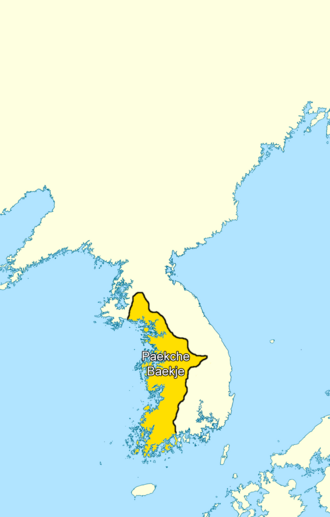
“Of the Three Kingdoms, Baekje shone brightest in the arts — and its light reached across the sea to Japan.”
When most people think of ancient Korea, they think of Goguryeo’s warrior culture or Silla’s eventual triumph in unifying the peninsula. Yet Baekje — the kingdom that ruled the southwestern corner of the Korean peninsula for nearly seven centuries — was in many ways the most cosmopolitan and culturally sophisticated of the Three Kingdoms. Its artisans, monks, and scholars carried Buddhism, writing, and refined artistic traditions to the Japanese archipelago, shaping civilizations far beyond its own borders. And yet Baekje is the kingdom history has most often forgotten.
Founded, according to tradition, in 18 BCE, and extinguished in 660 CE by a combined Silla-Tang Chinese alliance, Baekje left behind golden crowns, stone pagodas, and a legacy embedded in the very foundations of Japanese culture. This is the story of that kingdom.
Quick Facts: The Kingdom of Baekje at a Glance
| Founded | 18 BCE (traditional date) |
| Fell | 660 CE |
| Capital Cities | Wiryeseong (early), Ungjin, Sabi (final capital) |
| Location | Southwestern Korean peninsula (modern Chungcheong and Jeolla provinces) |
| Religion | Buddhism (officially adopted 4th century CE); indigenous beliefs |
| Major Rivals | Goguryeo (north), Silla (east), Chinese dynasties |
| Known For | Buddhist art, cultural transmission to Japan, sophisticated court culture |
Origins: A Kingdom Born from Goguryeo’s Shadow
Baekje’s founding legend is deeply intertwined with the origins of Goguryeo itself. According to the Samguk Sagi — the 12th-century Korean chronicle that remains one of the primary written sources for the Three Kingdoms period — Baekje was founded by Onjo, a son of Jumong, the legendary founder of Goguryeo. Onjo and his brother Biryu led a group of followers southward from the north and established their own polity in the Han River basin, in the region of modern-day Seoul and Gyeonggi Province.
Whether this founding legend reflects genuine historical memory or was constructed later to lend Baekje’s royal line dynastic prestige, the kingdom that emerged in the southwestern peninsula was a formidable power. Its early capital, known as Wiryeseong, placed it at the heart of the fertile Han River lowlands — excellent agricultural land that supported a growing population and a prosperous economy.
Baekje’s ruling elite were almost certainly of northern origin, likely descended from the Buyeo people, and they governed over a largely indigenous population in the southwest. This layered social structure — a northern-origin aristocracy presiding over local communities — would shape Baekje’s culture and politics for centuries.
3 Reasons Why Baekje Mattered Beyond the Korean Peninsula
1. Baekje Transmitted Buddhism to Japan
Perhaps the single most consequential act in Baekje’s history was the transmission of Buddhism to the Yamato court of Japan. In 552 CE — though some sources give 538 CE as the date — the Baekje king sent Buddhist scriptures, images, and monks across the sea to Japan. This moment is traditionally regarded as the formal introduction of Buddhism to Japan, an event that would profoundly reshape Japanese religion, art, architecture, and governance for more than a millennium. Baekje monks, scholars, and artisans continued to flow into Japan for decades, carrying with them knowledge of temple construction, painting, medicine, calendar-making, and Confucian learning.
2. Baekje Produced Some of Korea’s Most Refined Art
The material culture of Baekje stands apart from that of Goguryeo and Silla. Where Goguryeo is celebrated for its dramatic tomb murals and Silla for its golden crowns and ornaments, Baekje became renowned for the elegance and restraint of its artistic style. The famous Baekje Gilt-bronze Incense Burner — discovered in the 20th century and now regarded as a national treasure of South Korea — is a masterwork of sculptural complexity, depicting mountains, mythical creatures, and Buddhist imagery in breathtaking detail. Equally iconic is the so-called Baekje Smile, a serene and gently smiling expression found on Buddhist stone statues from the Sabi period that has become a symbol of the kingdom’s artistic sensibility.
3. Baekje Was a Maritime Power and Regional Diplomat
Unlike Goguryeo, which expanded overland, Baekje developed as a maritime-oriented state with active sea trade and diplomacy. Baekje maintained close relations with successive Chinese dynasties along the southern sea routes, receiving cultural and technological influences from the continent and re-exporting them — often filtered through Baekje’s own artistic sensibility — to Japan. This role as cultural intermediary gave Baekje an outsized influence on East Asian civilization relative to its geographic size.
“Baekje was the great connector — between China and Japan, between the continent and the archipelago. Without Baekje, early Japanese civilization would have looked profoundly different.”
The Long Struggle: Baekje Against Goguryeo and Silla
Baekje’s seven-century history was not one of peaceful cultural flowering. The kingdom was locked in almost constant conflict with its neighbors, and its political geography forced it into a perpetual defensive crouch.
The most devastating blow came in 475 CE, when the powerful Goguryeo king Jangsu led a massive military campaign southward and captured Wiryeseong, the Baekje capital. The Baekje king Gaero was killed, and the kingdom was thrown into crisis. Survivors fled south and established a new capital at Ungjin — modern-day Gongju in South Chungcheong Province — abandoning the Han River basin that had been the heartland of Baekje power for centuries.
The loss of Wiryeseong was a turning point. Baekje never fully recovered its earlier territorial extent in the north, and the court spent the following decades rebuilding. In 538 CE, the capital was moved again, this time further south to Sabi — modern-day Buyeo — which would remain the kingdom’s final capital until its destruction in 660 CE. The Sabi period is generally regarded as the cultural high point of Baekje, a time when Buddhist architecture, the arts, and court culture reached their greatest refinement.
Relations with Silla fluctuated between alliance and bitter rivalry. For a time in the late 5th and early 6th centuries, Baekje and Silla cooperated against their common enemy Goguryeo. But by the mid-6th century, Silla had seized the Han River basin from both Baekje and Goguryeo — a strategic betrayal from Baekje’s perspective — and the two kingdoms became implacable enemies. Baekje king Uija, who reigned in the final decades of the kingdom, launched repeated attacks on Silla’s western frontier, capturing dozens of fortresses and deepening the enmity between the two states.
Why Did Baekje Fall in 660 CE?
The fall of Baekje in 660 CE was the result of a coordinated military campaign that Baekje’s rulers had perhaps not fully anticipated in its scale and decisiveness. Silla, unable to defeat Baekje alone, appealed to the Tang dynasty of China for military assistance. The Tang emperor dispatched a massive naval force that landed on the western coast of the Korean peninsula while Silla’s armies advanced from the east.
Baekje’s defenses, weakened by years of internal court factionalism and the exhausting series of wars against Silla, could not withstand the combined assault. The final battle took place at Hwangsanbeol, where the Baekje general Gyebaek led a force of five thousand soldiers against a Silla army many times larger. Gyebaek, knowing the odds were impossible, reportedly executed his own family before the battle so they would not suffer the fate of conquest. His force fought ferociously but was ultimately overwhelmed. The story of Gyebaek became one of the great tragic episodes in Korean historical memory — a last stand of loyalty and courage against impossible odds.
With the defeat at Hwangsanbeol, the road to Sabi was open. The Tang naval forces arrived simultaneously, and King Uija was captured. The kingdom of Baekje ceased to exist. Resistance movements — sometimes called the Baekje Restoration Movement — continued for several years, aided by Japanese forces dispatched across the sea, but they were ultimately suppressed. The naval battle of Baekgang in 663 CE, in which the Tang-Silla fleet decisively defeated the Japanese-Baekje restoration forces, marked the final end of any hope of reviving the kingdom.
Baekje’s Legacy: What Survived the Conquest
The kingdom of Baekje was destroyed, but its cultural legacy proved far more durable than its political existence. In Japan, the contributions of Baekje emigrants and envoys were so deeply absorbed into the fabric of early Japanese civilization that separating them out is nearly impossible. Early Japanese Buddhist temples show the unmistakable influence of Baekje architectural styles. Techniques of roof tile manufacture, bronze casting, and painting that Baekje craftsmen brought to Japan became foundational to what would later be celebrated as distinctly Japanese artistic traditions.
In Korea itself, the physical remains of Baekje have been recognized for their outstanding universal value. The Baekje Historic Areas — encompassing sites in Gongju, Buyeo, and Iksan — were inscribed on the UNESCO World Heritage List in 2015. These sites include the Gongsanseong fortress, the royal tombs of Songsan-ri, the Jeongnimsaji temple site, and the Mireuksa temple site at Iksan, the largest Buddhist temple complex ever built on the Korean peninsula. Together, they preserve the memory of a civilization that shaped the broader course of East Asian history.
Continue Exploring
Deepen your understanding of Baekje and the Three Kingdoms period with these resources:
- Baekje — Wikipedia: Comprehensive overview of the kingdom’s history, politics, and culture.
- Encyclopedia of Korean Culture (AKS): Scholarly entries on Baekje institutions, rulers, and society.
- Baekje Historic Areas — UNESCO World Heritage: Official listing and description of the inscribed sites.
- Paekche — Britannica: Encyclopedic summary of Baekje’s rise and fall.
- National Museum of Korea: Explore Baekje artifacts including the famous gilt-bronze incense burner.
- Asia Society: Context on Korean cultural transmission to Japan and East Asian exchange.