“The unification of the Three Kingdoms was not merely a military triumph — it was the birth of a shared Korean identity that would endure for millennia.”
For centuries, the Korean peninsula was divided among three rival kingdoms: Goguryeo in the north, Baekje in the southwest, and Silla in the southeast. These states competed fiercely for territory, trade, and cultural prestige. Then, in the second half of the seventh century, the smallest and most isolated of the three — Silla — forged a fateful alliance with the Tang Dynasty of China and, in a series of dramatic military campaigns, brought the entire peninsula under a single ruler for the first time in its history. The era that followed, known as Unified Silla, lasted from 668 CE until 935 CE, and it represents one of the most formative periods in Korean civilization.
The story of Unified Silla is one of ambition, cultural flowering, and eventual fragmentation. It is a story that left permanent marks on Korean religion, art, governance, and identity — marks that are still visible today in the ancient city of Gyeongju, once the glittering capital of Silla and now a UNESCO World Heritage site.
Quick Facts: Unified Silla at a Glance
| Category | Detail |
|---|---|
| Period | 668 CE – 935 CE |
| Capital | Gyeongju (then known as Seorabeol) |
| Founder (of unification) | King Munmu (r. 661–681) |
| Religion | Buddhism (state religion); indigenous shamanistic traditions also practiced |
| Key Ally | Tang Dynasty China |
| Notable Monuments | Bulguksa Temple, Seokguram Grotto, Cheomseongdae Observatory |
| End | 935 CE — King Gyeongsun surrendered to Wang Geon of Goryeo |
How Did Silla Unify the Korean Peninsula?
Of the Three Kingdoms, Silla began as perhaps the most geographically disadvantaged. Tucked into the southeastern corner of the peninsula, it lacked the northern breadth of Goguryeo or the maritime connections of Baekje. Yet it possessed something equally valuable: political flexibility and a willingness to look outward for alliances.
In the mid-seventh century, Queen Seondeok and her successors pursued closer ties with the Tang Dynasty, which was itself eager to extend its influence across East Asia. The alliance proved decisive. In 660 CE, a combined Silla-Tang force defeated Baekje, the southwestern kingdom. Eight years later, in 668 CE, the same alliance brought down the mighty northern kingdom of Goguryeo, whose kings had famously repelled earlier Chinese invasions.
But the story did not end with the military victories. Tang China harbored its own ambitions on the peninsula, and Silla was unwilling to become a vassal state. In the years following 668, Silla fought a series of wars against its former Tang allies, eventually forcing the Chinese forces to withdraw north of the Taedong River by around 676 CE. This hard-won expulsion of Tang forces from the peninsula is often described by historians as completing the true unification — a unification defined not only by conquest but by independence.
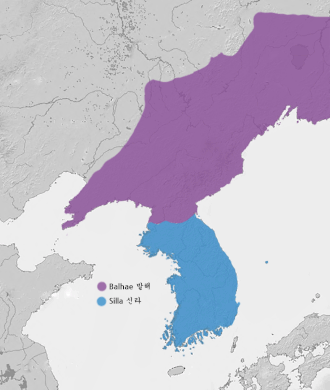
The kingdom that emerged was not a complete unification of all Korean-speaking peoples. The northern territories of old Goguryeo passed largely to a new state called Balhae, which existed simultaneously with Unified Silla — a fact that leads some historians to refer to this period as the “North-South States Period” rather than simply the era of Unified Silla. Nevertheless, Silla’s control of the peninsula’s core agricultural and cultural heartland made it the dominant political and cultural force of its age.
3 Pillars of Unified Silla’s Golden Age
1. Buddhism as State Culture
Buddhism had entered the Korean peninsula centuries earlier, but it was during the Unified Silla period that it reached its fullest expression as a state religion and cultural force. The kings of Silla were ardent patrons of Buddhist institutions. Monasteries were built across the kingdom, monks were dispatched to Tang China and even to India to bring back scriptures and teachings, and Buddhist philosophy penetrated every level of society from the royal court to rural villages.
The crowning achievement of Silla Buddhist art came in the eighth century with the construction of Bulguksa Temple and the nearby Seokguram Grotto near the capital Gyeongju. Seokguram, carved into a granite hillside overlooking the East Sea, houses a serene stone Buddha of extraordinary craftsmanship. The grotto’s precise geometry, its harmonious integration of sculpture and architecture, and its spiritual atmosphere have earned it recognition as one of the finest examples of Buddhist art anywhere in East Asia. Together, Bulguksa and Seokguram were designated a UNESCO World Heritage Site in 1995.
2. A Sophisticated Capital and Aristocratic Culture
At its height, Gyeongju — then called Seorabeol — was one of the largest cities in the world. Some estimates suggest its population reached close to one million people during the kingdom’s peak in the eighth century, placing it alongside Constantinople, Baghdad, and Chang’an as a great urban center of the medieval world.
Silla’s aristocratic class, organized under the rigid bone-rank system (golpum), accumulated extraordinary wealth and artistic patronage. Goldsmiths produced spectacular crowns, earrings, and ceremonial objects of breathtaking refinement — pieces now displayed in the Gyeongju National Museum that continue to astonish visitors with their intricacy. The bone-rank system determined not only a person’s political rank but also the kind of home they could live in, the clothes they could wear, and the carriage they could ride — a reflection of a society that placed enormous value on hereditary status.
3. Scientific and Scholarly Achievement
Unified Silla was not only a kingdom of religious devotion and aristocratic splendor — it was also a place of intellectual curiosity. The Cheomseongdae Observatory in Gyeongju, built during the reign of Queen Seondeok in the seventh century (and thus predating formal unification), stands as one of the oldest surviving astronomical observatories in East Asia. Its bottle-shaped stone tower was used to observe celestial movements, reflecting the kingdom’s interest in linking cosmological knowledge to agricultural and ceremonial calendars.
Silla scholars traveled to Tang China to study at the imperial academies, and some rose to remarkable prominence. The scholar Choe Chiwon, who passed the rigorous Tang civil service examinations and served in the Chinese bureaucracy before returning to Silla, left behind literary works that are still read and studied in Korea today. His life embodied the cultural exchange that defined the Unified Silla era — a kingdom deeply rooted in Korean traditions yet fully engaged with the wider world of East Asian civilization.
“Gyeongju in its prime was not a provincial capital at the edge of the world — it was a cosmopolitan city, connected by sea and land routes to China, Japan, and the trade networks of Central Asia.”
The Decline and Fall of Unified Silla
No golden age lasts forever, and Unified Silla’s decline unfolded over the course of the ninth century in a pattern familiar from the histories of many great kingdoms: the corrosive effects of aristocratic factionalism, weakening royal authority, and the rise of powerful regional lords.
The bone-rank system, which had given Silla’s aristocracy its cohesion and identity, also made it extraordinarily resistant to reform. As royal power weakened through the eighth and ninth centuries, noble families competed violently for the throne. Between 780 and 935 CE — a period of roughly 155 years — Silla had more than twenty monarchs, many of whom were deposed or assassinated. The instability at the center encouraged ambitious local strongmen, known as hojok, to assert independence in the provinces.
By the early tenth century, the peninsula had fragmented once again into competing states in what historians call the Later Three Kingdoms period. Former Silla general Gung Ye founded the state of Taebong in the north, while another rebel leader, Gyeon Hwon, established Later Baekje in the southwest. It was a military commander named Wang Geon — a man of considerable political skill and genuine charisma — who ultimately reunified the peninsula, defeating Later Baekje and receiving the peaceful surrender of the last Silla king, Gyeongsun, in 935 CE. Wang Geon founded the Goryeo Dynasty, from whose name the modern word “Korea” is derived.
Unified Silla vs. Later Goryeo: A Brief Comparison
| Feature | Unified Silla (668–935) | Goryeo Dynasty (918–1392) |
|---|---|---|
| Capital | Gyeongju (Seorabeol) | Gaeseong (Kaesong) |
| Social Structure | Hereditary bone-rank system | Civil service examinations introduced |
| Religion | Buddhism (dominant) | Buddhism (dominant, with Confucian influence) |
| Territory | Southern and central peninsula | Larger, including northern regions |
| Legacy Art | Stone Buddhas, gold crowns | Celadon ceramics, Tripitaka Koreana |
| End of Period | Peaceful surrender (935) | Joseon Dynasty coup (1392) |
Why Does Unified Silla Still Matter?
The legacy of Unified Silla is woven into the fabric of Korean culture in ways that are easy to overlook precisely because they have become so fundamental. The kingdom’s embrace of Buddhism shaped Korean art, philosophy, and ritual practice for centuries. The architectural vocabulary of Korean Buddhist temples — the stone pagodas, the wooden main halls, the hillside settings — was largely established during the Unified Silla period and has been maintained and elaborated ever since.
Gyeongju, the ancient capital, remains one of Korea’s most remarkable heritage destinations. Often described as a “museum without walls,” the city and its surrounding hills are dotted with royal tombs, stone pagodas, temple sites, and the ruins of the Anapji Pond, an artificial pleasure garden built for the Silla royal family. The Gyeongju Historic Areas were designated a UNESCO World Heritage Site in 2000, ensuring that the physical traces of Unified Silla’s golden age are preserved for future generations.
Beyond the physical monuments, Unified Silla represents a crucial chapter in the long story of Korean national identity. It was in this period that a distinctively Korean cultural sensibility — one that engaged deeply with Chinese civilization while remaining rooted in native traditions — first fully emerged. The scholars, monks, artists, and rulers of Unified Silla did not simply absorb Tang culture; they transformed it, producing something uniquely their own. That creative synthesis remains one of the defining characteristics of Korean civilization to this day.
From the golden crowns in Gyeongju’s museum to the serene face of the Seokguram Buddha gazing out toward the sea, the achievements of Unified Silla endure as a testament to what a small, determined kingdom can accomplish when it combines military resolve with cultural ambition.
Continue Exploring
- On Korea Through Time: The Three Kingdoms of Korea: Goguryeo, Baekje, and Silla
- On Korea Through Time: The Goryeo Dynasty: How Korea Got Its Name
- On Korea Through Time: Gyeongju Historic Areas: A UNESCO World Heritage Guide
- Unified Silla — Wikipedia
- Encyclopedia of Korean Culture — Academy of Korean Studies
- Gyeongju Historic Areas — UNESCO World Heritage Centre
- Seokguram Grotto and Bulguksa Temple — UNESCO World Heritage Centre
- Silla — Encyclopaedia Britannica
- Visit Gyeongju — Korea Tourism Organization