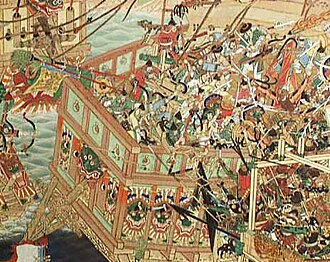
“I still have twelve ships.” — Admiral Yi Sun-sin, refusing to abandon his command before the Battle of Myeongnyang, 1597
On a narrow stretch of water off the southwestern coast of Korea, one of history’s most astonishing military reversals unfolded in the autumn of 1597. The Battle of Myeongnyang, fought on October 26 of that year, saw Korean Admiral Yi Sun-sin lead a desperately outnumbered fleet against an overwhelming Japanese naval force — and win. With as few as 13 warships against a Japanese armada reported to number in the hundreds, Yi’s victory at the Myeongnyang Strait stands not only as the defining moment of the Imjin War but as one of the most celebrated battles in all of Korean history.
To understand why this battle matters so deeply to Korean national memory, it is necessary to understand the desperate circumstances that preceded it, the geography that made the victory possible, and the extraordinary leadership of the man at the center of it all.
Quick Facts: The Battle of Myeongnyang
| Detail | Information |
|---|---|
| Date | October 26, 1597 |
| Location | Myeongnyang Strait, near present-day Jindo Island, South Jeolla Province |
| Korean Commander | Admiral Yi Sun-sin |
| Korean Fleet Size | 13 panokseon warships (some sources note 1 additional vessel) |
| Japanese Fleet Size | Approximately 133 warships (with hundreds of support vessels) |
| Outcome | Decisive Korean victory |
| Significance | Halted the Japanese western advance; secured Korean naval superiority |
| Conflict | Imjin War (Japanese invasions of Korea, 1592–1598) |
The Road to Disaster: How Korea’s Navy Was Nearly Destroyed
To fully appreciate the miracle of Myeongnyang, one must first understand the catastrophe that preceded it. The Imjin War had begun in 1592 when Toyotomi Hideyoshi launched a massive Japanese invasion of the Korean peninsula. Throughout the early years of the conflict, Admiral Yi Sun-sin had been the navy’s indispensable commander, winning battle after battle and frustrating Japanese supply lines with his innovative use of the famous turtle ship (geobukseon) and his expert exploitation of Korean coastal waters.
But in 1597, Yi Sun-sin fell victim to court politics and a Japanese disinformation campaign. He was arrested, stripped of his rank, and subjected to torture. His replacement, Won Gyun, was given command of the Korean navy. The results were catastrophic. At the Battle of Chilcheollyang in August 1597, Won Gyun led nearly the entire Korean fleet into a Japanese trap. The Korean navy was annihilated. Won Gyun himself was killed. Of an entire fleet, only a handful of ships escaped — under the command of a subordinate officer named Bae Seol.
The Joseon court, now facing total naval collapse, had little choice but to reinstate Yi Sun-sin. He was hastily restored to command. What he inherited was a shattered institution: approximately 13 warships, demoralized sailors, and a Japanese fleet that now believed it had free rein over Korean waters.
Why Did Yi Sun-sin Choose the Myeongnyang Strait?
This is perhaps the most important strategic question of the entire battle. Yi Sun-sin was not a man who fought recklessly. His genius lay in preparation, in reading terrain, and in turning the environment itself into a weapon. The Myeongnyang Strait — the narrow channel between Jindo Island and the Korean mainland — was chosen with great deliberation.
The strait is famous for its exceptionally powerful and unpredictable tidal currents. The waters reverse direction with tremendous force multiple times each day. A commander who understood these tidal patterns could use the strait as a force multiplier, channeling enemy ships into confined waters where their numerical advantage would be neutralized. A large fleet maneuvering in such a narrow passage would become disorganized, unable to bring all its vessels to bear simultaneously.
Yi Sun-sin studied these currents. He positioned his small squadron at the optimal point in the strait and waited for the tide to work in his favor. This was not luck — it was meticulous calculation.
“The narrow strait and the reversing tides were as much Yi Sun-sin’s weapons as his cannons. He understood that the geography of the battlefield could compensate for the overwhelming disparity in numbers.”
3 Reasons the Battle of Myeongnyang Was Winnable Against All Odds
1. The Geography of the Strait Negated Japanese Numbers
The Myeongnyang Strait is exceptionally narrow. In such confined waters, Japan’s fleet of over a hundred warships could not attack simultaneously. Ships bunched together, became difficult to maneuver, and were exposed to the powerful currents that Yi had studied so carefully. The Japanese fleet’s greatest asset — sheer numbers — became a liability in those waters.
2. Yi Sun-sin’s Personal Leadership Held the Line
When the battle began, Korean ships reportedly began to retreat in panic. Yi Sun-sin advanced alone in his flagship, leading by example and reportedly signaling his other commanders to hold their positions. His personal courage steadied his officers and crew. The sight of their admiral’s vessel engaging the enemy alone, rather than fleeing, transformed the psychology of the battle.
3. The Tidal Current Turned at the Critical Moment
As the engagement progressed, the tidal current reversed direction — exactly as Yi had anticipated. Japanese ships that had been pressing the attack were now swept by the current into disarray. Some were driven into one another. Yi’s ships, positioned and prepared for this moment, were able to press their advantage as the Japanese formation collapsed. The reversal of the tide was the turning point that transformed a desperate defense into a decisive victory.
The Battle Itself: Hours That Changed the War
The Japanese fleet, commanded by Todo Takatora and other senior admirals, advanced into the strait on the morning of October 26, 1597. Their objective was clear: destroy the remaining Korean naval force, secure control of the Yellow Sea and the western coast, and open a supply route that would allow the Japanese land campaign to push northward toward the capital.
Yi Sun-sin’s 13 ships waited. When the Japanese advance force entered the strait, Korean cannons opened fire. The panokseon warships, with their elevated decks and broadside cannon arrangements, were formidable gun platforms. Korean naval doctrine emphasized gunnery at range rather than boarding, and in the narrow strait, they could concentrate fire effectively.
The Japanese suffered significant losses among their leading vessels. Reports indicate that dozens of Japanese warships were sunk or disabled during the engagement. Among those killed was the Japanese commander Kurushima Michifusa, whose death disrupted the Japanese command structure at a critical moment.
When the tide reversed, the situation for the Japanese became untenable. Ships were swept backward, colliding with vessels behind them. What had been an organized assault became a chaotic tangle. The Korean ships pressed their fire. The Japanese fleet withdrew.
The battle had lasted only a matter of hours. Korea’s 13 ships had turned back a fleet more than ten times their number.
Aftermath: What Myeongnyang Meant for the Imjin War
The strategic consequences of the Battle of Myeongnyang were profound. The Japanese had planned to use naval dominance to support a renewed land offensive pushing up the western coast of Korea toward Hanyang (present-day Seoul). That plan depended on controlling the sea lanes. Yi Sun-sin’s victory denied them that control.
With the Yellow Sea no longer safely in Japanese hands, supply lines for the western land campaign became dangerously exposed. The Japanese advance slowed. The momentum that had been building since the disaster at Chilcheollyang was broken. Korea’s navy — rebuilt from almost nothing around Yi Sun-sin’s 13 surviving ships — went on to recover its strength and continue contesting Japanese naval power until the end of the war in 1598.
Yi Sun-sin himself would not survive to see the peace. He was killed in action at the Battle of Noryang in November 1598, reportedly his last words urging his officers not to announce his death lest it demoralize the fleet during the final engagement. He died as he had lived — putting the mission before himself.
Comparing Korean and Japanese Naval Strength at Myeongnyang
| Factor | Korean Fleet | Japanese Fleet |
|---|---|---|
| Number of Warships | 13 | ~133 warships + hundreds of support vessels |
| Primary Tactic | Ranged gunnery, tidal positioning | Boarding and melee combat |
| Key Advantage | Knowledge of local tidal currents | Overwhelming numerical superiority |
| Commander’s Fate | Yi Sun-sin survived (died later at Noryang, 1598) | Kurushima Michifusa killed in action |
| Outcome | Decisive victory | Retreat; strategic objective failed |
Yi Sun-sin’s Legacy: Why Korea Still Remembers Myeongnyang
The Battle of Myeongnyang occupies a unique place in Korean historical memory. It represents the archetype of intelligent, principled leadership overcoming seemingly impossible odds — not through recklessness or luck alone, but through meticulous preparation, deep knowledge of the environment, and the ability to inspire those under command at the most critical moment.
Admiral Yi Sun-sin is commemorated throughout modern South Korea. His statue stands in Gwanghwamun Square in central Seoul, one of the most prominent public memorials in the country. The Imjin War naval battles, including Myeongnyang, are taught as foundational events in Korean national history. The 2014 Korean film The Admiral: Roaring Currents depicted the battle and became the highest-grossing Korean film of its time, demonstrating the enduring grip this story holds on the national imagination.
The site of the battle — the Myeongnyang Strait near Jindo Island — remains a place of pilgrimage and remembrance. The Myeongnyang Victory Memorial Hall stands near the strait, and each year ceremonies mark the anniversary of the battle. The waters themselves, still tidal and powerful, are a living reminder of how geography and genius combined to change the course of Korean history.
For historians, Myeongnyang also raises enduring questions about the nature of military genius. What separates a great commander from a merely competent one? Yi Sun-sin’s career offers a consistent answer: the willingness to accept reality as it is, prepare with exhaustive care, and act decisively when the moment arrives — even when the odds appear insurmountable.
Continue Exploring
Learn More on Korea Through Time
- Admiral Yi Sun-sin: Life, Battles, and Legacy
- The Imjin War: Japan’s Invasions of Korea (1592–1598)
- The Turtle Ship: Korea’s Revolutionary Warship
- Jindo Island: History, Heritage, and the Sea That Saved Korea