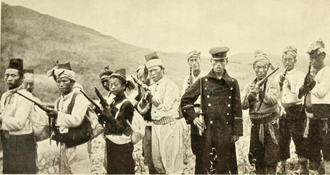
“When the state is in danger, the people must become the army.” — A guiding spirit of the Uibyeong tradition
Throughout Korean history, some of the most consequential resistance to foreign aggression did not come from professional soldiers or royal commands. It came from farmers, scholars, monks, and merchants — ordinary people who picked up weapons because they believed it was their duty. These volunteer fighters were known as the Uibyeong (의병), meaning “righteous armies,” and their story runs like a thread through more than five centuries of Korean history, from the Goryeo period all the way to the final resistance against Japanese colonial rule in the early twentieth century.
The Uibyeong represent one of the most enduring and distinctive features of Korean civic life: the idea that loyalty to one’s country and culture is not solely the responsibility of kings and generals, but belongs to every person who calls Korea home.
Quick Facts: Korea’s Righteous Armies (Uibyeong)
| Fact | Detail |
|---|---|
| Korean Name | 의병 (Uibyeong) |
| Meaning | “Righteous Army” or “Righteous Soldiers” |
| Period Active | Goryeo era through early 20th century |
| Key Conflicts | Japanese invasions of 1592–1598, late Joseon resistance movements |
| Composition | Confucian scholars, farmers, Buddhist monks, merchants |
| Motivation | Defense of country, Confucian duty, cultural preservation |
| Organizational basis | Voluntary, locally organized, often led by yangban scholars |
What Were the Righteous Armies and Why Did They Form?
The term Uibyeong refers to irregular, volunteer military forces that arose spontaneously — or were organized by civic leaders — in response to foreign invasion or internal crisis. Unlike the official armies of the Joseon or Goryeo states, these forces were not conscripted by royal decree. They were motivated by a combination of Confucian ethics, deep-rooted patriotism, and a sense of personal honor that demanded action when the state was threatened.
In the Confucian worldview that dominated Joseon society, loyalty to the ruler and love of country were inseparable virtues. For educated men of the yangban class — the scholarly elite — allowing foreign invaders to ravage the land without resistance was not just a political failure; it was a moral one. This ethical framework gave the Uibyeong movements their distinctive character: they were as much about preserving Korean culture and Confucian civilization as they were about military victory.
But the righteous armies were never composed solely of scholars. Farmers formed the backbone of most units. Buddhist monks, despite their complicated relationship with the Confucian state, contributed significantly — most famously during the Japanese invasions of the 1590s. Local merchants and craftsmen also joined, bringing practical skills and resources. What united them was not social class but shared purpose.
The Roots: Righteous Armies in the Goryeo Period
The tradition of the Uibyeong did not begin with the famous conflicts of the Joseon dynasty. Its roots reach back into the Goryeo period, when the Korean peninsula faced repeated invasions from external powers. During these earlier crises, communities organized local resistance forces that operated alongside — and sometimes independently of — the official state military.
This precedent established an important principle in Korean political culture: that ordinary subjects had not only the right but the obligation to defend their land when official forces failed or were absent. By the time the Joseon dynasty was established in 1392, this tradition was already deeply embedded in Korean historical memory.
The Greatest Test: The Imjin War (1592–1598)
The most celebrated chapter in the history of the righteous armies came during the Japanese invasions of Korea, known in Korean as the Imjin Waeran. When Toyotomi Hideyoshi launched his invasion in 1592, Japanese forces advanced with devastating speed, capturing the capital Hanyang (modern Seoul) within weeks. The official Joseon military, undermined by decades of relative peace and internal political conflict, was initially overwhelmed.
It was in this moment of crisis that the Uibyeong came into their own. Across the peninsula, local leaders — many of them retired officials or Confucian scholars with no current government post — began organizing resistance. They raised funds, recruited fighters from their local communities, and launched guerrilla campaigns against Japanese supply lines and garrison forces.
“The righteous armies did not wait for royal orders. They rose because they could not do otherwise — because the land beneath their feet demanded it.”
These forces were not always militarily sophisticated, and they suffered heavy losses in many engagements. But their strategic impact was significant. By harassing supply lines, ambushing isolated Japanese units, and denying the invaders control of the countryside, the righteous armies prevented Japan from consolidating its conquest. They bought time for the official Joseon forces to regroup and for Ming Chinese allies to intervene.
Buddhist monks also played an extraordinary role during this period. Despite the Joseon state’s long-standing suppression of Buddhism in favor of Confucianism, monks organized their own fighting units. Their contributions during the Imjin War earned them a degree of social rehabilitation and remain a celebrated part of Korean historical memory.
How the Righteous Armies Were Organized
Understanding how the Uibyeong functioned reveals much about Joseon society and its values. These were not professional armies with standing command structures or government funding. They were ad hoc organizations built on personal relationships, local loyalties, and shared ideology.
Leadership typically fell to yangban scholars who had the social prestige to attract followers, the literacy to manage correspondence and planning, and the Confucian education to frame resistance in morally compelling terms. A local scholar who issued a public call to arms — a geogi — could attract hundreds of men who trusted his leadership and shared his values.
Funding and supply were equally improvised. Local contributions of grain, horses, and weapons formed the material base of most units. Some leaders used their personal wealth to equip fighters. Others negotiated with local officials for access to government stores. The result was a military force that was deeply embedded in its local community and dependent on local support to survive.
This local character was both a strength and a weakness. Righteous armies knew their terrain intimately and could draw on deep wells of community loyalty. But they often struggled to coordinate with one another over long distances, and their effectiveness varied enormously depending on the quality and charisma of individual leaders.
Comparison: Righteous Armies vs. Official Joseon Military
| Feature | Righteous Armies (Uibyeong) | Official Joseon Military |
|---|---|---|
| Recruitment | Voluntary, community-based | State conscription |
| Leadership | Local scholars, retired officials | Professional military officers |
| Funding | Private donations, local resources | State treasury |
| Motivation | Confucian duty, patriotism | Legal obligation, pay |
| Tactical style | Guerrilla warfare, local knowledge | Conventional military formations |
| Coordination | Often fragmented, locally focused | Centrally commanded |
| Social composition | Mixed — scholars, farmers, monks | Primarily conscripted commoners |
The Late Joseon Period and the Fight Against Colonial Rule
The Uibyeong tradition did not end with the Imjin War. It resurfaced at every major moment of national crisis in subsequent centuries. The late Joseon period, and especially the years following Japan’s growing encroachment on Korean sovereignty in the late nineteenth and early twentieth centuries, saw a powerful revival of the righteous army spirit.
As Japan tightened its grip on Korea through a series of unequal treaties and ultimately the annexation of 1910, armed resistance movements emerged across the country. These later Uibyeong drew consciously on the historical memory of the Imjin War fighters, framing their resistance in the same moral and patriotic language. Scholars who had served in government, farmers who had lost land to Japanese economic policies, and former soldiers discharged from the Joseon military all joined these movements.
The resistance was fierce but ultimately could not overcome the disparity in military power. Japanese authorities suppressed these movements with considerable force. Yet the spirit they represented — the insistence that Koreans would not accept foreign domination without resistance — became a foundational element of Korean national identity and the later independence movement.
Why the Righteous Army Legacy Still Matters
The Uibyeong are remembered today not simply as military forces but as symbols of a particular Korean understanding of civic virtue and national identity. They represent the idea that the defense of culture and sovereignty is a collective responsibility — that history is made not only by kings and commanders but by the communities that choose to act.
In Korean historical memory, the righteous armies occupy a place of deep honor. Their stories are taught in schools, commemorated in monuments, and referenced in public discourse whenever questions of national identity and resistance arise. Museums and cultural institutions across Korea preserve their memory, and the records of individual units and leaders continue to be studied by historians.
The Uibyeong tradition also raises important questions about the relationship between state and society in Korean history. These movements flourished precisely in moments when the official state had failed — when bureaucratic inertia, military unpreparedness, or political conflict had left ordinary people exposed to danger. In this sense, they represent not just patriotism but also a form of civic accountability: the people stepping in when institutions fell short.
Continue Exploring
- On This Site: Explore our articles on the Imjin War, the Joseon dynasty’s military culture, and the Korean independence movement for more context on the world the Uibyeong inhabited.
- Righteous Armies — Wikipedia: A broad overview of the Uibyeong across Korean history.
- Encyclopedia of Korean Culture (AKS): Scholarly entries on Joseon military history and the Uibyeong tradition.
- Japanese Invasions of Korea 1592–1598 — Wikipedia: Detailed history of the Imjin War and the role of volunteer forces.
- Korea — Britannica: Essential background on Korean history and society.
- Korean History and Political Geography — Asia Society: Educational resources on Korea’s historical context.