“Korea is not lost. Korea will never be lost.”
— A sentiment echoed by millions who lived through the peninsula’s most devastating modern conflict
Few events in modern history scarred the Korean peninsula as deeply or as permanently as the Korean War. Lasting from June 1950 to July 1953, the conflict drew in nations from across the globe, reduced entire cities to rubble, and ultimately left Korea divided along a border that endures to this day. Yet for many outside the region, the war remains underappreciated — sometimes called “the Forgotten War” — overshadowed by World War II before it and Vietnam after it. This is the story of how Korea became a Cold War battleground, and why its legacy still resonates across the peninsula and the world.
Quick Facts: The Korean War at a Glance
| Detail | Information |
|---|---|
| Dates | 25 June 1950 – 27 July 1953 |
| Location | Korean Peninsula |
| Primary Belligerents | North Korea (with China and Soviet support) vs. South Korea and UN Command (led by the United States) |
| UN Nations Involved | More than 20 countries contributed troops or support under the UN flag |
| Outcome | Armistice signed 27 July 1953; no formal peace treaty |
| Division Line | Roughly the 38th Parallel (Korean Demilitarized Zone) |
| Also Known As | “The Forgotten War,” “The Unknown War” |
The World That Made the War: Korea After 1945
To understand the Korean War, one must first understand the world Korea inherited after the end of Japanese colonial rule in 1945. For 35 years, Korea had been governed by Imperial Japan. When Japan surrendered at the end of World War II, the peninsula was divided — almost arbitrarily — along the 38th Parallel as a temporary administrative measure. The Soviet Union administered the northern zone; the United States administered the south.
What began as a temporary arrangement hardened into ideological entrenchment. In the north, Kim Il-sung, backed by the Soviet Union, consolidated power and built a communist state. In the south, Syngman Rhee — with American backing — established a separate government. By 1948, two distinct Korean states had formally declared their existence: the Democratic People’s Republic of Korea in the north and the Republic of Korea in the south. Each claimed to be the legitimate government of the entire peninsula. The stage was set for catastrophic confrontation.
25 June 1950: The Day War Came to Korea
In the early morning hours of 25 June 1950, North Korean forces crossed the 38th Parallel in a massive, coordinated invasion of the south. The attack was sudden and overwhelming. North Korean troops, equipped with Soviet-supplied tanks and artillery, drove deep into South Korean territory with alarming speed. Within three days, Seoul — the southern capital — had fallen.
The United Nations Security Council, meeting in emergency session and with the Soviet Union absent, passed resolutions condemning the invasion and authorizing member states to assist South Korea. The United States, under President Harry S. Truman, committed military forces almost immediately. General Douglas MacArthur was appointed to command UN forces. Nations from across the world — including the United Kingdom, Canada, Australia, France, Turkey, and dozens of others — would eventually contribute troops under the UN banner.
By August 1950, UN and South Korean forces had been pushed back to a small perimeter around the port city of Busan in the southeast — a defensive line that became known as the Pusan Perimeter. The situation looked dire.
The Korean War was not simply a civil war or a proxy conflict alone — it was both simultaneously, a microcosm of every Cold War tension compressed into three brutal years on a single peninsula.
Why Did the Conflict Escalate So Dramatically?
Several factors transformed what might have remained a localized conflict into a full-scale international war.
1. Cold War ideology shaped every decision. For both Washington and Moscow, Korea was not merely a peninsula — it was a symbol. Allowing communism to advance in Korea, American policymakers argued, would embolden Soviet-backed movements elsewhere. The doctrine of containment, articulated by diplomat George Kennan and embraced by the Truman administration, demanded a response.
2. MacArthur’s Incheon gamble changed the war’s trajectory. On 15 September 1950, General MacArthur launched one of military history’s most audacious amphibious assaults at Incheon, on Korea’s west coast near Seoul. Against formidable odds — treacherous tides, heavily fortified positions — the landing succeeded spectacularly. UN forces broke out of the Pusan Perimeter, recaptured Seoul, and began driving north toward the Chinese border.
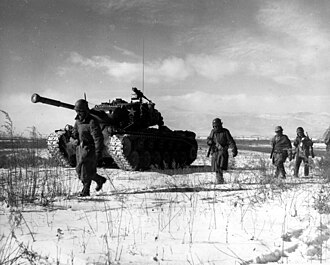
3. China’s entry transformed the conflict entirely. As UN forces approached the Yalu River — the border between North Korea and China — the People’s Republic of China intervened massively in October 1950, sending hundreds of thousands of troops across the border. The UN advance was shattered. Once again, Seoul changed hands, and the front lines seesawed dramatically through the bitter Korean winter.
The Human Cost: What the War Meant for Ordinary Koreans
Behind the strategic maneuvers and Cold War calculations lay a catastrophe of almost incomprehensible scale for the Korean people themselves. Cities and towns were destroyed repeatedly as the front lines moved back and forth. Seoul alone changed hands four times during the war. Millions of civilians were displaced, becoming refugees in their own land.
Families were separated — sometimes permanently — as the conflict hardened the border between north and south. The phenomenon of separated families, known in Korean as 离散家族 (isan gajok), became one of the war’s most enduring and painful legacies. Decades after the armistice, elderly Koreans who had lost contact with relatives across the DMZ would wait — sometimes a lifetime — for the chance to be briefly reunited through carefully negotiated meetings.
The physical destruction was staggering. Much of the Korean peninsula’s infrastructure, built during the Japanese colonial period, was obliterated. Agricultural land was ruined. Entire communities ceased to exist. The process of rebuilding — which would eventually produce South Korea’s extraordinary economic transformation — lay far in the unimaginable future.
Comparing North and South: Two Paths From the Same War
| Aspect | South Korea (Republic of Korea) | North Korea (DPRK) |
|---|---|---|
| Political System After War | Initially authoritarian; gradually democratized | Single-party communist state under Kim family |
| Economic Trajectory | Rapid industrialization; became major global economy | Centrally planned; periodic severe economic hardship |
| International Relations | Alliance with US; member of UN; global trade ties | Isolated; subject to international sanctions |
| Narrative of the War | “6.25 War” — a northern invasion to be resisted | “Fatherland Liberation War” — framed as defense against US aggression |
| Reunification Stance | Desired, with varying conditions over time | Desired on Pyongyang’s ideological terms |
The Armistice of 1953: An End That Was Not an End
After two years of grinding, attritional fighting roughly along the 38th Parallel — punctuated by difficult armistice negotiations that began in July 1951 — a ceasefire agreement was finally signed on 27 July 1953 at Panmunjom. The armistice established the Korean Demilitarized Zone (DMZ), a strip of land approximately four kilometers wide running across the peninsula, and set procedures for prisoner exchanges.
Crucially, the armistice was not a peace treaty. Technically, a state of war between North and South Korea has never formally ended. The DMZ — ironically one of the most biologically rich zones on the peninsula due to decades of human absence — remains one of the world’s most heavily militarized borders. The absence of a formal peace treaty has cast a long shadow over inter-Korean relations and Northeast Asian security for more than seven decades.
South Korea, it is worth noting, did not sign the armistice. President Syngman Rhee, opposed to any arrangement that left Korea divided, refused to add his signature. The document was signed by representatives of the UN Command, the Korean People’s Army, and the Chinese People’s Volunteer Army.
Why Does the Korean War Still Matter Today?
The Korean War’s relevance has not diminished with time. In several profound ways, it continues to shape the present.
The division of the Korean peninsula remains one of the defining geopolitical realities of East Asia. The DMZ cuts across a peninsula that was, for most of its recorded history, a single cultural and political entity. The aspiration for reunification — however distant it may seem — remains a powerful force in Korean society, north and south.
The war also established patterns of alliance and rivalry that endure. The US-South Korea security alliance, formalized in the Mutual Defense Treaty of 1953, remains one of America’s most significant overseas military commitments. Tens of thousands of US troops continue to be stationed in South Korea. Meanwhile, North Korea’s pursuit of nuclear weapons — which it frames partly as a response to perceived US hostility rooted in the Korean War — is among the most consequential security challenges of the 21st century.
For historians and heritage scholars, the Korean War also raises enduring questions about memory and commemoration. In South Korea, 25 June is observed as “6.25” — a day of solemn remembrance. Veterans from more than 20 countries carry the war’s memories across the world. And for millions of Korean families, the war is not history — it is biography, woven into stories of grandparents, of homes lost, of relatives never seen again.
Continue Exploring
Deepen your understanding of the Korean War and its place in Korean history with these resources:
- Korean War — Wikipedia: Comprehensive overview of the conflict’s causes, major phases, and aftermath
- Encyclopedia of Korean Culture (AKS): Scholarly Korean historical reference
- Korean War — Britannica: Authoritative summary for general readers
- Asia Society: Teaching the Korean War — context and educational resources
- National Museum of Korea: Explore Korean history and material culture across the ages
- UNESCO World Heritage Sites in Korea: Discover Korea’s protected cultural landscapes
Korea Through Time explores Korean history, culture, and the places where history happened. From ancient kingdoms to modern struggles, every era of the Korean story deserves to be remembered.