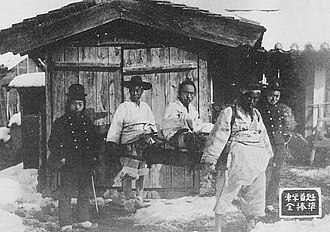
“The people are the root of the nation. If the root withers, the nation falls.”
— A guiding principle echoed by Tonghak leaders during the 1894 uprising
In the spring of 1894, something extraordinary happened across the hills and rice paddies of Korea’s Jeolla Province. Tens of thousands of farmers, artisans, and low-ranking soldiers set down their tools, picked up weapons, and marched on the government. They were not bandits or criminals. They were people pushed beyond endurance — by corrupt local officials, crushing taxation, and the creeping influence of foreign powers in a kingdom struggling to survive on its own terms. The Tonghak Peasant Revolution, known in Korean as the Donghak Nongmin Hyeongmyeong, would become one of the most consequential uprisings in all of Korean history, setting in motion events that would ultimately reshape East Asia.
Quick Facts: The Tonghak Peasant Revolution
| Date | 1894 (Joseon Dynasty) |
| Also Known As | Donghak Peasant Revolution; Donghak Peasant Movement |
| Location | Korean Peninsula, primarily Jeolla Province, spreading nationwide |
| Key Leaders | Jeon Bong-jun (“Green Bean”), Son Byong-hui |
| Ideology | Tonghak religious teaching; anti-corruption; anti-foreign encroachment |
| Outcome | Suppressed by combined Joseon, Chinese, and Japanese forces; triggered the First Sino-Japanese War |
| Dynasty | Late Joseon |
What Was the Tonghak Movement, and Why Did It Spark Revolution?
To understand the revolution, one must first understand the religious and social movement that gave it its name. Tonghak — literally meaning “Eastern Learning” — was founded in 1860 by Choe Je-u as a direct response to the perceived threat of “Western Learning,” or Catholicism, which had been spreading through Korea despite official persecution. Choe Je-u synthesized elements of Confucianism, Buddhism, and Shamanism into a new spiritual framework that emphasized the divine worth of every human being. Its core teaching, Innaecheon, held that “humans are heaven” — a profoundly egalitarian idea in a rigidly stratified Joseon society.
The Joseon court viewed Tonghak with deep suspicion. Choe Je-u was arrested and executed in 1864, just four years after founding the movement. Yet Tonghak did not die with its founder. Under the second patriarch, Choe Si-hyeong, the movement spread quietly through the countryside, drawing in the rural poor, displaced farmers, and those chafing under the weight of the class system. By the late 19th century, Tonghak had tens of thousands of followers, organized into local cells called po.
The social context that fed the revolution was one of systemic crisis. The Joseon government of the late 19th century was burdened by factional infighting, a deteriorating tax system, and rampant corruption at every level of local administration. Magistrates routinely extracted illegal fees from farmers. Land surveys were manipulated to inflate tax burdens. Famine and debt drove rural families into destitution. Meanwhile, the opening of Korea to foreign trade following the 1876 Treaty of Ganghwa had flooded markets with cheap Japanese goods, devastating Korean merchants and artisans. Resentment toward both the domestic ruling class and foreign economic penetration was running dangerously high.
The Match That Lit the Fire: Events of Early 1894
The immediate trigger of the revolution came from Gobu County in North Jeolla Province. The local magistrate, Jo Byeon-gap, had been extorting the population with particular brutality — forcing farmers to build a new reservoir and then charging them water fees for using it. In January 1894, a local Tonghak leader named Jeon Bong-jun led a group of farmers in an armed protest against Jo’s abuses, seizing the county office and distributing the illegally collected grain back to the people.
The government’s response — sending investigators who punished the protesters rather than the corrupt magistrate — transformed a local grievance into a regional uprising. By spring, Jeon Bong-jun, who became known popularly as “Nokdu” (Green Bean) for his short, stocky build, was leading a full-scale peasant army. In May 1894, this force achieved a remarkable military victory, defeating government troops at the Battle of Hwangtojae and marching on Jeonju, the provincial capital of Jeolla. The city fell to the peasant army — a stunning demonstration of the uprising’s scale and organization.
“We rise not for ourselves alone, but for the people beneath the sky. Drive out the corrupt officials. Protect the people. Expel the foreign powers.”
— Paraphrased from the proclaimed aims of the Tonghak peasant forces, 1894
3 Reasons the Tonghak Revolution Changed Korean and East Asian History
1. It Forced the Joseon Court to Invite Foreign Troops — With Catastrophic Consequences
Alarmed by the fall of Jeonju and unable to suppress the uprising on its own, the Joseon court made a fateful decision: it requested military assistance from Qing China under the terms of the 1885 Tianjin Convention. China dispatched troops to Korea — but Japan, citing the same treaty’s mutual notification clause, also sent forces. The presence of both Chinese and Japanese armies on Korean soil in the summer of 1894 created a powder keg. By August, China and Japan were at war. The First Sino-Japanese War, which ended in a decisive Japanese victory, permanently altered the regional balance of power, ending Chinese suzerainty over Korea and accelerating Japan’s rise as an imperial power. The peasants of Jeolla had, without intending it, triggered one of the most consequential wars of the 19th century.
2. It Demonstrated the Political Power of Korea’s Peasant Majority
For most of Joseon’s five-century history, the rural peasantry had been the silent foundation of the kingdom — taxed, conscripted, and largely voiceless. The Tonghak Revolution shattered that silence. At its peak, the peasant army numbered in the hundreds of thousands, organized across multiple provinces. The rebels established local governing bodies called jipgang, through which they enacted reforms: canceling debts, redistributing illegally seized land, abolishing social discrimination, and punishing corrupt officials. These bodies represented, however briefly, a form of popular self-governance unprecedented in Korean history.
3. Its Suppression Planted the Seeds of the Independence Movement
The second phase of the uprising, launched in the autumn of 1894, was partly driven by outrage at the Japanese military presence in Korea and the humiliating reforms Japan was imposing on the Joseon court. Jeon Bong-jun raised his forces again, this time explicitly to expel the Japanese. The combined might of Japanese troops and reorganized Korean government forces crushed the peasant army at the Battle of Upo Swamp and the Battle of Gongju. Jeon Bong-jun was captured, tried, and executed in 1895. The death toll from the suppression campaigns is estimated in the tens of thousands. Yet the memory of the uprising — its leaders’ courage, its popular ideology, and its anti-imperialist spirit — was never extinguished. It fed directly into the nationalist consciousness that would fuel the March First Movement of 1919 and Korea’s long struggle for independence.
The Aftermath: Reform, Repression, and Remembrance
Even as the revolution was being suppressed, its demands echoed in government policy. Under Japanese pressure, the Joseon court enacted the Gabo Reforms of 1894, which abolished the centuries-old bone rank-style social hierarchy, ended the practice of inherited social status, and introduced new administrative structures. While these reforms were imposed partly to serve Japanese interests, they addressed many of the grievances the Tonghak rebels had articulated. The movement’s vision of a more equal society had, in a warped and partial way, found its way into law.
The legacy of the Tonghak Peasant Revolution has been contested across Korean history. During the Japanese colonial period (1910–1945), the uprising was either ignored or characterized as primitive disorder. After liberation, both North and South Korea claimed the revolution’s legacy — the North emphasizing its class struggle dimensions, the South its nationalist and democratic spirit. Today in South Korea, Jeon Bong-jun is recognized as a national hero. The site of the Donghak Revolution in Jeolla Province is commemorated, and the memory of 1894 is taught as a foundational moment in the nation’s democratic and nationalist tradition.
A Comparison: Tonghak Demands vs. Gabo Reforms
| Tonghak Rebel Demands | Gabo Reforms (1894) — Government Response |
|---|---|
| Abolish the traditional class system (nobi slavery, hereditary status) | Abolished hereditary social status distinctions; ended nobi slavery |
| Punish corrupt local officials | Restructured local administration; introduced new accountability mechanisms |
| Cancel illegitimate debts owed to the wealthy | Partial debt relief measures introduced |
| Redistribute land seized by corrupt officials | Limited land reforms; full redistribution not enacted |
| Expel foreign economic and military influence | Not addressed; Japanese influence in fact increased |
The table above illustrates both the partial success and the ultimate limits of the revolution’s impact. Where the rebels demanded social equality and an end to corruption, the Gabo Reforms delivered meaningful if incomplete change. Where they demanded the expulsion of foreign powers, history moved in precisely the opposite direction.
Why the Tonghak Revolution Still Matters
More than a century after Jeon Bong-jun’s forces marched out of Gobu County, the Tonghak Peasant Revolution remains one of the most studied and debated events in Korean history. Its relevance is not merely academic. The revolution raised questions about political representation, social equality, and national sovereignty that Korea would spend the next hundred years answering — through colonial resistance, division, war, and ultimately democratization. The Tonghak ideals of human dignity and popular sovereignty, articulated by farmers with no formal education but an unshakeable sense of justice, resonate across every era of Korean history.
The revolution also reminds us how connected Korea’s internal struggles were to the great power rivalries swirling around it. The peninsula’s fate in 1894 was shaped not only by the choices of Korean peasants and Korean kings, but by the ambitions of China and Japan, and by the global currents of imperialism and modernization. Understanding 1894 is, in many ways, essential to understanding modern Korea — its sense of national identity, its relationship with Japan, and the deep democratic instincts of its people.
Continue Exploring
On Coreaverse
- The Late Joseon Dynasty: Reform, Crisis, and Survival
- The March First Movement of 1919: Korea’s Cry for Independence
- The Gabo Reforms of 1894: Joseon’s Last Great Reinvention