“We are the successors of Goguryeo. That is why our country is called Goryeo.”
— Seo Hui, Goryeo diplomat, during negotiations with the Khitan general Xiao Sunning, 993 CE
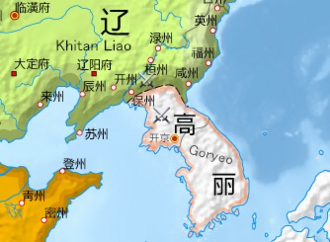
In the late tenth and early eleventh centuries, the Goryeo kingdom faced one of the gravest threats in its history. To the north and west, the Khitan Liao dynasty had risen to become the dominant power in northeast Asia, having already crushed the rival Balhae kingdom and extorted tribute from the Song dynasty of China. Now the Khitans turned their gaze toward the Korean peninsula. What followed was a series of three devastating invasions — and a remarkable story of how a smaller kingdom outmaneuvered a superpower through a combination of sharp diplomacy, heroic defense, and military ingenuity.
Quick Facts: The Goryeo–Khitan War
| Conflict | Goryeo–Khitan War |
| Period | 993 – 1019 CE |
| Belligerents | Goryeo Kingdom vs. Khitan Liao Dynasty |
| Number of Invasions | Three (993, 1010, 1018–1019) |
| Key Figures | Seo Hui (Goryeo diplomat), Gang Gam-chan (Goryeo general), Xiao Sunning (Khitan general) |
| Outcome | Goryeo maintains independence; Khitan invasions repelled |
| Significance | Goryeo secures territory and establishes itself as a regional power |
The World That Made the War: Northeast Asia in the Tenth Century
To understand the Goryeo–Khitan War, we must first understand the world in which it took place. The Goryeo kingdom had unified the Korean peninsula in 936 CE, bringing to an end the chaotic Later Three Kingdoms period. Its founders looked back to the ancient kingdom of Goguryeo for inspiration — indeed, the very name “Goryeo” is a shortened form of Goguryeo — and harbored ambitions to reclaim territory in Manchuria once held by that earlier state.
Meanwhile, the Khitan people had established the Liao dynasty (916–1125 CE) across a vast territory stretching from Manchuria into northern China. The Liao were formidable: they had destroyed the kingdom of Balhae in 926 CE, a northeastern state that many Goryeo Koreans considered a cultural and political successor to Goguryeo. The destruction of Balhae brought Liao power directly to Goryeo’s northern frontier and sent thousands of Balhae refugees streaming into the Korean peninsula, where Goryeo welcomed them.
Goryeo maintained close cultural and commercial ties with the Song dynasty of China, which the Khitans viewed with deep suspicion. From the Liao perspective, Goryeo was a potential ally of their great rival and a kingdom sitting on a strategically important peninsula. The stage for conflict was set.
The First Invasion (993): When Diplomacy Won the Day
In 993 CE, a massive Khitan force crossed the Amnok River (Yalu River) and pushed into Goryeo territory. The invasion initially threw the Goryeo court into crisis. Some officials advocated for immediate surrender or the cession of northern territories in exchange for peace. Others urged relocation of the capital. It was a moment of profound national anxiety.
Into this crisis stepped Seo Hui, one of the most remarkable diplomats in Korean history. Rather than capitulating, Seo Hui requested permission to negotiate directly with the Khitan commander, Xiao Sunning. What followed was an extraordinary exchange that changed the outcome of the conflict entirely.
Seo Hui argued that Goryeo was not an enemy of the Liao but rather the rightful successor state to Goguryeo — and that the lands between the two kingdoms were occupied not by Goryeo but by the Jurchen tribes, who were themselves hostile to Liao. He proposed that if Liao helped Goryeo push out the Jurchens from the northwestern territories, Goryeo would sever its ties with Song China and establish formal tributary relations with Liao instead.
Remarkably, Xiao Sunning accepted. The Khitan army withdrew without a battle. More remarkably still, Goryeo emerged from the crisis with a diplomatic victory that also delivered a territorial gain: the right to settle the lands east of the Amnok River up to the sea, an area known as the Gangdong-6-ju (the Six Garrison Settlements). It was a masterclass in negotiation under pressure.
“Seo Hui’s negotiations in 993 represent one of the most brilliant diplomatic achievements in Korean history — securing both peace and new territory without a single battle.”
Why Did the Khitans Invade Again in 1010?
The peace that followed the First Invasion lasted less than two decades. By the early eleventh century, tensions had re-emerged. Goryeo had not fully severed its relationship with Song China as promised, and the Khitans were angered by what they perceived as Goryeo’s bad faith. A domestic crisis within Goryeo itself provided the trigger for renewed conflict.
In 1009, a military strongman named Gang Jo seized power in Goryeo, assassinating King Mokjong in a coup. The Khitan Emperor Shengzong used this political upheaval as a pretext for invasion, declaring that he was marching to avenge the murdered king and restore order. In 1010, he led a reported army of 400,000 soldiers — a figure that likely reflects an exaggeration common in historical records of the era, but which nonetheless indicates an enormous force — across the border.
The Second Invasion was far more destructive than the first. Goryeo’s defenses, though valiant in places, could not hold the main Khitan advance. King Hyeonjong was forced to flee the capital Gaegyeong (modern-day Kaesong), which the Khitans captured and burned. Gang Jo, who had precipitated the crisis, was killed during the fighting. Yet even in retreat, Goryeo demonstrated resilience. Individual fortress commanders refused to surrender, and the Khitan army — vulnerable to supply shortages and guerrilla harassment deep in Korean territory — was unable to consolidate its gains. Liao forces eventually withdrew, having devastated much of the northwest but failing to force Goryeo’s submission.
The Third Invasion and the Battle of Gwiju (1018–1019)
The Khitans launched their third and largest invasion in late 1018, sending a force reportedly numbering 100,000 soldiers under the general Xiao Baiya. By this time, however, Goryeo had spent years preparing. The kingdom had rebuilt its defenses, constructed a massive wall system across the northern frontier, and — most importantly — produced a military commander of exceptional talent: Gang Gam-chan.
Gang Gam-chan was a scholar-official who had also proven himself a capable military strategist. As the Khitan army advanced southward, he devised a bold defensive strategy. He ordered a large stream dammed near the Khitan line of march, and when the enemy forces were crossing, the dam was broken, flooding the valley and wreaking havoc on the advancing army. Despite this setback, the Khitan force pushed on toward Gaegyeong, which it besieged without success.
The decisive moment came during the Khitan withdrawal in February 1019. Gang Gam-chan had positioned Goryeo forces at Gwiju (near modern Kusong in North Korea) to intercept the retreating Khitan army. The battle that followed was a catastrophic defeat for the Liao forces. Historical Korean sources record that of the 100,000-strong Khitan army that had entered Goryeo, only a few thousand escaped back across the Amnok River. While such figures are difficult to verify, the scale of the Khitan defeat at Gwiju is not in doubt: it effectively ended Liao’s ambitions of subjugating Goryeo.
3 Reasons the Goryeo–Khitan War Shaped Korean History
- It secured Goryeo’s political independence. Despite three major invasions by one of Asia’s most powerful empires, Goryeo was never conquered. The kingdom’s survival confirmed its legitimacy as the ruling state of the Korean peninsula and set a precedent for Korean resistance against foreign domination that would echo through later centuries.
- It expanded Korean territory. The diplomatic genius of Seo Hui during the First Invasion won Goryeo control over the Gangdong-6-ju territories in the northwest, pushing the kingdom’s effective border further toward the Amnok River. This territorial consolidation laid the groundwork for the boundaries of later Korean states.
- It produced enduring cultural legacies. The trauma and triumph of the Khitan wars left deep marks on Korean culture and national memory. The wars are credited with inspiring one of Korea’s great cultural achievements: the first printing of the Tripitaka Koreana, the vast Buddhist canon carved onto woodblocks. According to tradition, Goryeo began this monumental project as a prayer for divine protection against the Khitan invaders. The original set was later destroyed, but a second edition produced in the thirteenth century survives and is now a UNESCO World Heritage Site.
A Comparison: Three Khitan Invasions at a Glance
| Invasion | Year | Khitan Leader | Outcome for Goryeo |
|---|---|---|---|
| First | 993 | Xiao Sunning | Diplomatic victory; territorial gain (Gangdong-6-ju) |
| Second | 1010 | Emperor Shengzong | Capital sacked; king fled; Khitans eventually withdrew |
| Third | 1018–1019 | Xiao Baiya | Decisive Goryeo victory at Battle of Gwiju; Khitan threat ended |
The Aftermath: A Hard-Won Peace
Following the disaster at Gwiju, the Liao dynasty never again invaded Goryeo in force. The two states settled into a more stable, if occasionally tense, relationship based on formal diplomatic ties and trade. Goryeo continued to pay periodic tribute to Liao while quietly maintaining cultural connections with Song China — a pragmatic balancing act that the kingdom’s diplomats had essentially pioneered during the First Invasion negotiations.
The Goryeo–Khitan War also accelerated the construction of the Cheolli Jangseong, a great defensive wall stretching across the northern frontier of the Korean peninsula. This fortification project, completed over several decades, represented an enormous investment of state resources and reflected just how seriously Goryeo took the ongoing threat from northern neighbors.
For Korean collective memory, the war produced heroes whose names endure to this day. Gang Gam-chan in particular is celebrated as one of Korea’s great military figures, honored in temples and commemorated in modern media. His victory at Gwiju in 1019 is remembered as a defining moment of national resilience — proof that a determined people, well-led and fighting on home ground, could defeat even the most powerful of enemies.
Continue Exploring
Learn more about the Goryeo–Khitan War and its era: